








The story so far: A new study projects that climate change will significantly impact El Niño-La Niña weather patterns approximately by 2030 — a decade before what was earlier predicted, and around four decades earlier than the suggested timeline without separating the two regimes. This is predicted to result in further global climate disruptions.
El Niño and La Niña are atmospheric patterns that influence warming and cooling of sea surface temperatures in the Central and Equatorial Pacific. The two opposing patterns occur in an irregular cycle called the El Niño Southern Oscillation (ENSO) cycle. The study used mathematical models that analysed sea surface temperature (SST) from 1870 to 2019 to observe ENSO and make predictions.
Preparation, not fear will combat El Nino: Agriculture Minister Chouhan
La Niña can also potentially result in severe flooding across England in February 2023, The Guardian reported. The U.K. government’s Flood Action Week, from November 7 to 13, sought to raise awareness about La Niñaand prepare communities for winter flooding. England’s Meteorological Office said that unexpected flooding could occur any time since the “chance of wet and windy weather increases as we go through the [winter] season”.

Earlier this year, the World Meteorological Organisation predicted the first “triple dip” La Niña of the century, spread over three consecutive northern hemisphere winters. Meteorology centres worldwide have confirmed that we are indeed in one at present.
This is only the third time since 1950 that a triple dip La Nina has been observed.
ENSO’s scale is significant enough to influence global climate. According to the study, published in NatureCommunications journal, increased SST variability from ENSO in the eastern Equatorial Pacific (EP) will emerge around 2030 ( error margin of +/- 6 years), more than a decade earlier than that of the central Pacific ENSO. If CP and EP are not separated, SST variability from ENSO will occur almost four decades earlier than previously suggested. Changes in the equatorial Pacific will be visible first due to a stronger increase in EP-ENSO rainfall response, leading to increased SST variability.
The study used results from 68 climate models participating in phases five and six of the Coupled Model Intercomparison Project (CMIP) — a coordinated global scientific research project, which compares climate models to real-world observations and intercompares simulations of the earth’s future climate.
The models from which outputs were utilised consist of three experiments, each dealing with data, simulation, or predictions from a different time: past, present, and future. The study noted a significant increase in the amplitude of both EP-ENSO AND CP-ENSO under greenhouse warming, substantiated by strong inter-model agreement.
El Niño is the warming of sea waters in Central-east Equatorial Pacific that occurs every few years.
During El Niño, surface temperatures in the equatorial Pacific rise, and trade winds — east-west winds that blow near the Equator — weaken. Normally, easterly trade winds blow from the Americas towards Asia. Due to El Niño , they falter and change direction to turn into westerlies, bringing warm water from the western Pacific towards the Americas.
Deeper waters are usually more nutrient-rich, but upwelling (where deeper waters rise towards the surface) is reduced under El Niño, in turn reducing phytoplankton off the coast. Fishthat eat phytoplankton are affected, followed by other organisms higher up the food chain.. Warmer water also carries tropical species towards colder areas, disrupting multiple ecosystems.
Heat redistribution on the surface impacts airflows above the ocean. While easterly winds are dry and steady, Pacific westerlies are warmer and moister.
Since the Pacific covers almost one-third of the earth, changes in its temperature and subsequent alteration of wind patterns disrupt global weather patterns.
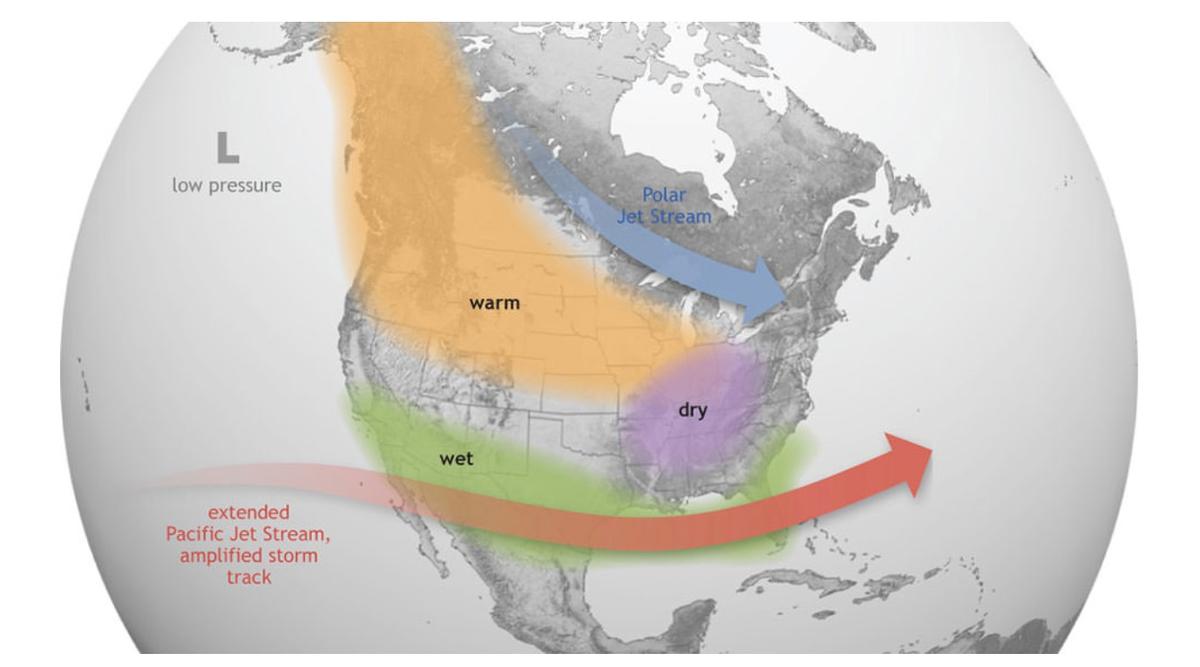
El Niño causes the Pacific jet stream to move south and spread further east. | Photo Credit: National Oceanic and Atmospheric Administration
El Niño is a loose translation of “little boy” or even “Christ child” in Spanish. South American fishermen are believed to have noticed unusually warm water in the Pacific Ocean in the 1600s. Earlier, it was also called “El Niño de Navidad,” since it peaks around December.
El Niño causes dry, warm winter in Northern U.S. and Canada and increased flooding risk on the U.S. gulf coast and southeastern U.S. It also brings drought to Indonesia and Australia.
La Niña, or “the girl/little girl”, is the opposite of El Niño. La Niña sees cooler than average SST in the equatorial Pacific region. Trade winds are stronger than usual, pushing warmer water towards Asia. On the American west coast, upwelling increases, bringing nutrient-rich water to the surface.
Pacific cold waters close to the Americas push jet streams — narrow bands of strong winds in the upperatmosphere — northwards. This leads to drier conditions in Southern U.S., and heavy rainfall in the northwest and Canada. La Niña also makes winter temperatures warmer in the south and cooler to the north of the U.S.
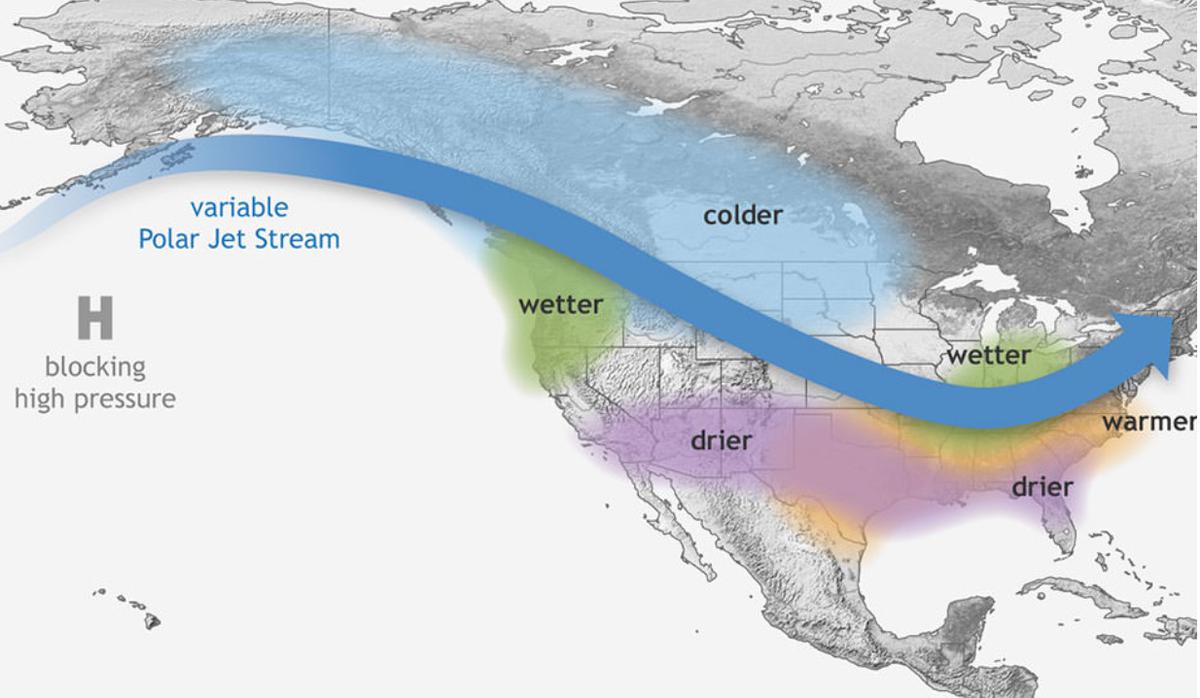
La Niña causes the jet stream to move northward and to weaken over the eastern Pacific. | Photo Credit: National Oceanic and Atmospheric Administration
La Niña has also been associated with heavy floods in Australia. Two successive La Niña events in the last two years caused intense flooding in Australia, resulting in significant damage. Parts of Australia are battling floods this year for the third year in a row, even as scientists hope La Niña will be relatively shorter in 2022.

Average of international model forecasts for NINO3.4 index, as updated on November 14, 2022 | Photo Credit: Australian Government’s Bureau of Meteorology
The combination of El Niño, La Niña, and the neutral state between the two opposite effects is called the El Niño Southern Oscillation (ENSO). Southern oscillations are large-scale changes in sea level pressure in the tropical Pacific region.
The phenomenon was discovered by Sir Gilbert Walker, who was researching the drought in India in the early 20th century and found an alternating variation in pressure between the eastern and western Pacific Ocean. He found that when pressure was high at Darwin, Australia (western Pacific) it was low at Tahiti (eastern Pacific), and vice-versa. However, it was only in the late 1960s that Norwegian meteorologist Jacob Bjerknes and others convincingly linked this with El Niño.

In India, El Niño causes weak rainfall and more heat, while La Niña intensifies rainfall across South Asia , particularly in India’s northwest and Bangladesh during the monsoon.
At present, India too is witnessing an extended triple dip La Niña. As reported by The Hindu, this, in part, is why India saw surplus rain in September, a month that usually sees the monsoon retreat, for the third year in a row.
While an IMD forecast indicated that Central India and the southern peninsula would get 6% more than their historical average this year, rainfall far exceeded this— likely linked to a La Niña.
此内容由惯性聚合(RSS阅读器)自动聚合整理,仅供阅读参考。 原文来自 — 版权归原作者所有。