







In the four Assembly seats of West Bengal’s Jhargram district, candidates across party lines are highlighting welfare promises for marginalised communities who make up almost half the population and hold decisive electoral sway across the region.
Also Read : Assembly Elections LIVE
This reflects the social composition of the district, which is part of the State’s Junglemahal region. Scheduled Castes account for 20.13% of the population of Jhargram district, while Scheduled Tribes make up 29.32%, taking their combined share to nearly 49.5%, along with the significant presence of other backward classes. Their massive vote share makes these communities a decisive electoral bloc that all major parties are keen to court.

“We need to make new rules for the people living in the forest area so they have better living conditions and employment. We should not be uprooting them; rather, we should try to use their knowledge about the forests to see if we can generate income through that,” said Birbaha Hansda, the Trinamool Congress candidate in Binpur and current Minister of State for Forests and Consumer Affairs. She added that, as a member of the tribal community, she tries to stay in touch with people on the ground to ensure her poll promises cater to the people’s actual demands and are not solely based on party politics.

Jhargram’s BJP candidate Lakshmikant Sahu, on the other hand, says the TMC government has done nothing to uplift the Scheduled Caste and Scheduled Tribe communities of the district in the last 15 years. “Even basic things like pacca roads and a concrete house are not available for most people in the SC/ST communities in the area. People living close to the main town do not have basic facilities. Imagine the condition of people in the interior forest areas,” Mr. Sahu said, vowing to bring industries to the area to address the unemployment crisis.

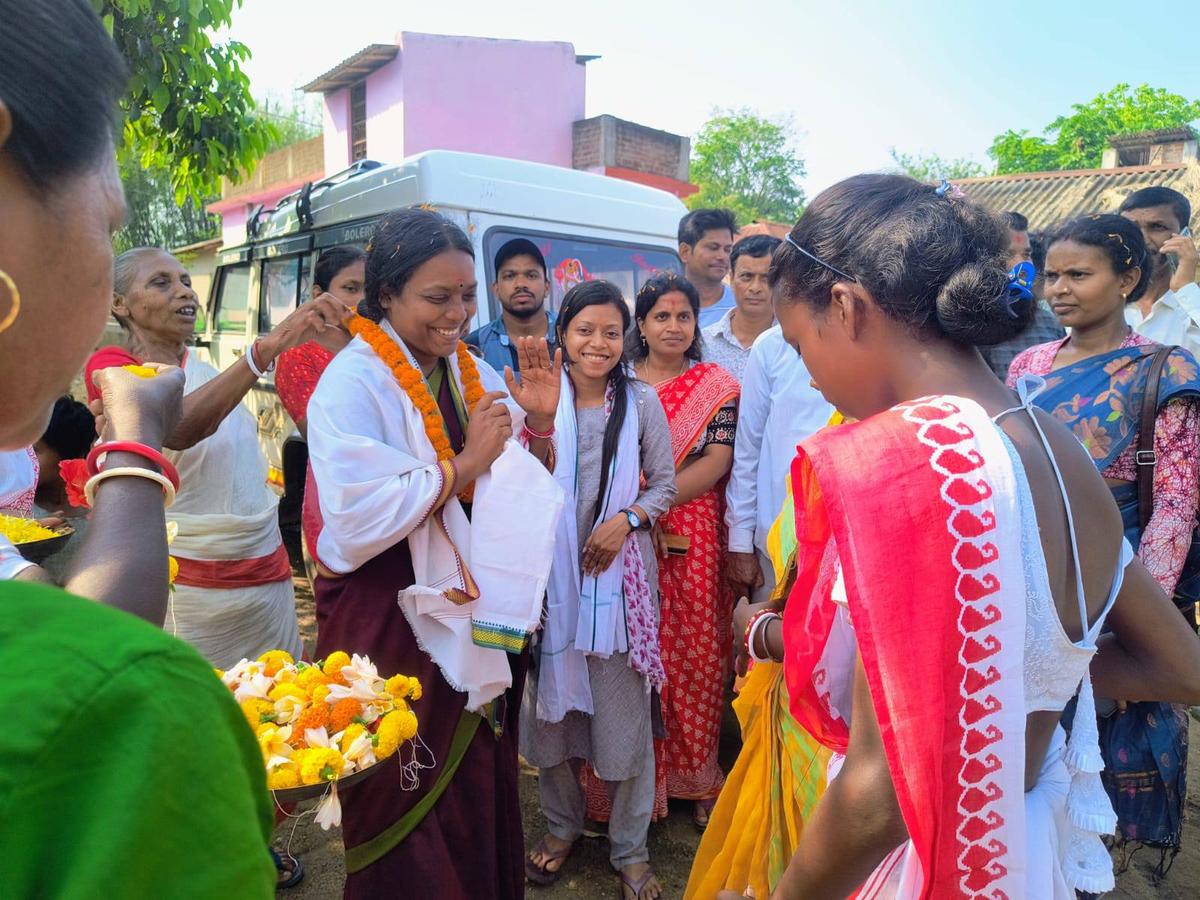
West Bengal Minister and Trinamool candidate Birbaha Hansda with voters in Binpur. | Photo Credit: Special arrangement
Voters are skeptical about such promises from both major parties. “Polls come and go. The marginalised people here keep waiting for the promises to become reality. The work that actually happens here is a drop of what is promised,” said a member of the Santhal community in Jhargram, who wished to stay anonymous. He added that the divide between Santhals and Kurmis that political parties have created in this area has further marginalised them.

Contesting against Mr. Sahu in the Jhargram seat is the TMC’s Mangal Soren. He said that while job scarcity remains a concern, there is a huge opportunity for self-employment and small-scale industries in the region. Communities should be trained to tap into their skills to become independent, he said.
Also read | How Dalit voting patterns have changed across elections
Mr. Soren, who also hails from the adivasi community, accused the BJP of trying to end diversity among communities by demanding the implementation or the Uniform Civil Code (UCC). “In a diverse country like India, bringing a law like the UCC will ruin the current working systems of the indigenous tribes, many of whom reside in Jhargram. We are a secular country, the UCC is not the right approach for us. We must respect individual communities and their systems,” Mr Soren added.
TMC general secretary Abhishek Banerjee agreed, saying, “If the UCC is implemented by the BJP, STs will be impacted the most.”
The BJP has made it clear it will implement the UCC in the State if it comes to power. At the release of the party’s poll manifesto on April 10, Union Home Minister Amit Shah reiterated this promise. “Our Constitution works on treating every religion equally. Then every person in the country from every religion should have equal law here... No matter what Mamata says, wherever there is BJP government, we will implement the UCC,” Mr. Shah said.

In Jhargram’s Gopiballavpur constituency, the Kurmi community’s long-standing desire for Scheduled Tribe status remains a key demand backdrop as the BJP has fielded Rajesh Mahato, a leader of the West Bengal Kurmi Samaj. However, Mr. Mahato said that in the upcoming Assembly election, neither he nor the party is foregrounding the Kurmi demand for ST status.

“I do not make false promises. However, I want to work on getting recognition for our Kurmali language in the Eighth Schedule along with the Mundari language, which has long been sidelined,” Mr. Mahato said, noting that this is a more achievable goal for him and a promise that will help the two communities take a step towards official recognition.
On April 10, Mr. Shah said the government plans to include the Kurmali and Rajbanshi languages in the Eighth Schedule of the Constitution. However, the same recognition was not offered to Mundari.

With a long history of Maoist insurgencies, development and welfare interventions have been constrained in these parts, but in recent years, poll promises have focussed on such support for the marginalised.

When the TMC’s second-in-command, Abhishek Banerjee campaigned from Binpur for the four Jhargram candidates on March 27, he praised the party’s development efforts in the region.
“In the last 12 years, what has the BJP government done for Binpur and Jamboni? What has been done for Adivasis and Tapashilis? On one hand, the CM has provided ₹1,700 to Adivasis and Tapashilis out of the Lakshmir Bhandar funds, and on the other hand, inflation is skyrocketing due to [Prime Minister Narendra] Modi. Mr. Modi is taking away what CM Mamata Banerjee is giving you,” Mr. Banerjee said.

He added that before 2011, the conditions in the area were so bad that people feared leaving their homes due to the Maoist insurgency, claiming that it is the TMC government that has established peace and prosperity in the region.
Jhargram goes to the polls on April 23. The results will be declared on May 4. In the 2021 Assembly election, all four seats in the districts were won by the TMC.
此内容由惯性聚合(RSS阅读器)自动聚合整理,仅供阅读参考。 原文来自 — 版权归原作者所有。