


For long, historians have portrayed Emperor Jahangir as weak and his chief consort Nur Jahan as manipulative. Modern scholars such as Ruby Lal reassess Nur Jahan as a powerful political and cultural figure. She tells the story of the Mughal world’s only female co-sovereign in Empress: The Astonishing Reign of Nur Jahan (2018); and in her recent Tiger Slayer (2025, published by Penguin Random House), illustrated by artist Molly Crabapple, for younger audiences.
A professor of South Asian history at Emory University (U.S.), Lal’s writing spans genres — both academic work and biography/narrative history (Vagabond Princess: The Great Adventures of Gulbadan, 2024). Excerpts from an exclusive conversation:
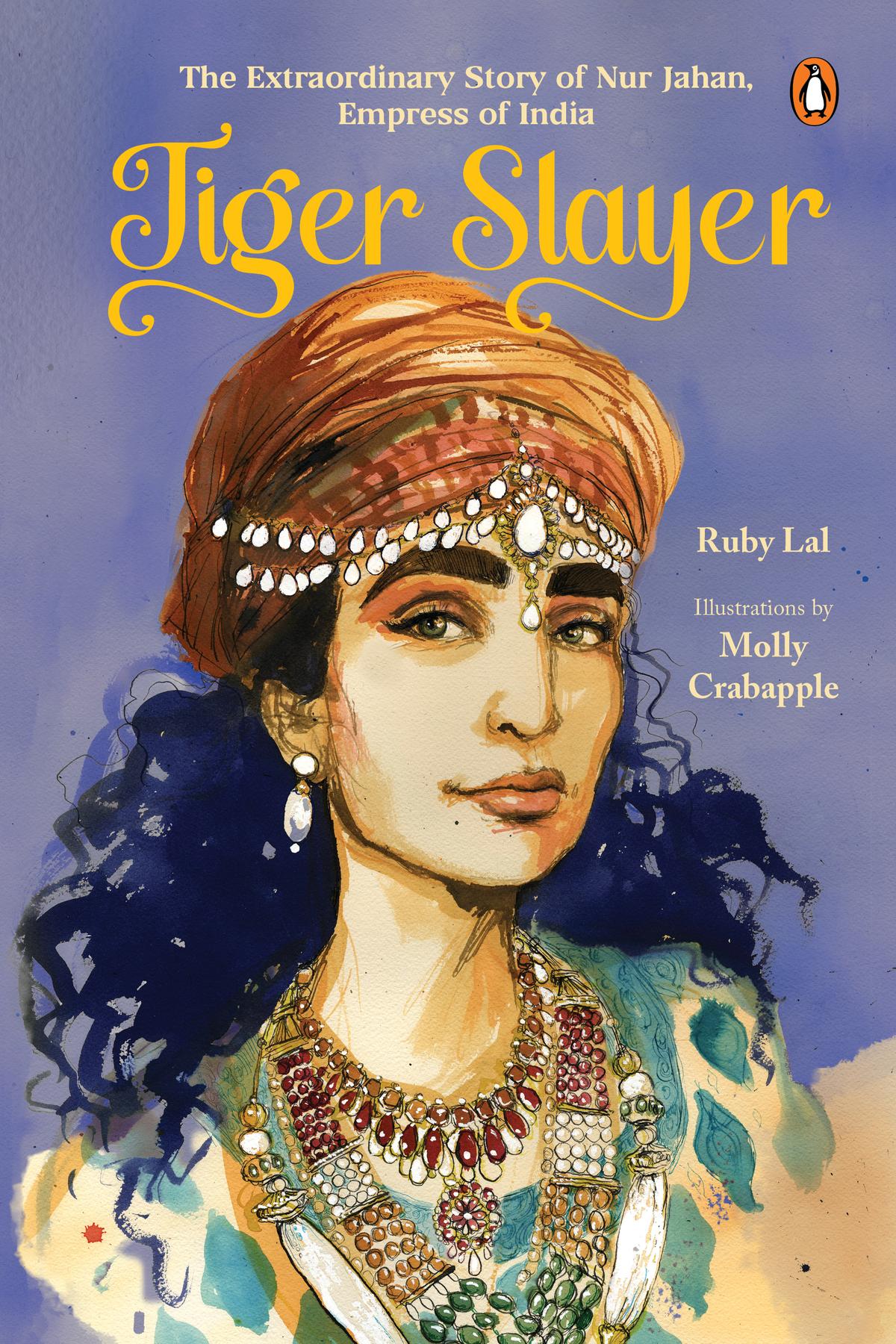
Cover illustration in Tiger Slayer (2025) by Molly Crabapple. | Photo Credit: Courtesy Penguin Random House
 Your groundbreaking academic work ‘Domesticity and Power in the Early Mughal World’ completely changed the way in which many of us saw women within the Mughal world. Then, you wrote two books of narrative history: Empress (on Nur Jahan) and Vagabond Princess (on Gulbadan Begum). Not often do academics stray into the murky waters of narrative writing. But you did it with much aplomb. Now, with the illustrated Tiger Slayer, you bring again the story of the incredible Nur Jahan to a much younger audience. What has been your driving force?
 The academic journey began with an angst about the worlds that I didn’t encounter as an undergraduate history student in Delhi. These are feminine experiences, worlds and spaces, and how they meld into the production of politics, the court, the world at large. This is what drove ‘domesticity and power in the early Mughal world’, [which probed] the notion of the harem as a stereotype. The political, academic, and storytelling forms melded.
When I began thinking about Nur Jahan for my third book (Empress), on an invitation from Penguin India, I thought she’s such an exceptional figure. In her melded the extraordinary history of India, feminine power, and — something I’ve been obsessed with — the erasure of histories in the archives and by historians themselves. While these are biographies, and people make a very strong distinction between biography and history, my concern in writing these books has been that these figures are part of a wider human condition.
Tiger Slayer is not a book I decided to dive into, but I kept getting asked about [writing] for young adults. I somehow put the pieces together and asked the fabulous artist Molly Crabapple, who’s very interested in Persian art, to draw the book. Given her strong feminist portrayals, ideas and commitment to glamour and beauty, which we need to reclaim as well, I thought she’d be a really great partner.
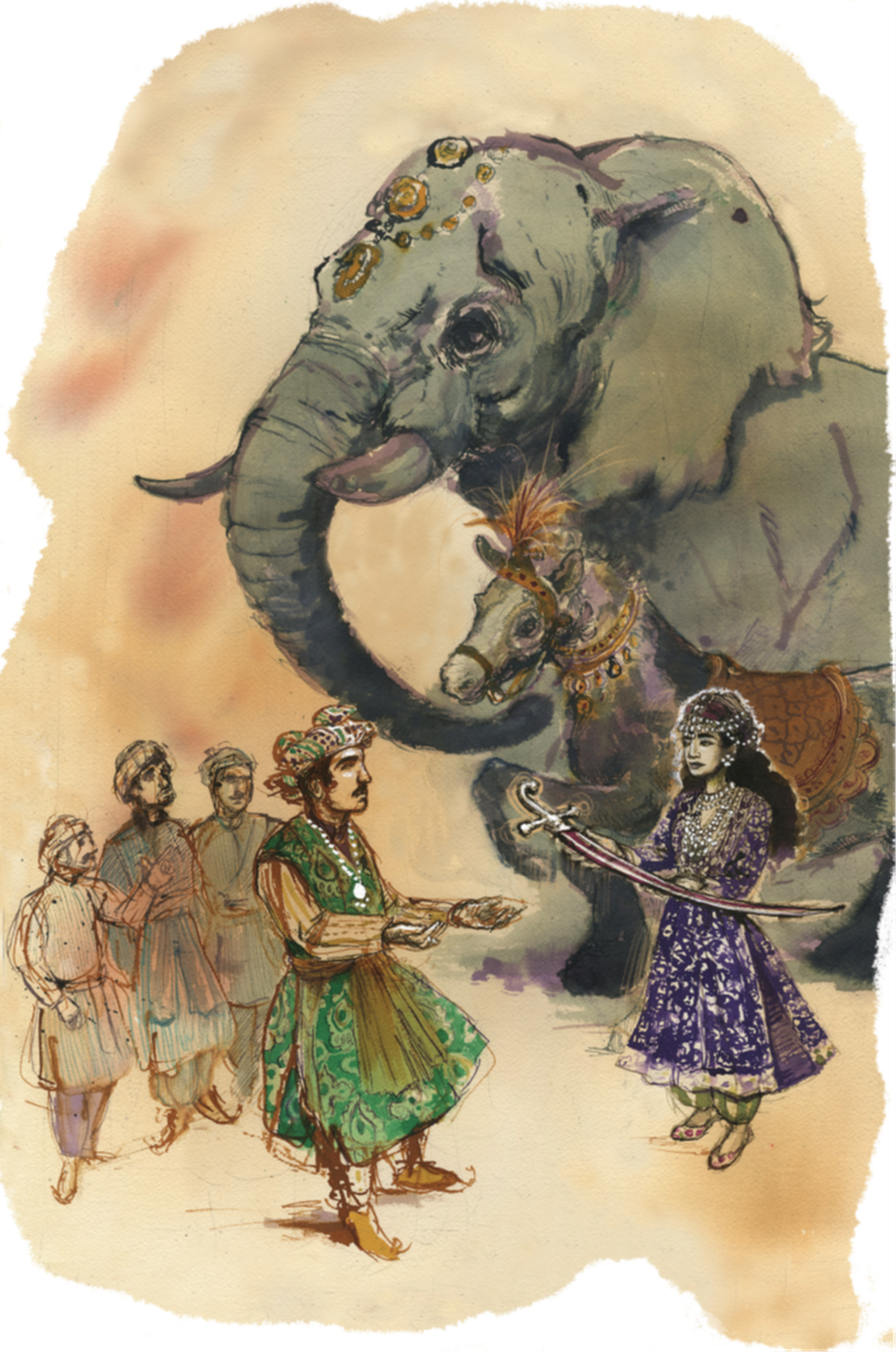
An illustration from Tiger Slayer | Photo Credit: Courtesy Penguin Random House
One painting that has been instrumental in your books on Nur Jahan is of her standing with a musket preparing to hunt a tiger. Your recent book is titled Tiger Slayer. Tell us about what that iconography means.
This is the Rampur Raza Library (Uttar Pradesh) portrait of Nur Jahan holding the musket, [an image] I’ve been obsessed with. Art historians have known that this was painted by Abu’l Hasan, the Nadir-uz-Zaman (or Wonder of the Age), as [emperor] Jahangir loved him.
The extraordinary iconographic moment in this painting is that she’s not just holding the musket, she’s loading the musket. It tells you technical know-how, [and] war expertise. Abu’l Hasan breaks from his own oeuvre to draw this portrait of the empress, a single portrait, because before this you had women represented in highly stylised nayika (actress) mode. In the Jahangir-nama, there’s at least 32 mentions of Nur’s hunting. So, the Empress actually begins with this moment while they are just outside Mathura, and there’s a killer tiger prowling the streets. Hunting was an informal sign of sovereignty, not everyone would hunt, it was essentially in the interest of protection of your subjects. And she does it many times over, thereby establishing her co-sovereignty. It was also to think what were the technical symbols of sovereignty, the nishaans, such as coins (which bore her name), etc., but also informal symbols such as the jharoka darshan (public appearance and address), hunting, architecture, usages, etc. I thought, for young adults, this would be an incredible incitement to think of a woman’s power, and the majesty of the tiger.
Molly Crabapple and I, we don’t call our work together as collaboration, it’s a co-creation. At one point, she drew a little cat. And I said, Molly, you cannot have a cat. Cats appear in art in India around the 18th century. The book has these very deep spreads of visuality on to word.
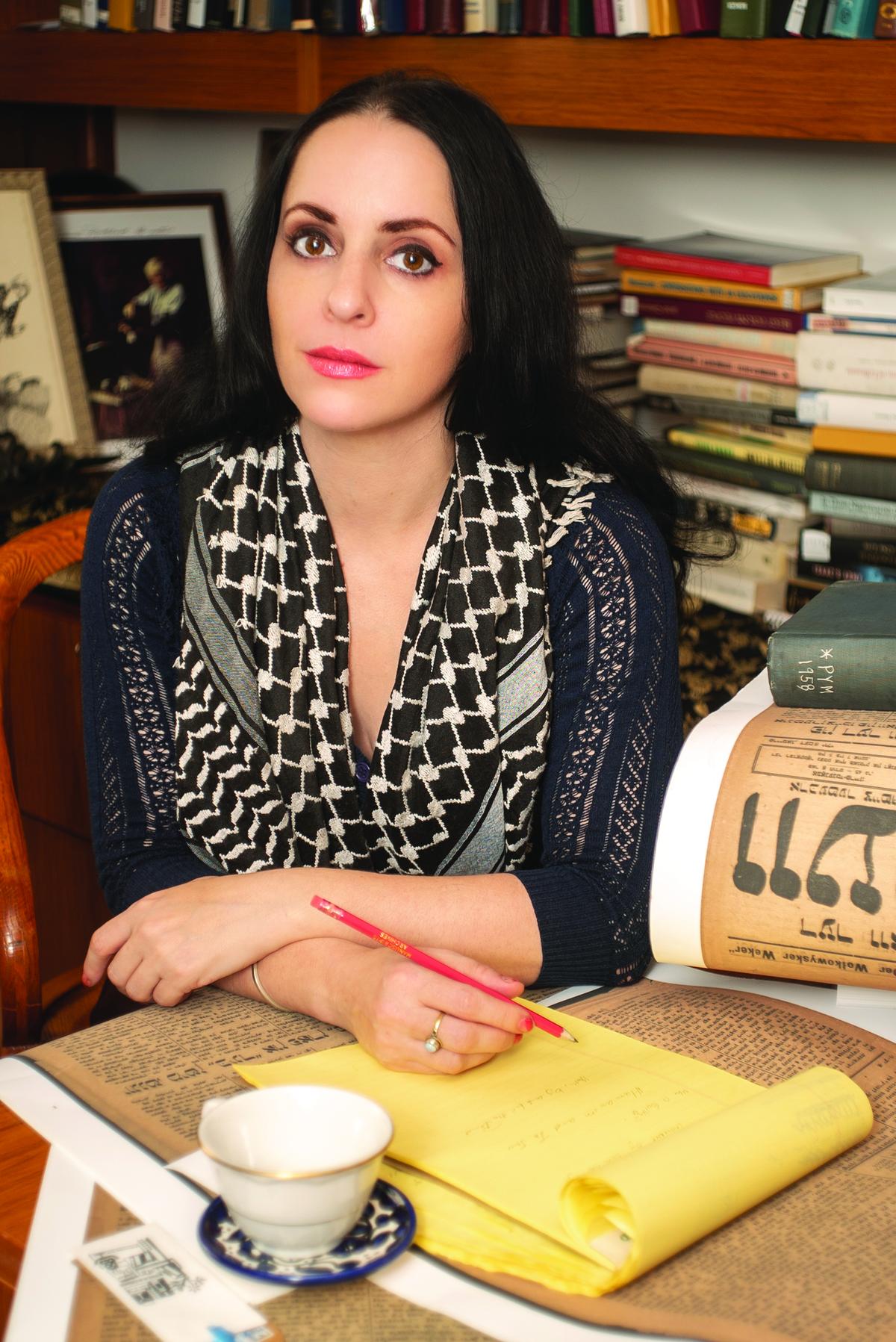
Artist Molly Crabapple | Photo Credit: Special Arrangement
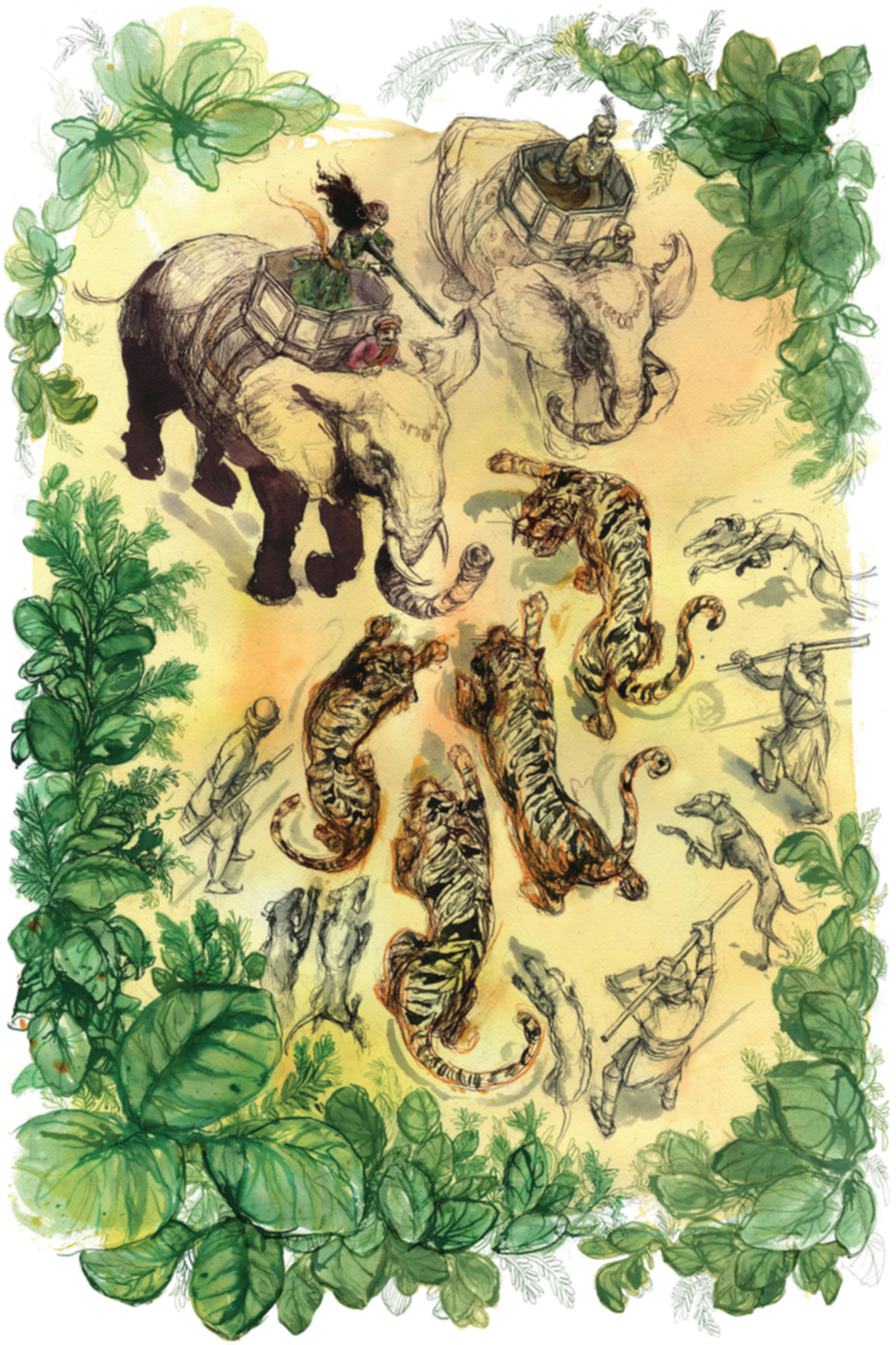
Illustration in Tiger Slayer (2025) by Molly Crabapple. | Photo Credit: Courtesy Penguin Random House
It’s a beautiful book. Molly’s style and the lushness of her paintings create the opulence of the Mughal world so well. Some of the things about Nur Jahan and Gulbadan that you bring out in your books struck us readers as a bolt of lightning. Although this information was there with male historians and writers, somehow there’s this tendency to limit their importance. Is this something you felt when writing about these women?
That is a beautiful question and it’s at the heart of everything I do. Essentially, I think historians tend to look for things that they want to look for, and part of the exercise almost always is a particular philosophical position in that looking. If it is court-sanctioned or state-sanctioned, then it is official or authentic. Not only that, what is authentic is everything that centres around the male figures in history. Within those so-called canons of the Mughal Empire, if you cast your eye closely, you will find one-liners, fragmented [mentions]. Gulbadan’s 83 folios have been dismissed by historians as her memoir was classified as soft society, whereas this is the most splendid articulation, along with Johar Aftabji and Bayazid Bayad, of the itinerant lifestyle that I’ve been a fan of.
In the case of Nur Jahan, it’s a lush archive. I’ve written in the Time magazine about a concept I finally came upon: male disbelief. Now, it is not just men but women, too, who are involved in this. Even when the most staggering pieces of evidence face you, you are saying, is this enough? You don’t ever ask, was there a painter’s name below the painting of Shah Jahan? But for Mumtaz, they will ask you. For Nur Jahan, they asked me that. These questions we have to ask ourselves about our historical practices.
In talking about the itinerant lifestyle of Gulbadan, in Vagabond Princess, what was your urge to bring episodes of her story that had been ignored by mainstream historians?
The long spell in Arabia really intrigued me. When she leaves Surat, Mughal India, and goes into the Arabian lands, my own journey with the archives had to change. I knew that I had to think what 16th-century Arabia looked like. And what was the pilgrimage that she goes for. But what got me really interested was that a year into her arrival, there were eviction orders, to some of the highest authorities in the region: the Sharif of Mecca to the tomb keepers of the prophets’ areas in Medina. She basically walked into this arid land giving out Sadaqah bounties. The conditions were very rough, particularly in the late 1570s. Sultan Murad III of Turkey and Akbar the Great never came. All Muslim kings were aspirants of the millennial sovereign, Sultan Murad III and Akbar were part of that ambition. And that is why you don’t have this detail recorded in Mughal histories. There are sanitised pictures of Gulbadan’s hajj, and there was a shipwreck at the end.
Schoolchildren in India will no longer be learning about the Mughals. Your books, then, are part of the process of a pushback, of recording the fact that the Mughals existed, and in incredible ways, that women had certain powers. Were you consciously setting out to do that or was it a logical extension of your current work?
There are certain themes that have been at the heart of my thinking about the Mughals, such as itinerant lifestyle, which was very much a part of society’s ethics. It doesn’t just mean movement and migration. It is how your senses get affected by that. It’s true of all of human history, that’s how societies and situations have happened. This is not to say that there aren’t indigenous populations in places. But the experimentation and the result of that intermingling is pretty glorious. That’s what I’ve been after — the mixing, grandeur, beauty, majesty in languages, in the arts, in our sensibilities, who we are as people. Gulbadan is the most itinerant of these figures, and she’s writing about this; but how the story of Nur Jahan, the daughter of aristocratic Persian migrants to the empire, unfolds is quite exquisite.
Tiger Slayer has acquired this political urgency because there’s a lot of interest, concern and awareness of continuing in whatever way people can. There are tonnes of student, artist and activist groups who are retelling, protecting, writing these monumental histories, and I’m definitely a part of the movement. I believe this very strongly that history is part of a thinking civilisation.
What’s next in the pipeline?
Two or three projects are brewing. There’s definitely a very deep history of Shah Jahan, Mumtaz and the Taj. And one on Razia [Sultan; pre-Mughal Delhi Sultanate]. These are early thoughts; I take time to write.
The interviewer is a writer of historical non-fiction; she has authored Akbar: The Great Mughal (2020), and The Lion and the Lily: The Rise and Fall of Awadh (2024).
此内容由惯性聚合(RSS阅读器)自动聚合整理,仅供阅读参考。 原文来自 — 版权归原作者所有。