








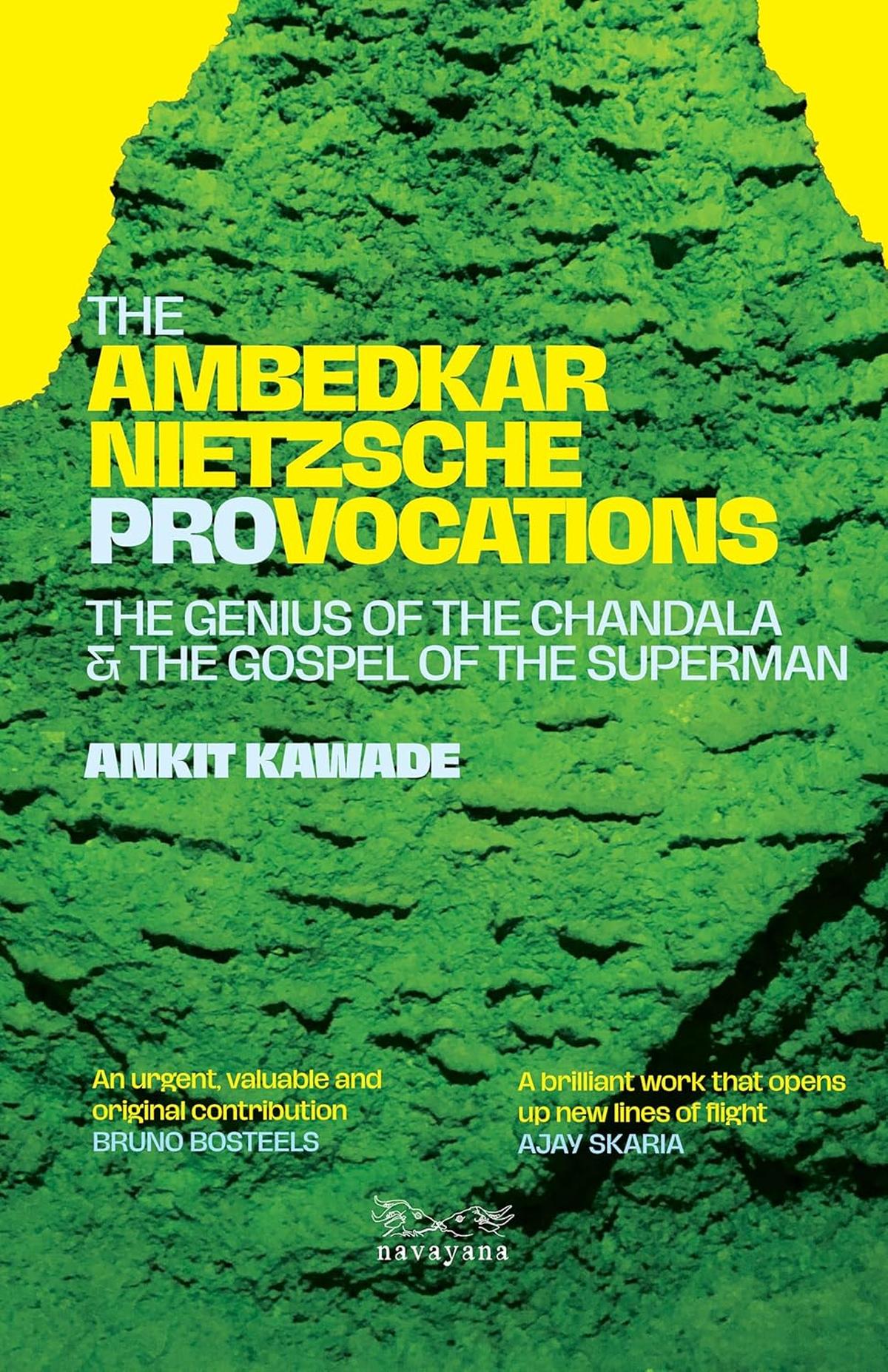
In Maharashtra, many posters of Dr. B.R. Ambedkar carry the word Mahamanav (Great Man) beneath his image. The association with Friedrich Nietzsche’s Übermensch (Overman or Superman) is not entirely lost to an attentive examiner. It is, however, a somewhat impudent comparison. Ambedkar repudiated the Nietzschean concept of the Overman as he saw it as a justification for oppression and social inequality. Moreover, Ambedkar detested Nietzsche’s admiration for the Gesetzbuch des Manu — the Manusmriti. These contradictions are precisely what Ankit Kawade, a doctoral candidate at Johns Hopkins University, explores in his debut work The Ambedkar-Nietzsche Provocations: The Genius of the Chandala and the Gospel of the Superman.
Walking a fine line
The central provocation of the book is terminological. In the late 1880s, Nietzsche called Christianity a “Chandala religion,” borrowing the Sanskrit term for those belonging to the so-called lowest castes of society. Decades later, Ambedkar called Hinduism “the gospel of the superman,” repurposing Nietzsche’s own coinage against hierarchical order.
Kawade begins by excavating Nietzsche’s ‘Chandala’ in close detail. Who is this figure? Chandala is a metaphor for degeneracy, a philosophical cudgel against Christian egalitarianism, stripped entirely of the lived horror it signifies in a caste-ridden society. Kawade is sharp here, and the book walks a fine line between illuminating Nietzsche’s appropriation and inadvertently lending it more philosophical dignity than it deserves.
The book explores the Manusmriti, the ancient Brahminical code that Nietzsche praised as an antidote to Christian conformity and that Ambedkar publicly burned at Mahad on Christmas Day, 1927. Kawade’s examination shows how the same text can simultaneously be a resource and a ruin: a manual of nobility to one reader while being a cudgel of oppression to another. The section on Ambedkar’s constitutionalism, particularly his insistence that he was “not a modern Manu,” is arguably the book’s most original political contribution, situating Ambedkar not merely as an anti-caste activist but as a thinker who had to ask what kind of law a liberated society legitimately requires. In an era when ancient legal texts are once again being mobilised as political instruments, the questions Kawade raises are not merely academic.
The most persuasive move
Kawade reads Ambedkar as a careful, combative reader of Nietzsche, not dismissing him wholesale but exposing the class and caste assumptions buried beneath the aristocratic individualism. The inversion that closes the book is elegant and deserves to be dwelt upon: if Nietzsche diagnosed Christianity as slave morality, Kawade argues that Ambedkar’s framework reveals Brahminism itself as yet another form of slave morality. A ruling order that requires the perpetual degradation of others to sustain its own sense of greatness is, by Nietzsche’s own criteria, driven by ressentiment. This is the book’s most persuasive move, and the one most likely to unsettle readers who have approached either thinker in isolation. It is also reason enough to read it.
Kawade moves fluently from Nietzsche’s aphoristic maxims to Ambedkar’s constitutional writings. There is a determined singularity that is also on occasion a limitation. The critical question the book must answer for any engaged reader is whether centring the analysis on Nietzsche illuminates Ambedkar or risks Europeanising him. There are moments where the Nietzschean scaffolding seems to dominate the structure when the Ambedkarite argument is entirely capable of standing on its own terms.
And yet, perhaps, this is to mistake the book’s intent.
Nietzsche, in The Antichrist, states, “The ‘holy lie’ — common to Confucius, the law of Manu, Mohammed, the Christian church — is not absent in Plato. ‘Truth is there’: this means, wherever it is announced, the priest lies.” In Nietzsche’s view, such lies were meant to wrest control over the minds of the credulous.
But what then of truth? Francis Bacon, opening his essay Of Truth, recounts, “What is truth? said jesting Pilate, and would not stay for an answer.”
Both men gesture at the same metaphysical abyss. Ambedkar, however, had no patience for the abyss. In Annihilation of Caste, he wrote: “Equality may be a fiction, but nonetheless one must accept it as the governing principle.” It is the reply of a man who has read the Manusmriti not as a philosopher in repose but as someone it was written to destroy. In the spirit of the Buddhist parable of the poisoned arrow, Ambedkar understood that contemplating the metaphysics of the arrow is a luxury available only to those not already dying.