



Babur Ali, 62, and his son Mukaddas Ali, 33, were among the approximately 350 people who had gathered outside two polling stations — Sonapur Pathar Lower Primary School and a government facility at Kachutali Part 1 — in central Assam’s Kamrup Metropolitan district on April 9. They hoped against hope that the officials beyond the Lakshman Rekha, a line at least 300 metres from the entrance to each polling booth, which they were told not to cross, would restore their voting rights. These 350 women and men represented more than 2,000 people across three parts of Kachutali, who had ceased to exist as voters after the Special Revision (SR) of electoral rolls was conducted in Assam between November 2025 and February 2026.
All the adults of Babur’s 15-member family demonstrated outside the Sonapur Pathar Lower Primary School, barring his youngest son, Samsul. Around the same time, 20-year-old Samsul cast his vote at a booth in the Chenga Assembly constituency of western Assam’s Barpeta district.

He hoped his vote would make a difference to his family, who are now about 120 kilometres from where their home once stood before an eviction drive in September 2024. Samsul used the postal address of his maternal uncle in Barpeta district to enlist as a voter. He listed his father’s voter ID number in the “relative” column, even though the Election Commission had removed his father’s name from the voters’ list in Kachutali, under the Dimoria Assembly constituency.
“We are happy for the youngest member of our family, but we fail to understand how the government accepted him as a voter after deleting the name of our father, who has been voting at Kachutali since 1985,” says Mukaddas.
Mukaddas was a Bharatiya Janata Party (BJP) leader and contested the 2018 panchayat polls. He thought his association with the ruling BJP made his family immune to any drive against the ‘Miya’ people — a pejorative for Bengali-speaking or Bengal-origin Muslims — that the party unleashed after it retained power in 2021.

He was wrong; his house was among the first 150 that the local administration began demolishing on September 9, 2024, to clear about 100 bighas or 33 acres of notified tribal land. A year later, he found his name missing from the voters’ list along with some 2,000 others. They were among the 2.43 lakh voters removed from the revised electoral rolls released in February.
“If my removal from the voters’ list is a message that I am an Indian no longer, how was it that I was allowed to contest an election and even given a card by the Kamrup Metropolitan District Commissioner after my documents were cleared,” he asks.
According to government records, Assam has 30 tribal blocks and 17 tribal belts notified decades ago to safeguard the land rights of the State’s protected class. Abdul Aziz, 91, and Jayanal Haque, 80, say they were not aware of the status of the land in Kachutali when they bought it.
“We have agreements for land purchased from the Karbi tribal people in the 1980s. We also have the receipts of khajna (land tax) paid till the time of our eviction. The government says these land documents are kutcha (not legal) and we have no right to live here,” says Haque, who often spends his time staring blankly from the veranda of the Kachutali Jamia Masjid at the spot where his house once stood.

About 80 evicted families are now living in cramped shanties around the mosque, which was spared during the 2024 demolition.
Haque and Aziz are from Mayang Gazbari, a village that disappeared over 40 years ago after the Brahmaputra river washed away its last homes. Located about 16 km north-east of Kachutali, the village lay near the meeting point of the Brahmaputra and its southern tributary, the Kolong river. It also sat at the junction of three districts — Kamrup (before it was divided), Darrang, and Morigaon. All the evicted families in Kachutali say they were displaced by the river from riverbank villages around the tri-junction of these districts.
“We would perhaps not have come here had the Brahmaputra not swallowed up our riverbank homes and homesteads. Some of us still grow crops on the chars (sandbars) near our original homes, apart from the farmlands we purchased from the tribal people, which we no longer have access to,” Haque says.
Holding his voter ID, now rendered useless, Haque says his family faced a similar situation years ago. During the 1979 revision of electoral rolls for the Mangaldai Lok Sabha by-election, a cousin was included in a list of about 36,000 people marked as ‘doubtful voters’. Mayang Gazbari was part of that constituency.
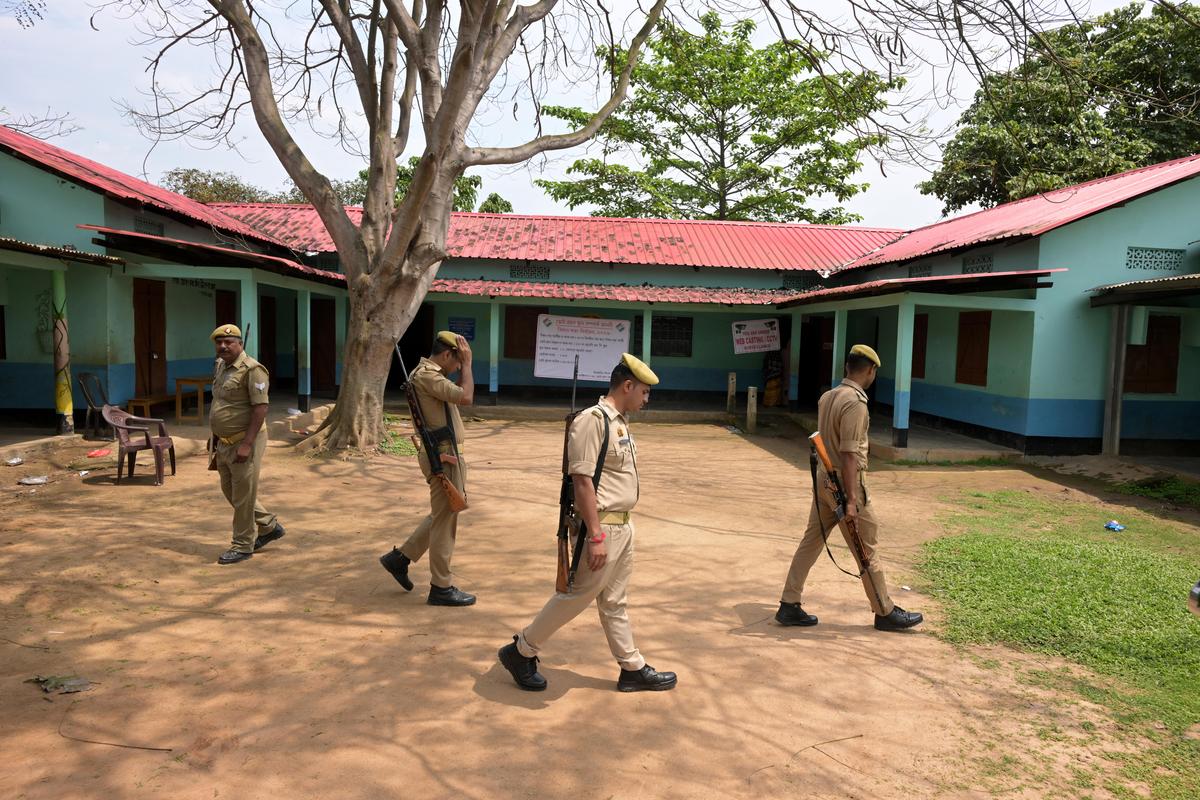
The deserted Kachutali polling station on April 9, 2026. | Photo Credit: Ritu Raj Konwar
The list sparked the Assam Agitation of 1979-85, which aimed to drive out non-citizens from the State. Over time, “non-citizen” started to mean Miya or Bangladeshi or the more politically correct term, illegal immigrants. “We have never been made to feel wanted since, but things were not as bad as now,” says Aziz.
Soon after taking charge as Chief Minister in May 2021, Himanta Biswa Sarma announced his government’s resolve to free various categories of government land, including forests and community grazing grounds, from encroachment. The drive began with Garukhuti in Darrang district in September 2021. The All Assam Tribal Sangha and other indigenous organisations began mounting pressure on the government for a similar action across the tribal blocks and belt. The Kamrup Metropolitan district authorities issued a notice to the Kachutali residents in September 2024, allegedly giving them three days to vacate the land they had occupied.
The eviction began on September 9, 2024, to clear about 100 bighas of land. Tensions escalated when the displaced villagers reoccupied the land three days later and clashed with the officials who resumed the demolition process. Two men, Haider Ali and Jubahir Ali, died in police firing, while 33 others were injured in the clash. A group of 48 evicted people approached the Supreme Court, which issued a stay order on September 30, 2024. However, residents say the authorities carried out another eviction drive in April 2025, demolishing the last of the houses and structures in the targeted area. At the end of the operation, more than 650 families were relocated temporarily to three camps within a kilometre of the area they were evicted from.
“The eviction notice was not as scary as the one we received in November 2024 from the electoral registration officer. It said that our names might be deleted from the voters’ list because we have ceased to be ordinary residents of Kachutali,” says 34-year-old Akkas Ali, a farmer who has been surviving on occasional work in the urban centres nearby.
“We were told to reapply (for enlisting as voters) from wherever we came. We reapplied in Kachutali because we had nowhere else to go, but our applications were rejected. At the District Commissioner’s office in Guwahati, we were advised to get a certificate (confirming they are residents in an area under the jurisdiction) from the gaonburah (village chief), who said we needed a valid voter ID to get the certificate. Our Aadhaar cards, ration cards, and other documents were ignored. It was as if everyone conspired to deny us our voting rights,” he adds.
The office of the district electoral officer told the media that the notices served on the evicted people and the action thereafter were part of a special summary revision of the electoral roll. Jiten Kakati, the gaonburah, merely said he had followed a certain process.
In 2025, the Chief Minister said over 1.29 lakh bighas or 42,000 acres out of an approximately 29 lakh bighas (about 3,900 sq. km) of government land had been freed from encroachers. He also said individuals evicted from illegally occupied land will have their names removed from the voters’ list. Ahead of the April 9 Assembly polls, he sought another five years for the BJP-led National Democratic Alliance government to complete the eviction mission and “break the backbone of Miyas politically”.
Legal experts say the government has the right to evict encroachers from its land, preferably after giving them adequate time and adopting a humanitarian approach. “You can evict a bona fide Indian voter from a place where he or she is not legally permitted to settle. Encroachment of land is a criminal offence that needs to be dealt with accordingly. The criminality of the act does not empower the State administration to deprive people of their voting right, which is connected to their citizenship status,” says Fazluzzaman Mazumdar, a Gauhati High Court advocate.
“The conditions with Form 7 issued by the Election Commission say that a voter can be deleted from the electoral roll if he or she is dead or has migrated permanently to another place and has enrolled there or if someone complains against him or her, provided it is legally proved,” Mazumdar says. He adds that the deletion of voters for an unrelated illegal act is unfair. They have the right to appeal to the Election Commission for enrolment. If that does not work, they can file a writ petition at the High Court under Article 226 of the Constitution of India (for the enforcement of fundamental rights). “Unfortunately, the affected people are mostly poor and uneducated,” he adds.
Ibrahim Ali, a 45-year-old trader, says the villagers lost a fortune to stay the eviction in vain. “We can rebuild a house, but how can we earn for it when we don’t have access to our farmlands? Most of us had to sell our livestock because we had no place to rear them. Under such circumstances, we cannot imagine going to the court to restore our voting rights,” he says.
Almost two decades after putting a question mark on the citizenship of a section of voters in the Mangaldai Lok Sabha constituency, the Election Commission issued a circular in July 1997, directing the Assam government to remove non-citizens from the electoral rolls. Assam, thus, became the only State with a ‘D-voter’ or ‘doubtful voter’ category in its electoral rolls. During the intensive revision of the electoral rolls that followed, almost 3.7 lakh people were marked ‘D’. They were barred from contesting elections and casting their votes.
In 2005, when a house-to-house survey was carried out by the poll panel, a large number of people marked ‘D’ in 1997 could not be traced. This list was officially revised to 1.81 lakh. Almost two decades later, Chief Minister Sarma said Assam has 97,987 ‘D-voters’ and the tag was removed from more than 89,000 people from 1997 to 2023. He also said that 26,144 ‘D-voters’ received notices from the Foreigners’ Tribunal, while 11,819 cases were pending.
The Foreigners’ Tribunals are quasi-judicial courts that adjudicate the citizenship of a person referred by the Assam police’s Border wing, which is tasked with detecting and detaining suspected foreigners. Based on documents, the tribunals either declare the suspected foreigners as Indians or send them to detention or transit camps, to be eventually “deported to the country they came from”.
Announcing the SR exercise for Assam on November 17, 2025, the Election Commission specified that the details of ‘D-voters’ should not be included during the house-to-house verification. It said that the particulars of all such voters have to be carried forward to the draft electoral rolls without any change. Any modification in a D-voter’s status, including removal or deletion of the ‘doubtful’ tag, can be made only based on an order from the Foreigners’ Tribunal or a court.
“We were never doubtful voters, but the government put us in a new category — deleted voters — not because we are foreigners but because they say we occupied lands we were not supposed to, although we have land purchase deeds,” Ibrahim says.
The residents of Kachutali hope the next government will resettle them or allot them some space to live without having to wear the non-voter tag on their foreheads. “We did not expect the BJP leaders to come to us offering hope. Members of other political parties, including the Congress and All India United Democratic Front, who claim to be friends of the minorities, let us down; they did not even visit us. So, we are not sure if we will get justice after a new government is formed,” Haque says.
The evictees fear that deletion from the electoral roll was the first step to robbing them of their citizenship and deporting them. “A government that can make us homeless can also kill us. Being dead should be better than living a life of uncertainty,” Annaf Ali, 65, says.
此内容由惯性聚合(RSS阅读器)自动聚合整理,仅供阅读参考。 原文来自 — 版权归原作者所有。