









Rising global uncertainties and elevated prices of key energy commodities pose some upside risks to India’s current account deficit (CAD) in 2026-27, cautioned the Reserve Bank of India.
Further, the rupee faces continued headwinds from a relatively strong dollar, uncertainty about the quantum and composition of capital inflows, and rising import costs.
CAD is a measure of a country’s trade where the value of the goods and services it imports exceeds the value of the products it exports.
CAD widened
India’s CAD widened to 1.3 per cent of GDP during Q3:2025-26 from 1.1 per cent in the corresponding period a year ago on account of higher merchandise trade deficit, while services and remittances receipts remained robust.
In the financial account, net capital inflows fell short of CAD and resulting in depletion of forex reserves, per RBI’s latest monetary policy report (MPR).
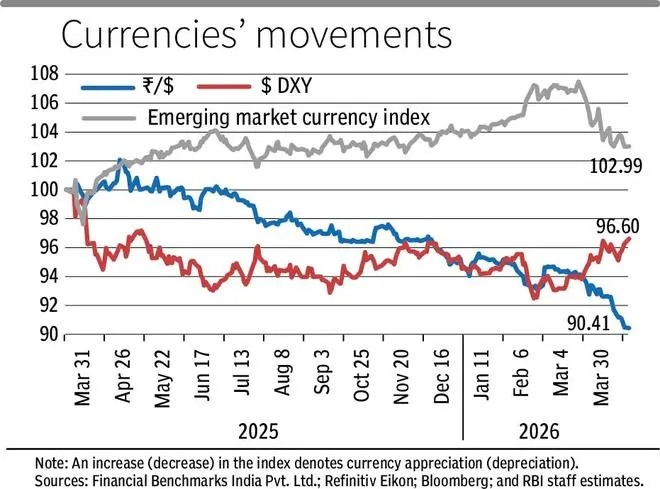
“Elevated and volatile energy prices, through higher import bill, may impact the current account deficit and exert imported inflation pressure, including potential second-round effects.
“Heightened uncertainty, increasing risk aversion and safe-haven demand may lead to capital outflows thereby exerting sustained depreciation pressure on the exchange rate,” warned the report.
The report underscored that given India’s high import intensity of exports, higher input prices along with a depreciating currency may raise the cost of production of exports which, if passed on to output prices, may act as terms of trade shock.
Further, weaker global growth prospects may dampen external demand and reduce remittance flows.
Rupee fall
Despite stronger macroeconomic fundamentals, the MPR noted that the rupee in 2025-26 depreciated more than the average in the previous years. Overall, the rupee depreciated by 6.2 per cent against the US dollar in H2 (October 2025-March 2026).
The report said in March 2026, depreciation pressures accentuated with the rupee breaching 95 per US dollar intraday, surpassing its previous record lows amid concerns over West Asia conflict.
A primary driver has been the sustained portfolio outflows, reflecting a risk-off sentiment towards emerging markets amid heightened global uncertainty, it added.
Published on April 8, 2026