









Indian age-group results in sport do not usually generate much buzz, but there was something particularly unique about the promise behind Omik Bhakkad’s silver medal in the individual elimination competition at the Indian Under-13 Archery Nationals held in Guntur, Andhra Pradesh, on March 31 this year. It was not so much about the 13-year-old Omik, who also won bronze in the ranking round with a score of 354/360, but about the compound bow he shot with.
While competitors around him used imported Hoyt, Sanlida and PSE bows, Omik’s metallic neon green instrument was a Tej 28, built by Indian company Imaxx Sports, the country’s only domestic manufacturer of compound bows.
“Omik’s medals are an important milestone in our journey to manufacture India’s first compound bow,” says Girish Venkatasubban, proprietor of Imaxx Sports.
Girish says he set out to manufacture India’s first indigenous compound bow three years ago. At the time, he approached the project as a technical challenge he was confident of solving.
“Just how hard could it be to make one? It’s not exactly rocket science,” he remembers thinking.

Thirteen-year-old Omik Bhakkad with the Tej 28, an Indian-made compound bow built by Chennai-based Imaxx Sports. Omik won silver in the individual elimination event and bronze in the ranking round at the U-13 Archery Nationals in Guntur. | Photo Credit: Special Arrangement

Thirteen-year-old Omik Bhakkad with the Tej 28, an Indian-made compound bow built by Chennai-based Imaxx Sports. Omik won silver in the individual elimination event and bronze in the ranking round at the U-13 Archery Nationals in Guntur. | Photo Credit: Special Arrangement
The 49-year-old is no stranger to solving some of India’s toughest engineering problems and is more than familiar with rockets. Girish is also the managing director of Microfine Bushings Pvt Ltd, a precision manufacturing company based in Chennai. Established by his father in 1981, the company has built indigenous machinery for India’s military and space programmes: launch vehicle umbilicals (the mechanism that separates the booster from the main vehicle), power packs for the Army’s heavy tanks, guidance fins for rockets, and pin assemblies for the supersonic missiles India deployed during Operation Sindoor last year.
Now, add India’s first range of compound bows to that portfolio.
It is an unlikely journey, one that began in 2023 when Girish turned to his nine-year-old son Vishwa and told him he needed to learn a sport and a craft.
“Archery,” came the answer.
Girish remembers being mildly surprised. He had assumed his son would pick cricket or football, not something as niche as archery. Still, he searched for a nearby academy, found one and enrolled him. At first, it was routine: practice sessions with basic equipment, the kind of entry-level recurve bows available at any multi-sport goods store. But a few weeks later, the coach suggested it was time for an upgrade if Vishwa was going to take the sport seriously.
There was the option of buying a recurve or a compound bow. Recurve bows are unforgiving and harder to draw, especially for young archers, so Girish’s son was advised to take up compound archery, where pulleys attached to the limbs make it easier to hold the arrow at full draw.
Girish paid the money, about Rs. 1,35,000 for a bow from Chinese manufacturer Sanlida, without much thought. It seemed expensive, but he assumed that was the cost of importing specialised equipment.
Then he waited.
Weeks passed. Then more weeks. There was always a reason. The equipment had not arrived yet. It was being shipped. It was stuck somewhere in the supply chain.

Girish Venkatasubban (L) and Ganesh Krish, the duo behind the development of an indigenous Indian compound bow. | Photo Credit: Special Arrangement
Girish Venkatasubban (L) and Ganesh Krish, the duo behind the development of an indigenous Indian compound bow. | Photo Credit: Special Arrangement
“Eventually, I had to ask what the reason was behind the delay. That’s when the coach told me that none of the bows used by Indian archers was made in India. They came from either China or the USA. I also found out later, when I compared the manufacturer’s selling price with what I was paying, that I was paying nearly three times the actual cost,” he says.
For most people, that would have been the end of the matter: an acceptance that imported sports equipment is expensive. There was a kind of recurve bow, known as the Manipur bow and made out of bamboo, that was built locally, but nothing similar existed in compound archery.
India is considered one of the global powerhouses of compound archery. Across the last two World Championships, Indian archers have won five medals, including four gold medals in compound events. Thousands of archers compete with compound bows domestically. Every one of them used bows imported from China or the USA.
Girish wondered if he could change that.
“At our unit, we produce parts that go into rockets and missile systems where the tolerances are measured in microns, and there’s next to no margin for failure. If we can do that, why can’t we make a bow?”
A few weeks later, Imaxx Sports was founded out of the same Microfine Bushings factory in Chennai, with a few engineers from the parent company joining the effort.
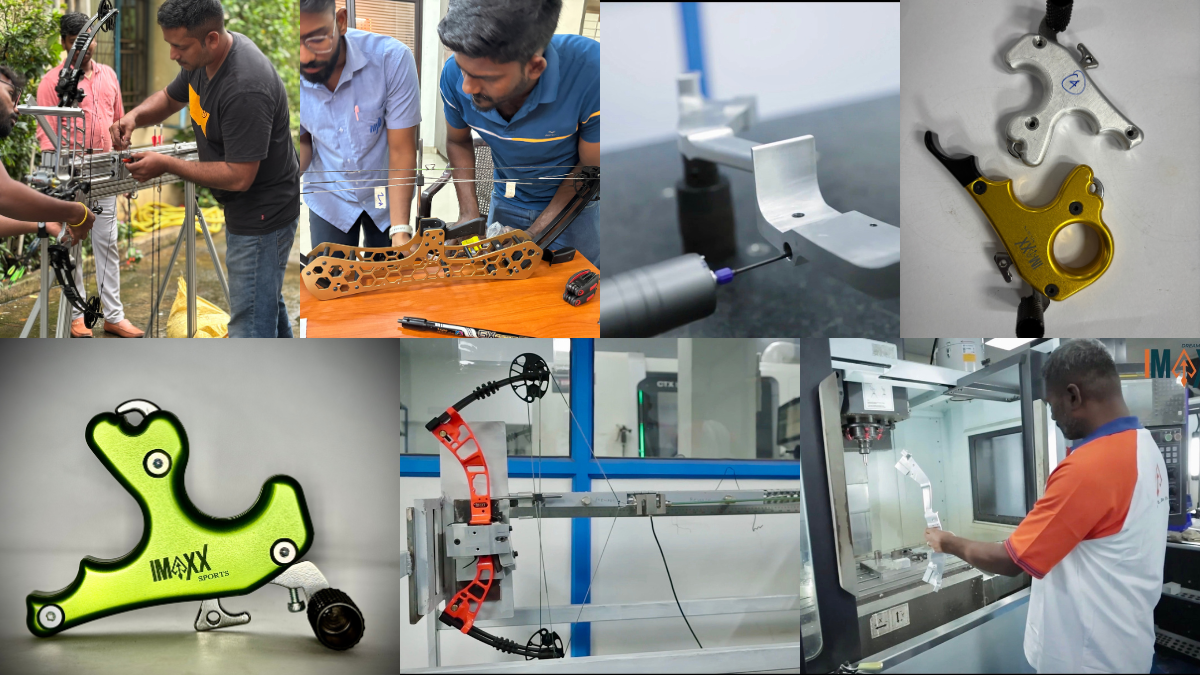
From prototype sketches and precision machining to testing rigs and final assembly, the journey behind Imaxx Sports’ indigenous compound bow was shaped through months of experimentation, redesign and engineering development. | Photo Credit: Special Arrangement
From prototype sketches and precision machining to testing rigs and final assembly, the journey behind Imaxx Sports’ indigenous compound bow was shaped through months of experimentation, redesign and engineering development. | Photo Credit: Special Arrangement
First copy
Initially, they decided to reverse-engineer what already existed.
“We took an imported compound bow. We separated its components. We measured everything. We got a mould made from that and cast our first bow in aluminium,” he says.
He took the bow to a local competition in Chennai and, on the advice of a coach, showed the product to Ganesh Krish.
Krish is not a manufacturer. He is a former chartered accountant who developed a keen interest in compound archery while taking a break from work in Texas, USA. He immersed himself in understanding the technical aspects of compound bow-making and repair. Within India’s domestic archery circuit, and even among members of the national squad, Krish had developed a reputation for understanding archery and bow-making at a highly technical and scientific level.
“There was a coach who told me I needed to see this bow that Girish had brought, and when I saw it, I was intrigued,” says Krish.
At first glance, he remembers thinking the prototype looked right.
“But you only really know how a bow shoots when you put it through its paces. When we tested it, we realised that although it shot, the arrows didn’t group well. There was no consistency. It looked like a compound bow should, but it didn’t shoot as well as you’d want an elite-level bow to,” he says.
On the surface, a compound bow looks straightforward enough to replicate. It comprises a curved frame, a pulley system to reduce the difficulty of drawing, and a string. That simplicity, though, is misleading.
“You can take a stick and tie a rope. It will shoot an arrow. But that’s not the point,” says Krish.
“A professional compound bow must deliver identical performance across repeated shots. There are some 65 components, including cams, limbs, strings and risers, that go into making a compound bow, and everything must work together. The cams must rotate with exact timing. The limbs must flex and recover within controlled limits. The force must build and release in a very specific pattern as the string is drawn. Everything must work together,” he says.
Although the first bow was imperfect, Krish says he saw enough potential in the venture to eventually join Girish on the project.
For both men, this was unfamiliar territory.
“It wasn’t just a matter of precision. When you work in aerospace, you know exactly what the standards are. But because no one had ever made a compound bow in India, we had to figure out the standards ourselves. We had to define what mattered,” Girish says.
The two eventually began breaking down exactly what their bow needed to achieve.
“We needed to know how fast the arrow travels. How tightly do the arrows need to group? How does the load build while drawing the string? Even something as simple as measurements was not straightforward because, in India, we use the metric system, while compound bows originate from the USA, where everything is measured in pounds and inches. We had to start creating our own framework,” Krish says.
None of this was easy. Or cheap.
Prototype after prototype had to be machined out of aluminium. Designs were tested, rejected and redesigned. Small changes required new parts. Entire assemblies were scrapped.
“We went through 30 to 40 aluminium blocks. Each one costs money. I think I would have spent around 50 lakhs on prototypes and experimentation,” says Girish.
Even for a company accustomed to high-end manufacturing, the unpredictability proved challenging.
“It’s a lot easier to do what we are doing in China. For example, if we are trying to get a mould for our bow limbs made, it can be done in 15 days. In India, it will take two to three months,” he says.
Multiple challenges
There was also the challenge of the Indian market.
As they began speaking to coaches, parents and archers, Girish and Krish say they discovered a system warped by layers of intermediaries: distributors, dealers and coaches. In some cases, the same product costs several times its original value.
“Everyone is taking a cut,” he says.
Eventually, in 2024, the duo released its first product, the Vishwa 37, named after Girish’s son and the 37-inch distance between the two axles of the pulleys at the ends of the bow’s limbs. They showcased it at tournaments and introduced it to top archers.
The response was polite but non-committal.
“People liked it. But nobody bought it,” Girish says.
For serious archers, the bow was not good enough to compete with established international brands. For casual users, the bow, priced at Rs. 40,000 before dealer markup, was too expensive.
“The elite archers don’t want to leave anything to chance. They already feel habituated to bows by American and Chinese manufacturers. If they were to switch to our bow, it would mean adjusting once again, and, at the level they are at, they don’t want to leave anything to chance,” says Krish.
Just when they appeared to have reached a dead end, Girish noticed something.
“Most archers in India aren’t elite seniors. They are youth and kids, and the equipment they were using wasn’t made for them,” he says.
Most bows imported into India are oversized and designed for taller, stronger Western users.
“The standard bows brought into India have a draw length of 37 inches. When a young archer adapts, they invariably compromise on their form. A lot of them eventually drop out of archery. That’s when we realised we needed to solve a different problem. We needed to design for kids,” says Krish.
They returned to the design stage and began taking their products to academies around Chennai. The feedback was immediate and unfiltered.
“Kids don’t sugar-coat. If something is wrong, they tell you. Sometimes we’d get complaints like: ‘It hurts to hold,’ or ‘It’s too heavy,’” says Krish.
Each comment became a data point.
“It became a loop,” he says. “Test, change, test again.”
Breakthrough product
The result of this process was the Tej 28 series, bows designed specifically for younger archers, with a shorter draw length of 28 inches and a draw weight between 15 and 40 pounds.
Built with frames made from aviation-grade 6061 magnesium aluminium and silicon alloy, along with carbon-fibre limbs, the bows were lighter, more ergonomic and tailored to Indian body types. With a dealer price of less than Rs. 20,000, they were also far cheaper than comparable products built overseas.
For the first time, Girish felt they had something that genuinely addressed a gap.
“This was not a copy. This was ours,” he says.
The response was encouraging. Their initial small batches sold out quickly. Enquiries have started coming in from academies across the country.
The path ahead, however, is not entirely clear.
Girish admits challenges remain for Imaxx Sports. Pricing, he says, continues to be a sticking point. International prices of the alloy used for the riser, the section to which the limbs connect, have risen by a third over the last couple of months because of the war in Iran. Meanwhile, cheap imports, often benefiting from grey-market practices, continue to flood the market.
At one point, Girish even considered selling at minimal margins simply to gain traction.
“You have to be realistic,” he says. “You can’t price yourself out.”
For now, Girish remains optimistic. The company has introduced more cost-effective bows with a 10m range for archers under six years old and is bringing out a larger bow, the Tej 34, for archers between 13 and 16 years old.
Already, five archers competed with the Tej 28 at the most recent U-13 Nationals in Guntur and, with the first medals won there, Girish believes he finally has a product capable of competing with the best.
Looking back, he is clear about what kept him going through the setbacks.
“We knew we had something unique. If we can do this, it opens up possibilities. And honestly, if we can’t do this, who can? If we can build for space, why not for sport?” he says.
Published on May 07, 2026