


‘The more the merrier’ — FIFA president Gianni Infantino and U.S. President Donald Trump would be high-fiving over this phrase, as the 2026 World Cup begins with a staggering 48-team roster, expanding from 32 teams in the 2022 Qatar edition.
The dress rehearsal for such a move has already been done: the FIFA Club World Cup last year, which expanded from seven to 32 teams, generated revenue of $2.16 billion, compared to $76 million from its previous two editions.
For this year’s World Cup, which already appears aggressive in its revenue generation (FIFA listed tickets worth over $2 million for the final), the larger roster seems planned along similar lines.

According to FIFA research, revenue for this World Cup is predicted to rise to £5.29 billion, with a potential profit increase of £521m. But there’s more than just money to such an event. There are millions of fans travelling to watch their favourite players. That adds nuance to this quadrennial spectacle.
For the 2026 edition, the biggest X-factor is its diversification. Tiny countries like Curacao, Cape Verde and Haiti have earned a spot in the biggest show on earth.
Lowest-ranked teams this edition
New Zealand (85), Haiti (83), Curacao (82), Ghana (74), Cape Verde (69), Bosnia and Herzegovina (65), Jordan (63), Saudi Arabia (61), South Africa (60), Iraq (57)
More space for ideas
For Africa, which boycotted the 1966 edition in protest against the lack of a direct spot, the expansion is pure bliss, offering another stage for moments like ‘Bafana Bafana’ in 2010, the roar of the Lions of Teranga in 2002, and Morocco’s semifinal run in 2022.
Asia, too, will rejoice at the prospect of a 48-team World Cup, with nine teams, including two debutants, punching their tickets.
Matches against European sides will not only allow these teams to rub shoulders with the traditional elite but also leave the door open for upsets, like Cameroon in 1990 or South Korea in 2002.
A bigger table provides space for more ideas, going beyond the archetypes of ‘Total Football’, ‘Catenaccio’ and ‘Tiki Taka’.
Roger Milla dancing past Romanian defenders or Salem Al-Dawsari humbling Argentina reflected a more pragmatic approach from emerging footballing nations.
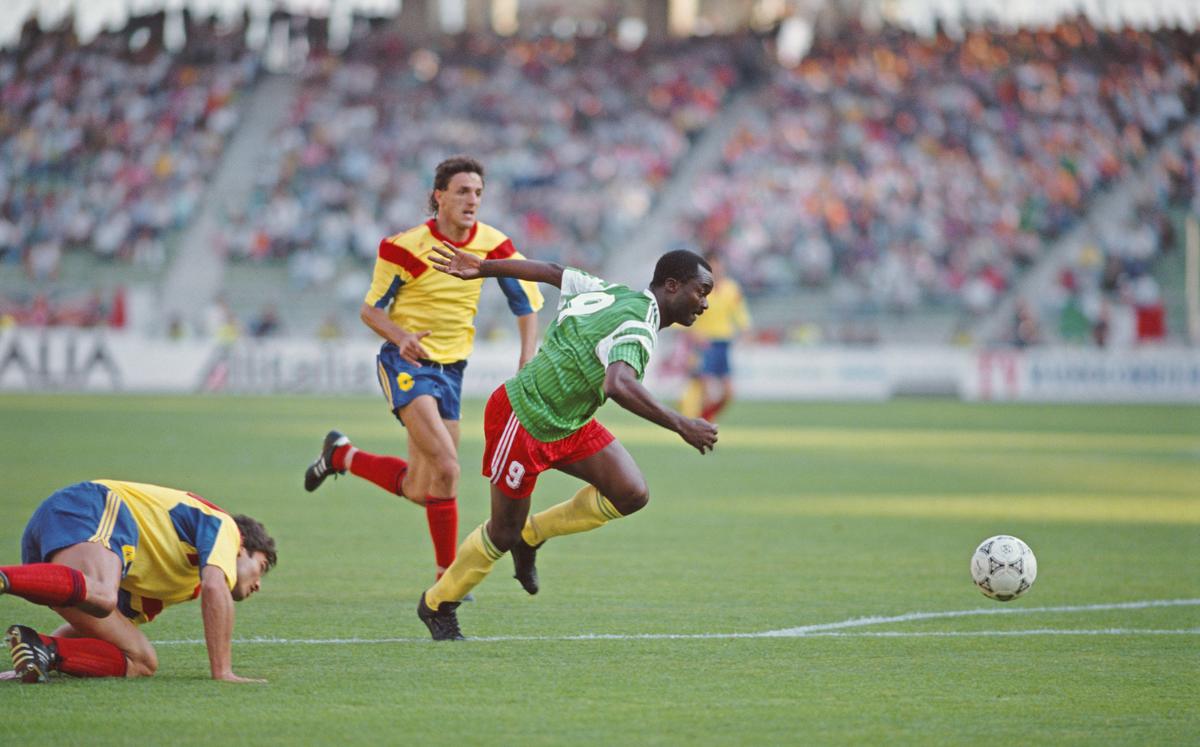
Cameroonian Roger Milla races through Romanian defenders in a group match in the 1990 FIFA World Cup. | Photo Credit: Getty Images

Cameroonian Roger Milla races through Romanian defenders in a group match in the 1990 FIFA World Cup. | Photo Credit: Getty Images
Senegal’s run to the 2002 quarterfinals featured prominently in a paper by Raffaele Poli titled ‘Understanding Globalisation Through Football’, where he argued that expansion helps create a global market for footballers, with clubs and competitions playing complementary, increasingly integrated roles beyond national borders.
The move benefited both players and coaches — Ji Sung Park moved to the Netherlands (PSV Eindhoven), Asamoah Gyan to the Premier League (Sunderland), while Guus Hiddink returned to Europe after his impressive spell with South Korea in 2002.
According to economists John Horne and Wolfram Manzenreiter, ‘Sports ‘mega-events’ are important elements in the orientation of nations to international or global society.’ A bigger tournament doesn’t just make the game beautiful, it makes it global in spirit and ethos.
Dilution of competitiveness
There are, however, two sides to a coin. American economist Simon Rottenberg had once explained that fan interest is closely tied to competitive balance — the greater the uncertainty about the outcome, the higher the appeal.
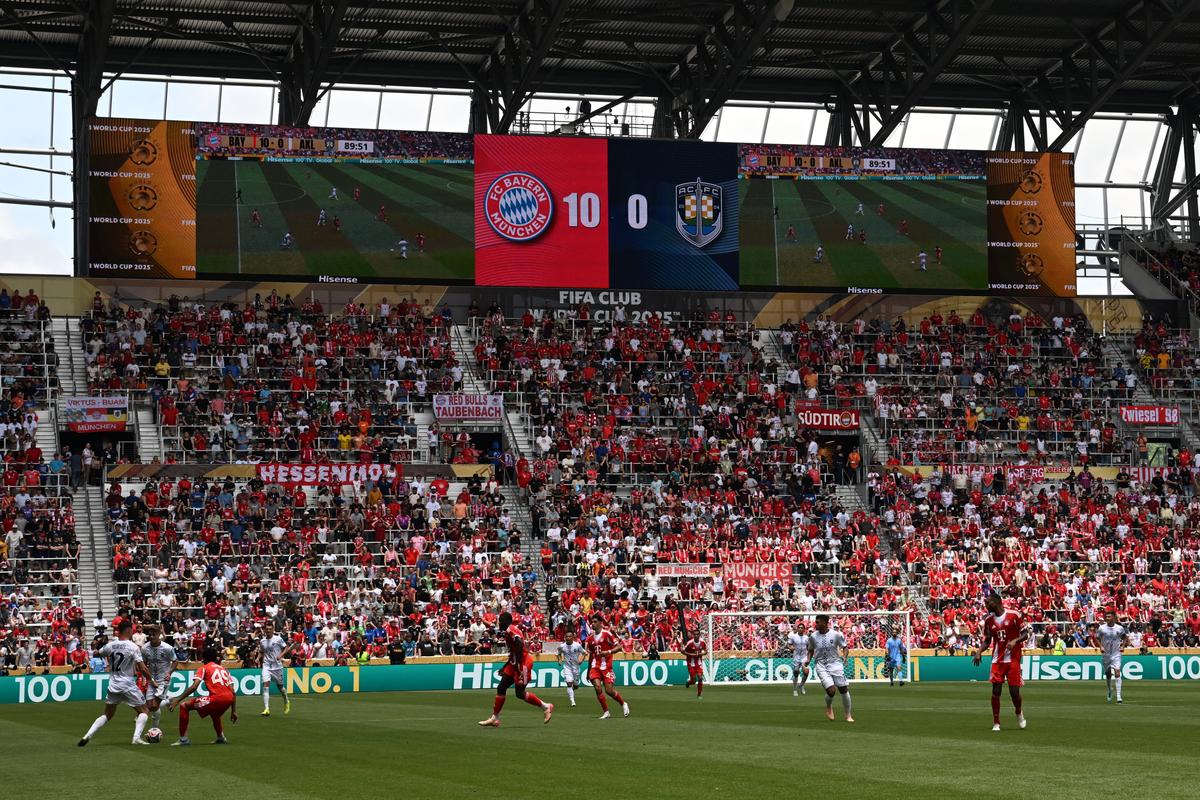
At the FIFA Club World Cup 2025, when Bayern Munich struck 10 goals against Auckland City, there was little tension in the stands. Fans noted the stark difference in quality, and the more devoted ones flocked towards tighter contests instead. | Photo Credit: AFP
At the FIFA Club World Cup 2025, when Bayern Munich struck 10 goals against Auckland City, there was little tension in the stands. Fans noted the stark difference in quality, and the more devoted ones flocked towards tighter contests instead. | Photo Credit: AFP
Walter C. Neale further argued that ‘the demand for competition will decrease if spectators can predict the outcome.’
At the FIFA Club World Cup 2025, several matches lacked that uncertainty. When Bayern Munich struck 10 goals against a meek Auckland City, or Juventus scored five against Al Ain, there was little tension in the stands. Fans noted the stark difference in quality, and the more devoted ones flocked towards tighter contests instead.
The Bayern vs Auckland City match drew 21,152 spectators, compared to the near-capacity crowd of 80,619 for Paris Saint-Germain vs Atletico Madrid. This raises the question of whether an expanded field will follow the same pattern at the 2026 World Cup. Contests like Brazil vs Haiti or England vs Panama raise doubts over whether they can truly live up to the billing. Final group-stage matchdays, often known for producing blockbuster contests, could risk becoming formalities.
Matches with biggest ranking gaps
76: Belgium (9) vs New Zealand (85) – Matchday 3; Brazil (6) vs Curacao (82) – Matchday 2
74: Morocco (8) vs Curacao (82) – Matchday 3
72: Germany (10) vs Curacao (82) – Matchday 1
70: England (4) vs Ghana (74) – Matchday 2
Add travel bans by the United States, and turnouts for lopsided matches could dip further. Haiti and Iran face full bans, while Ivory Coast and Senegal have partial restrictions.
It is also worth noting that blowouts are not new to World Cups: Germany’s 8-0 demolition of Saudi Arabia in 2002 and Portugal’s 7-0 win over North Korea are stark examples. But further expansion risks making such results the norm rather than the exception.
Former German football president Reinhard Grindel had opposed expansion, citing the “considerable weaknesses” highlighted in FIFA factsheets.
“At the DFB, we’re fundamentally convinced that the tried-and-tested model of 32 participating nations should be held,” he had said in 2017.
The paradox of expansion
João Havelange, with Sepp Blatter as General Secretary, oversaw the World Cup’s evolution from 16 to 24 teams in 1982 and then to 32 in 1998.
Spain ‘82 loosened the game: goals per game rose (2.68 to 2.81), but matches lacked balance — El Salvador’s 1-10 loss to Hungary remains one of the most one-sided matches in the tournament’s history.
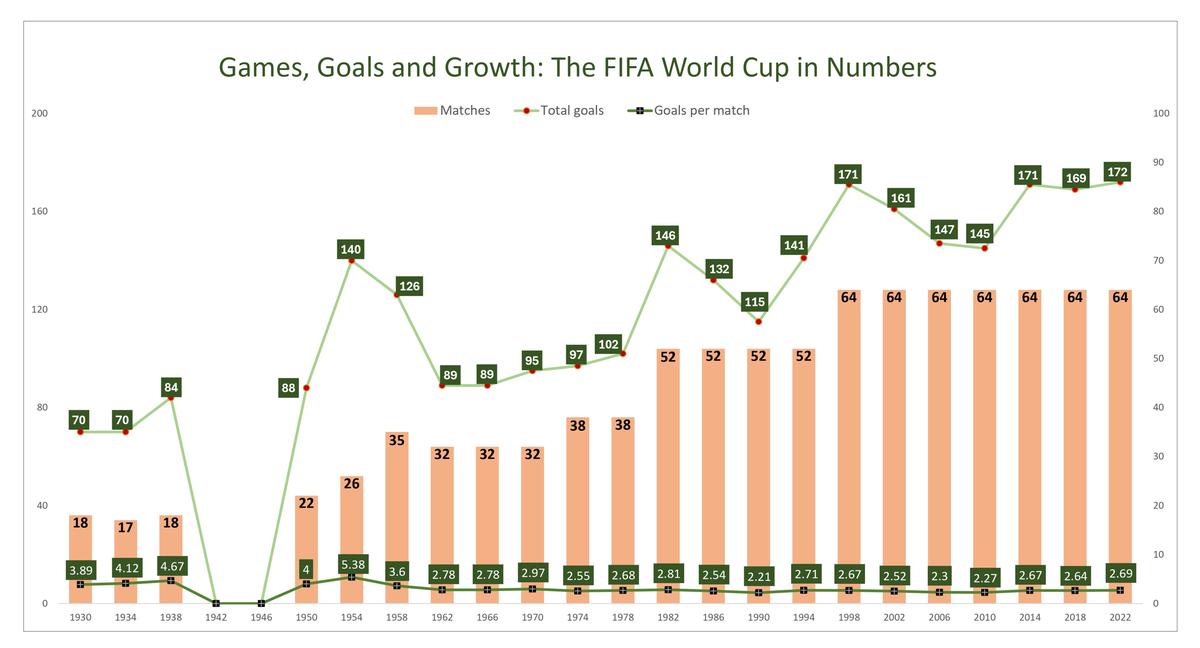
On the other hand, France ‘98 tightened it. Goals per game fell from 2.71 to 2.67 despite an increase in total goals (141 to 171). Margins reduced too — Spain’s 6-1 win felt dominant, not excessive.
Infantino would know that expansion does not follow a script as he looks to build his legacy with a bigger World Cup. 48 teams will play 104 matches over more than a month, with players arriving after gruelling domestic seasons.
The question now is no longer whether expansion is needed — that ship has sailed. What remains is this: at what point does more begin to feel like less?
Published on May 12, 2026