


A boy who could once barely walk has now etched his name in Indian quartermiling history. This is Vishal TK’s inspiring story from Jolarpettai to National Record glory. | Photo Credit: RITU RAJ KONWAR

A boy who could once barely walk has now etched his name in Indian quartermiling history. This is Vishal TK’s inspiring story from Jolarpettai to National Record glory. | Photo Credit: RITU RAJ KONWAR
When he blazed to a 44.98-second finish to win the 400m gold at the Federation Cup in Ranchi on Saturday, KT Vishal re-emphasised a point that track and field observers in India have known for a couple of years now. While Vishal had already held the national record heading into the Federation Cup, the 45-second barrier is one of the marquee landmarks in track and field and, in breaching that mark, the 23-year-old firmly established himself as a generational talent in the Indian quarter-mile tradition.
But Vishal wasn’t always so fast on his feet. As a child growing up in the town of Jolarpettai in Tamil Nadu’s Tirupattur district, there was little to suggest that Vishal would grow up to become one of India’s top athletes.
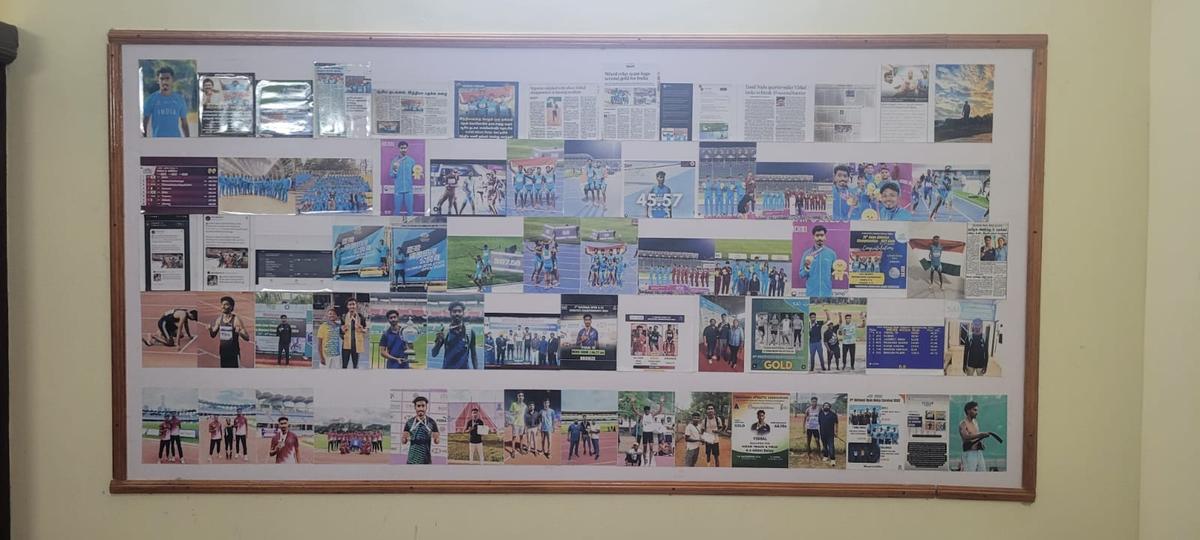
Vishal’s house bears the documentation of a relentless ambition to succeed on the track. | Photo Credit: Special Arrangement
Vishal’s house bears the documentation of a relentless ambition to succeed on the track. | Photo Credit: Special Arrangement
“As a young boy of six, Vishal was a very fussy eater. He was very weak and his knees bowed into each other when he walked. The doctors called it ‘knock knees’,” recalls his father, Thennarasu.
The doctors suggested a dietary regimen to treat the condition, but Thennarasu had a friend who suggested a unique form of physical therapy that, unbeknownst to him, would set the boy on a history-making journey.
“At that time, I used to play football in the evenings at the Jolarpettai mini stadium. When I told one of the coaches there, named John, about my son’s condition, he suggested physical therapy. He would take Vishal to the long jump pit and bury him up to his knees in the sand. Vishal would move around like that and, after a couple of hours, he’d make him run around the ground,” recalls Thennarasu.
Although unusual, the therapy slowly began to work. “Slowly, his knees started getting better. It took nearly six months for his condition to go away. But he didn’t stop after that. He started coming to the ground to practise his running!”
Vishal soon became a regular at the ground and the boy who could barely walk was soon the fastest among all the kids running at the Jolarpettai mini stadium. “They would call him Vishal Bolt!” recalls Thennarasu. More importantly, he became obsessed with running. It was a nickname Vishal relished.
Vishal ‘Bolt’
When he was in Class Four, Vishal says he brought the sprinting legend into his room. “At that time, my dad had a banner-printing business. I went to him and said, ‘ Appa, can you print me a poster of Usain Bolt?’ He printed a very large one and I put it up on the walls of my room. Every time I got up, I saw that poster. I’d make that Bolt pose and dream that one day I would be on a poster myself,” Vishal tells Sportstar.
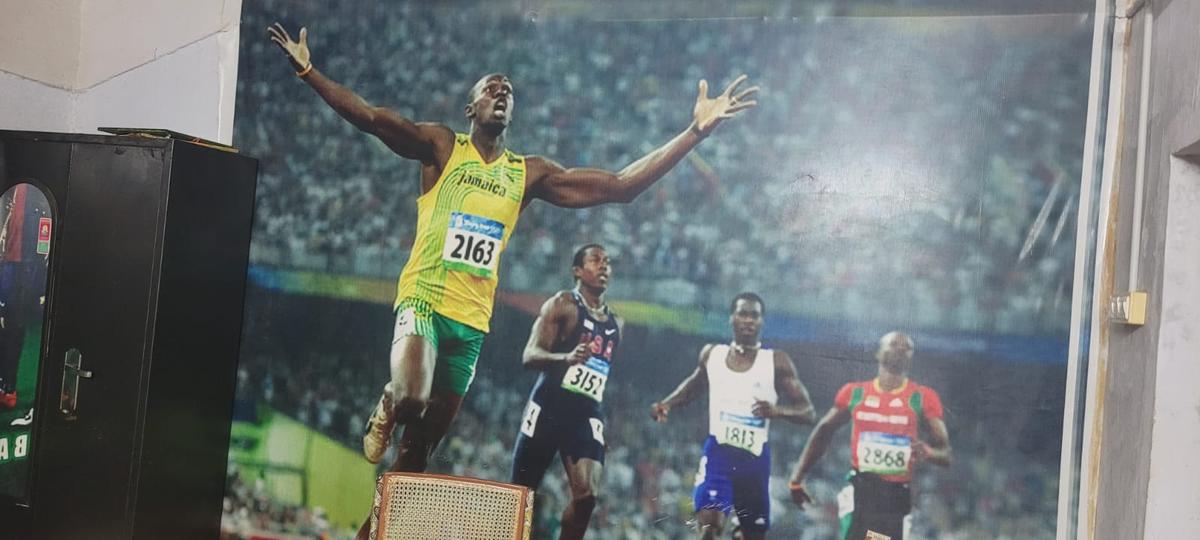
The Usain Bolt poster which drove a class four student’s athletics aspirations. | Photo Credit: Special Arrangement
The Usain Bolt poster which drove a class four student’s athletics aspirations. | Photo Credit: Special Arrangement
Thennarasu encouraged his son’s passion. “I wanted him to become an athlete or some kind of sportsperson because my own father didn’t encourage me. He wanted me to be a good student, but I didn’t really care so much,” he says.
A couple of years after the Bolt poster went up on the wall of Vishal’s room, his father learnt that selection trials were being conducted for the Tamil Nadu State Sports Hostel in Chennai. Competition was stiff. Thennarasu recalls that nearly 700 athletes had turned up, but Vishal got through.
Before he left home to live 200 kilometres away in a vast new metropolis, Vishal remembers his father’s farewell. “My dad told me, ‘You are going to raise the flag for India.’ I knew what the Olympics were, but I didn’t know anything else or what it would take to become an Indian athlete,” he says.
His early days at the hostel were difficult. The environment, far from home, didn’t always suit him. “For me, everything was new. Life was just a routine. It was study, train, study and train. I was very young when I went there and I realised soon enough that I wasn’t suddenly going to become this great athlete,” he says.
Results didn’t always go his way.
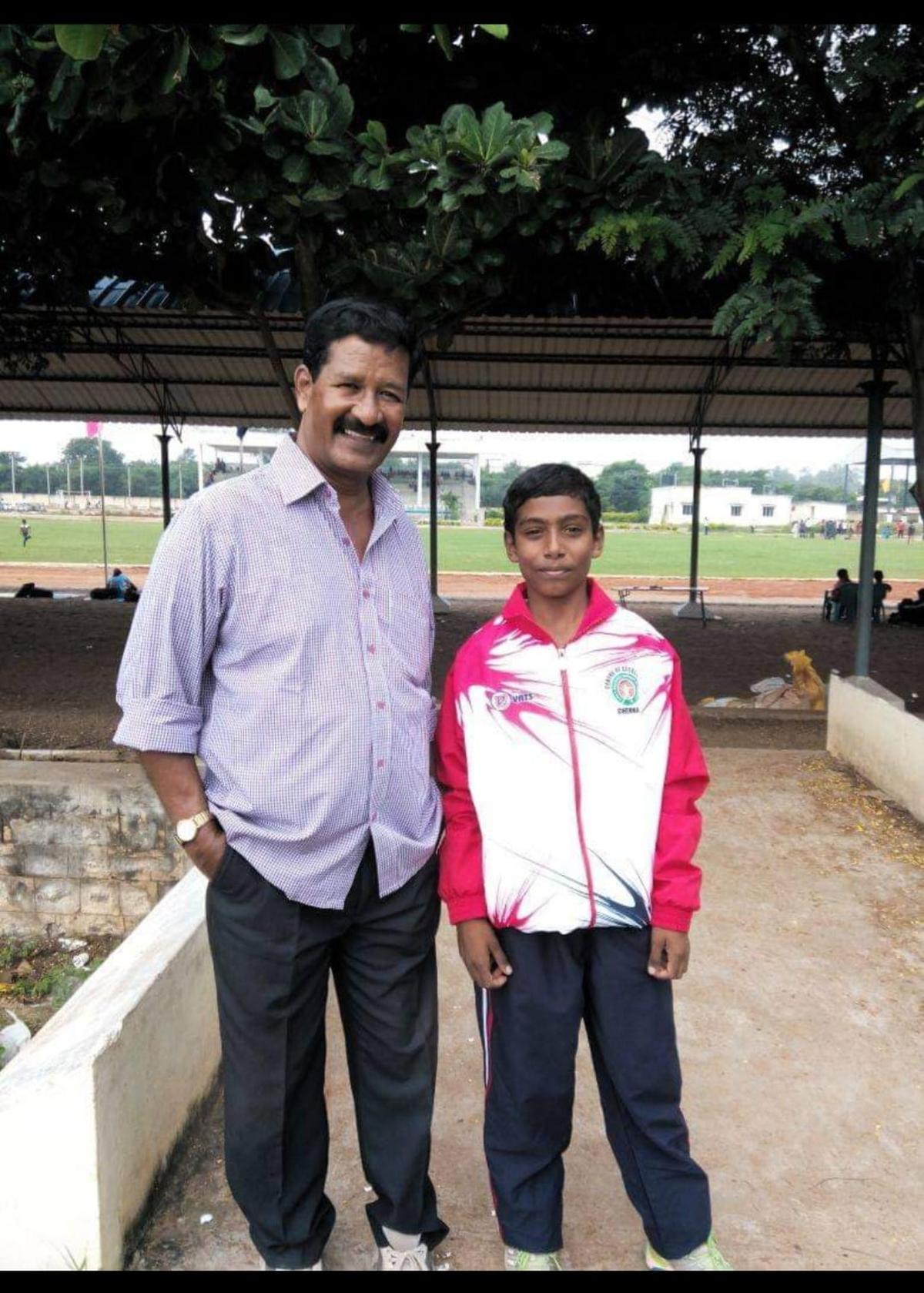
Vishal with coach John who buried him in the sand to try and address his ‘knock knees’. | Photo Credit: Special Arrangement
Vishal with coach John who buried him in the sand to try and address his ‘knock knees’. | Photo Credit: Special Arrangement
“I was just a kid. I only knew about winning or losing. If I didn’t win, I’d just feel bad. I didn’t understand that there’s something more important than winning and that’s improving. I don’t think I was a special athlete then,” he says.
Vishal says his perspective changed when he returned home during the Covid-19 pandemic in 2020. “I was just sitting at home thinking about what I was doing with my life. I wasn’t very motivated. But my family was so encouraging. It made me feel a little ashamed. I was getting so much support from them, but I wasn’t giving anything back. I told myself that when the pandemic eventually got over, I would push myself like never before. I focused seriously on my sprinting,” he says.
Slowly, the results began to reflect the effort he was putting in. In 2022, he won gold in the 200m at the Junior Federation Cup. “That motivated me even more,” he says.
Breakthrough moment
His real breakthrough didn’t come in a race. It came in 2024 when, on the advice of a coach at the National Centre of Excellence in Thiruvananthapuram, where he had been admitted following his junior national title, he switched to the 400m. The move was logical. At 189 cm tall, Vishal’s frame and longer stride length were better suited to the quarter-mile than the short sprints.
“Initially, I didn’t believe I would run as well as I did. But I decided to listen to my coaches. I learnt that I had to be patient and dedicated,” he says.
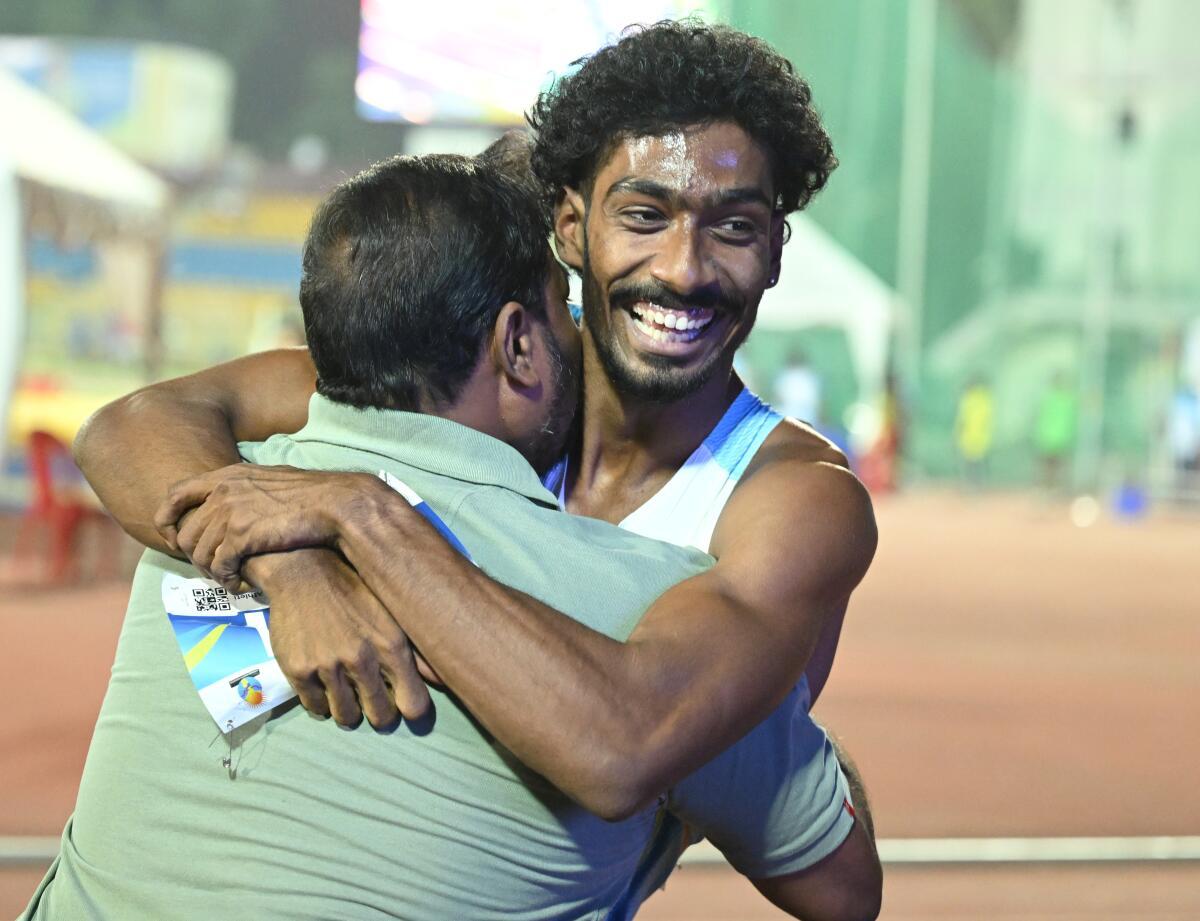
Vishal says his father has always been at the finish line of his races. | Photo Credit: RITU RAJ KONWAR
Vishal says his father has always been at the finish line of his races. | Photo Credit: RITU RAJ KONWAR
The shift wasn’t always smooth. After recording a personal best of 46.77 in 2024, he began his 2025 season by finishing last at the Open Nationals. “People who had started taking notice of me were thinking maybe I wasn’t as good as they had hoped. I was also demotivated,” he says.
But that was when Jason Dawson, the Jamaican-born coach working with the Indian team, pushed him further. “Coach taught me that I couldn’t go out and win every race. It wasn’t about winning all the time, but about winning where it mattered. He told me that if I continued to push myself, I’d win where it mattered,” he says.
Since then, Vishal has had good races and less impressive ones. But he has steadily improved. Each month, fractions of a second were shaved off his 400m timing. A best of 46.77 in 2024 came down to 45.57 at the Asian Championships, where he finished fourth, and that, in turn, was lowered to the new national record of 45.12 at the Inter-State competition in August that year.
That was a new national record and the first person at the finish line to wrap him in a bear hug was his father, Thennarasu. “He travels around the country to watch me compete. There won’t be a single race where he hasn’t been at the finish line waiting for me,” says Vishal.
Thennarasu was waiting at the finish line once again in Ranchi. “It’s a blessing that I get to see my son run such a historic race,” he says.
Published on May 25, 2026
此内容由惯性聚合(RSS阅读器)自动聚合整理,仅供阅读参考。 原文来自 — 版权归原作者所有。