









‘If you can make one heap of all your winnings,
And risk it on one turn of pitch-and-toss,
And lose, and start again at your beginnings …
Yours is the Earth and everything that’s in it …”
Starting from scratch, as Rudyard Kipling wrote in “If,” is often an exercise in uncertainty when building a football team. Failure can send clubs into a spiral. But when it works, it creates a parable of hope, success and joy.
East Bengal, one of India’s most decorated clubs, authored a similar chapter on Thursday. The team was built from scratch thrice, the only Indian Super League (ISL) club to do so. But when the alchemy clicked, it ended a 22-year wait for the national men’s top-flight title.
At the Kishore Bharati Krirangan, as Inter Kashi fell 1-2 to East Bengal on Thursday, the City of Joy turned red-and-gold. Everyone who believed a miracle was possible claimed a piece of it, either by running onto the pitch or weeping profusely in the stands.
A team that had never finished above ninth in the ISL was now champion. But the rise was hardly an overnight success story. Its seeds were sown 19 months ago.
East Bengal’s Super Cup title in 2024 might have ended a 12-year trophy drought, but its predictable set-piece-heavy play under coach Carles Cuadrat barely posed a challenge in the ISL. Oscar Bruzon replaced him, bringing with him a ‘my way or the highway’ approach.
Several key players under Cuadrat, including Cleiton Silva, Dimitrios Diamantakos and Madih Talal, departed, and a new cohort was assembled, one that could be moulded according to Bruzon’s plans.
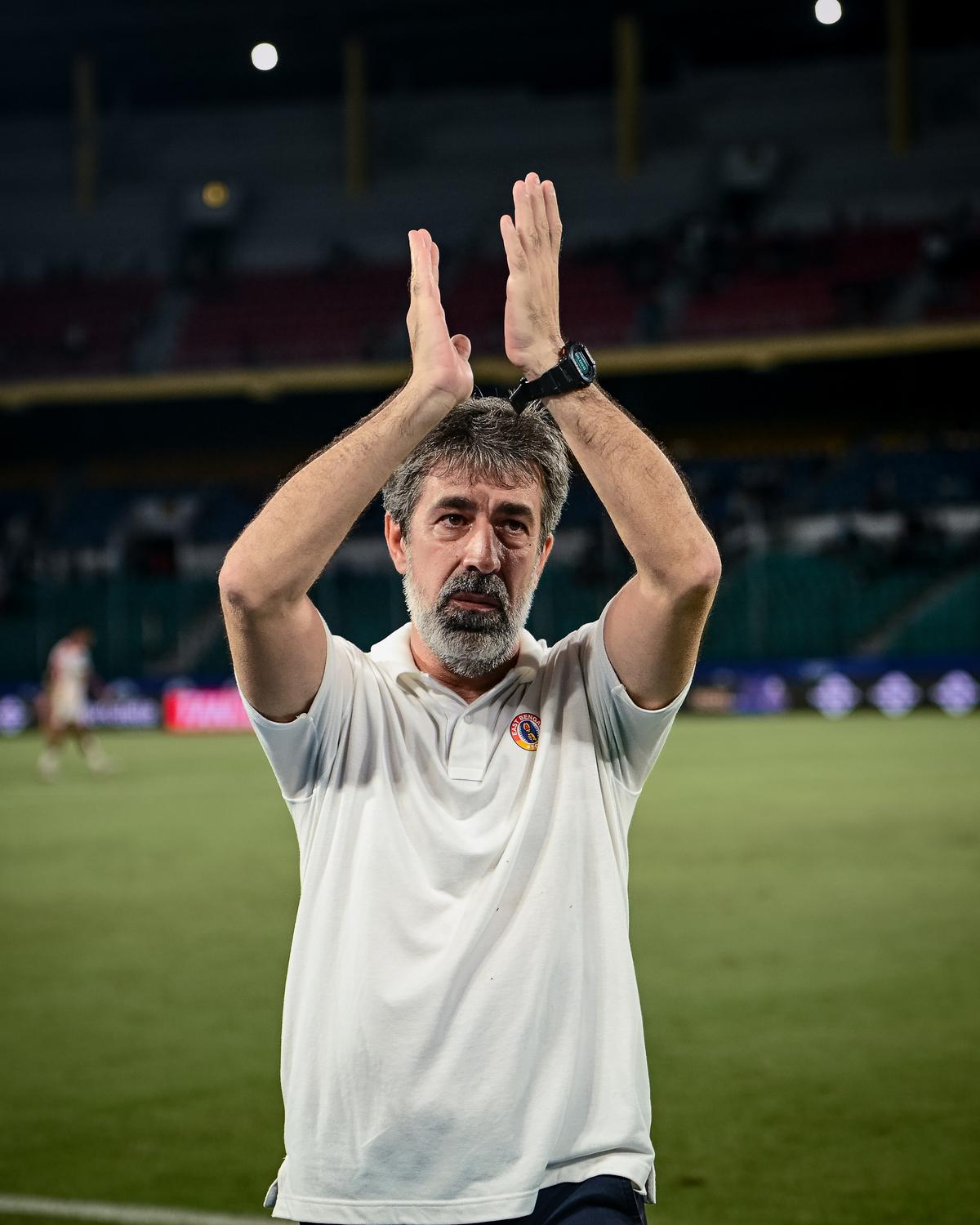
Oscar Bruzon rebuilt East Bengal piece by piece, demanding tactical flexibility, collective belief and what he called a ‘knockout mentality’. | Photo Credit: East Bengal Media

Oscar Bruzon rebuilt East Bengal piece by piece, demanding tactical flexibility, collective belief and what he called a ‘knockout mentality’. | Photo Credit: East Bengal Media
Project reset: Bruzon’s transfers
“When I came here, probably, the team was a bit imbalanced. We were having injuries at the start of the season, the confidence level of players was very, very low,” Bruzon told Sportstar.
“It’s not easy for a coach to be accepted when they were kind of supporting the former coach, a high-profile manager who did very good things in India. Even all the coaching staff were on his side. Many of the players were chosen by him. So for me, it was not easy,” he added.
The Spanish manager had broken Abahani Dhaka’s long-standing dominance in the Bangladesh Premier League, winning back-to-back titles with Bashundhara Kings. At East Bengal, he brought in the talisman from that side, Miguel Figueira.
Diamantakos, despite steering East Bengal to a win in the Kolkata derby, parted ways with the club, with Hamid Ahadad replacing him as the No. 9. However, uncertainty around the ISL saw Ahadad make way for Youssef Ezzejjari.
Figueira and Ezzejjari became the side’s attacking axis, while the triumvirate of Mohammed Rashid, Kevin Sibille, both new signings, and Saul Crespo controlled midfield and defence.
“In my humble opinion, they (East Bengal) have the best squad in their history of ISL. Mumbai City, Jamshedpur, FC Goa and Punjab, teams which were in contention for the title, don’t have a better squad than East Bengal,” Sergio Lobera, Mohun Bagan Super Giant’s head coach, said.
Figueira, with two goals and four assists, won the Golden Ball for best player, while Ezzejjari bagged the Golden Boot with 11 goals. Rashid, meanwhile, netted the winner that sealed the title against Kashi.
On-field strategy: Fluid formations
Unlike Cuadrat, who preferred a conventional 4-3-3 with heavy reliance on set pieces, Bruzon kept opponents guessing. Be it a 4-5-1 in the ISL opener, a 4-4-2 against Sporting Club Delhi or a counterattacking 3-4-3 against Odisha FC.
“In India, people like to talk a lot about formations and systems; it seems that without them, you can’t win games. I’m radically against this idea … In one game, we can use five or six different formations or systems, and that depends on the players on the pitch,” Bruzon said.
“Depending on their chemistry, their movement and on what we need to do in that particular moment of the game, we use one formation or another. Our system for defence is not the same as that for our attack.”
That flexibility depended heavily on constant repetition in training.
Perhaps East Bengal’s biggest advantage was a regular pre-season and a fixed core, irrespective of the ISL’s uncertain calendar. At a time when Bagan suspended first-team operations, East Bengal continued, laying the foundation for tactical flexibility.
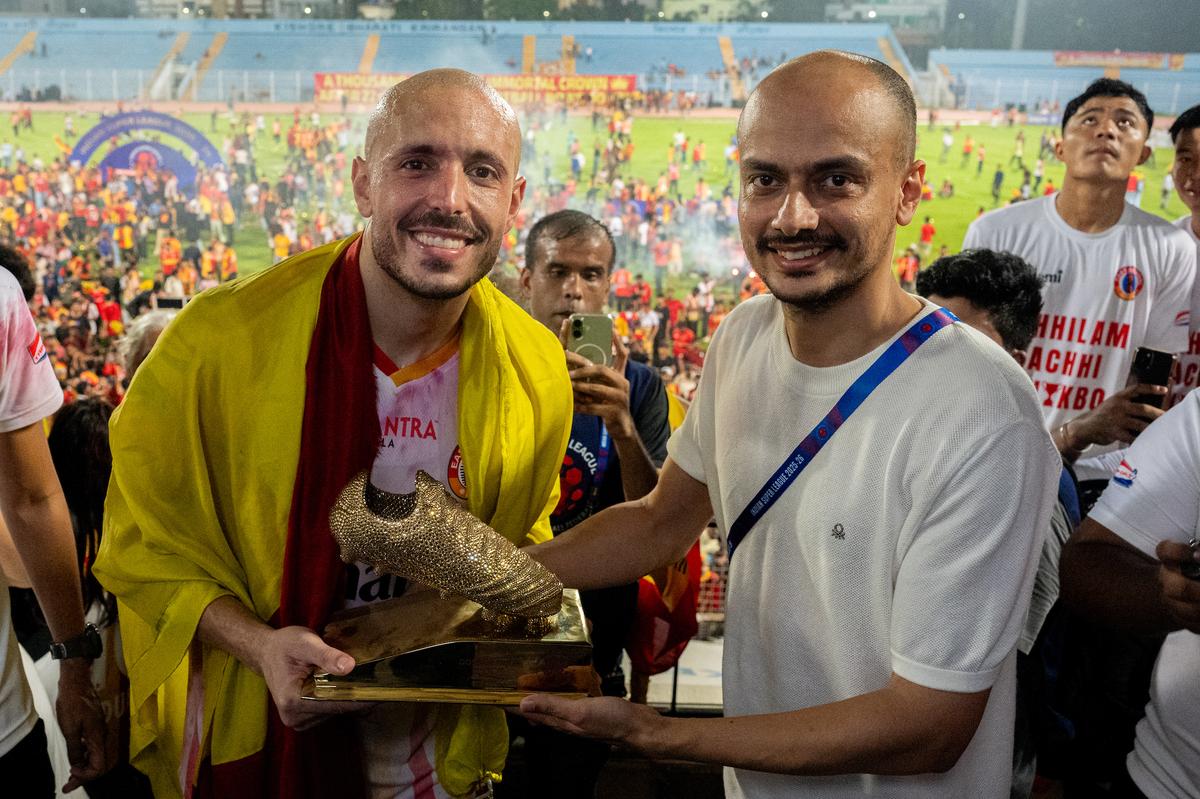
East Bengal’s Youssef Ezzejjari topped the ISL 2026 goal-scoring charts with 11 goals. | Photo Credit: East Bengal Media
East Bengal’s Youssef Ezzejjari topped the ISL 2026 goal-scoring charts with 11 goals. | Photo Credit: East Bengal Media
The 2025-26 season also presented a strange challenge: no second chances. In a truncated single-leg campaign, every match carried the potential to derail title hopes, making planning and execution pivotal.
Several clubs also released their foreign players. The three teams that retained their core squads, East Bengal, Bagan and Mumbai City, finished in the top three.
Bruzon, despite keeping his cards close to his chest, established control over both planning and execution, with his side losing just once in 13 league games. “The line-up and formation? You’ll definitely know, but tomorrow,” became one of his favourite phrases during pre-match press conferences.
Yet after games, particularly the Kolkata derby, he would explain every tactical detail with remarkable clarity.
“Mohun Bagan likes positional players and not vertical players. So, we had a plan to try to trouble their defenders. It worked very well because we created a lot of vertical openings, and they were suffering at the back. So I think that the plan was perfect,” Bruzon said after the 1-1 draw against Bagan, where his side created at least four clear chances against the run of play before Edmund Lalrindika eventually scored.
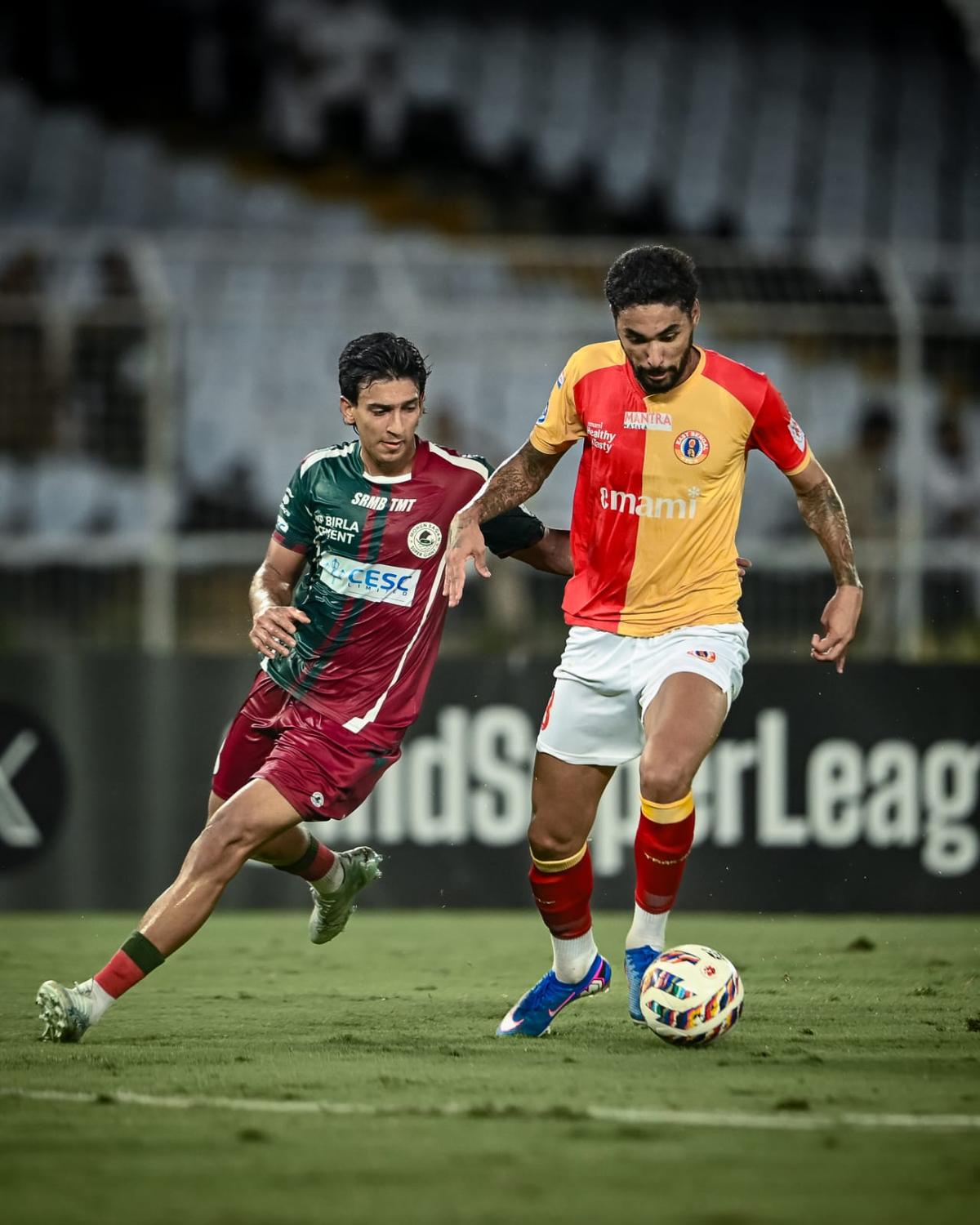
East Bengal and Mohun Bagan players clash during another high-intensity Kolkata derby in a season that ended with the red-and-gold brigade crowned champion. | Photo Credit: East Bengal Media
East Bengal and Mohun Bagan players clash during another high-intensity Kolkata derby in a season that ended with the red-and-gold brigade crowned champion. | Photo Credit: East Bengal Media
Off-field exploits: The collective over the individual
For legacy clubs like East Bengal, one of the biggest challenges lies in handling the noise: media chatter, comments from former players and the constant pressure of keeping the dressing room together.
Bruzon often hit back at critics, whether in press conferences or personal interviews. Beyond the dressing-room walls, though, he ensured the squad remained aligned with his vision.
“A coach, at times, has to be a psychologist. We often had players out with suspensions or injuries … but when the players do badly, they need love and confidence,” Bruzon explained.
“We put a lot of effort into making our players feel like a team. Many people say, ‘We are a family.’ But it’s not a word, it’s an attitude. One of the things that we do is make a lot of rotations, giving a chance to everybody. When you have a full squad connected to the game, you can get the best from everyone.”
The contingent also set realistic targets: not the title, but a place in the top six.
“Keeping in mind the seasons before, it’s hard to go from lower positions in the table to all the way to the top. Sometimes, it happens, but normally, you work step by step. It’s a process. We have to trust in it, and it is always game by game,” Mohammed Rashid, who scored the winner against Kashi, said.
Bruzon also stressed what he called a ‘knockout mentality’, an unwillingness to throw in the towel. East Bengal earned 12 points from losing positions in the ISL this season, including a 3-3 draw against Bengaluru and the title-winning match against Inter Kashi.
Without those points, it would have finished ninth again, the same position it occupied last season.
An extended pre-season and a consistent core under Bruzon eventually bore fruit: runner-up finishes in the Super Cup and the IFA Shield, along with an unbeaten record against Bagan in regulation time throughout the 2025-26 season.
Boardroom pressure, however, eventually caught up with Bruzon in the final few rounds, as he decided to walk away at the end of the season.
And in the final match, the wizard, alongside his comrades, made one heap of all his winnings, risked it on one turn of pitch-and-toss, and emerged on the winning side, finally becoming champion of India.
Published on May 22, 2026