







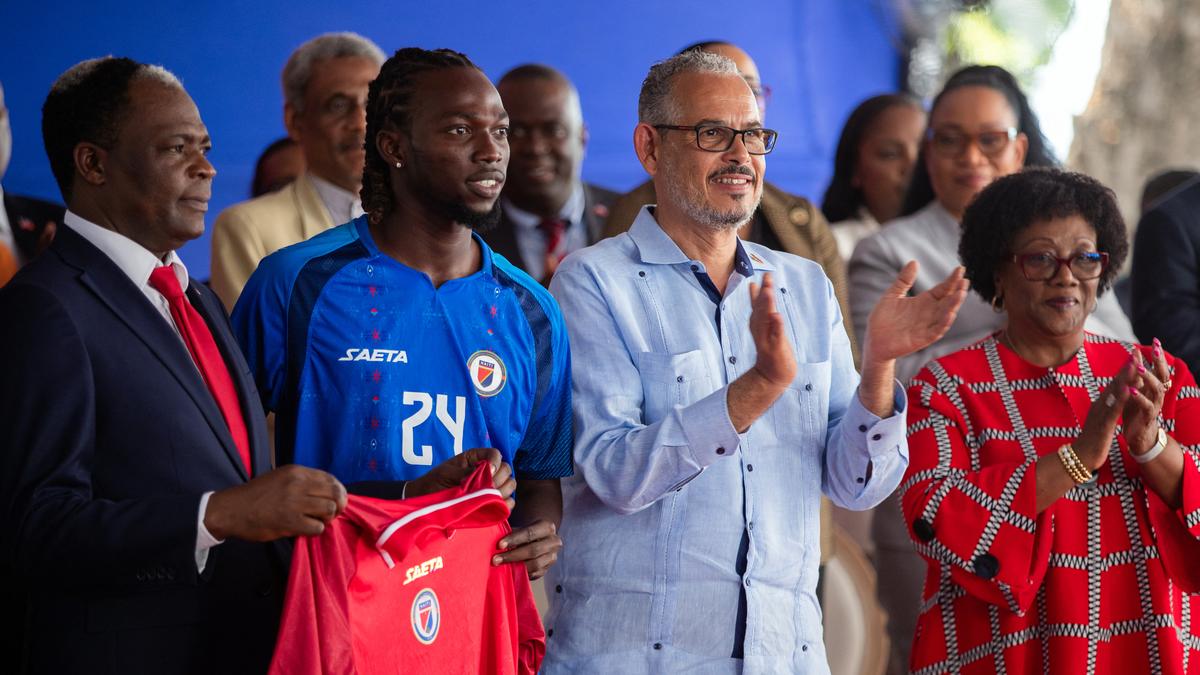
Haitian Prime Minister Alix Didier Fils-Aime (2nd-R), its football federation (FHF) president Marie Monique Andre (R), sports minister Pythagore Dumas (L) and player Woodensky Pierre pose for a photo. | Photo Credit: AFP

Haitian Prime Minister Alix Didier Fils-Aime (2nd-R), its football federation (FHF) president Marie Monique Andre (R), sports minister Pythagore Dumas (L) and player Woodensky Pierre pose for a photo. | Photo Credit: AFP
The only member of Haiti’s national football team who is based in the troubled Caribbean country is awaiting a U.S. visa to join the squad in Florida just weeks before the start of the World Cup.
Woodensky Pierre is a defensive midfielder who plays for Violette AC in Haiti’s capital, Port-au-Prince. An estimated 70 per cent of that city is under siege by violent gangs.
The other 25 players on the World Cup squad play outside the country, coming from leagues in places like England, France, Portugal, Canada and the United States.
This year’s World Cup will be only the second for Haiti in its history — the country’s only other appearance on football’s biggest stage was in 1974.
Haitian football federation spokesman Thecieux Jeanty said all but one player on the 1974 World Cup team was living and playing in Haiti at that time.
The U.S. visas for Pierre and nearly a dozen other officials with the Haitian federation have yet to come through as the administration of U.S. President Donald Trump continues to expand travel restrictions from certain countries.
Pierre continues to train at a field with synthetic grass in Pétion-Ville, an upscale area of Port-au-Prince, as he awaits his visa "in hopes of being with his team as soon as possible", Jeanty told The Associated Press in a phone interview on Wednesday.
“I hope he doesn’t have to live in (Haiti) after the World Cup,” Jeanty said. “It’s an opportunity to present himself to the world and await a contract.”
READ: South Africa squad for FIFA World Cup 2026: Two uncapped players named—Check full list
The team’s home stadium in Port-au-Prince — not far from the neighbourhood where Pierre is from — was deemed too dangerous, forcing Haiti to play its “home” World Cup qualifiers in Curaçao.
Pierre is from Cite Soleil, a seaside slum that has endured violence and hunger for years and serves as a base for powerful gang leaders. Cite Soleil has seen multiple massacres and gang rapes, with violence recently displacing more than 5,300 people, according to the latest report from the U.N.’s International Organization for Migration.
“It’s a source of pride for him,” Jeanty said of Pierre being able to play in the World Cup. “It’s satisfying for (football) officials and for the public, too. As you know, Haiti is in crisis.”
Pierre did not return messages seeking comment, and neither did the team’s coach.
Officials for Haiti’s squad arrived in Florida on Sunday, and players began training in Port St. Lucie on Tuesday. Three other players are scheduled to arrive on Wednesday, Jeanty said.
There is still time to resolve Pierre’s situation. Haiti will play two World Cup warmup matches, first against New Zealand on Tuesday and then against Peru on June 5, in South Florida.
ALSO READ: Neymar misses Brazil’s first training session ahead of FIFA World Cup 2026
Haiti opens World Cup play on June 13 in Foxborough, Massachusetts, against Scotland, then plays five-time champion Brazil on June 19 in Philadelphia and Morocco on June 24 in Atlanta.
Jeanty said he first made contact with Pierre in 2022, when they travelled together to Honduras for an under-20 match.
“I saw him as a top-level player,” Jeanty said, adding that “everybody’s very happy” to have Pierre on the team.
“There is soccer in Haiti,” Jeanty said. “It’s a country that wants to live.”
Published on May 28, 2026
此内容由惯性聚合(RSS阅读器)自动聚合整理,仅供阅读参考。 原文来自 — 版权归原作者所有。