


Wipro has acquired Mindsprint as part of a $1-billion-plus transformation deal with Olam Group, seeking to lock in long-term, annuity-style revenue and deepen domain capabilities. Analysts said this signals a shift towards large, outcome-led engagements amid slowing industry growth.
Wipro, on Monday, secured a multi-year strategic transformation deal with Olam Group, a Singapore-based food and agri-business with over $50 billion annual revenues. The eight-year engagement is expected to exceed $1 billion in contract value, with a committed spend of $800 million.
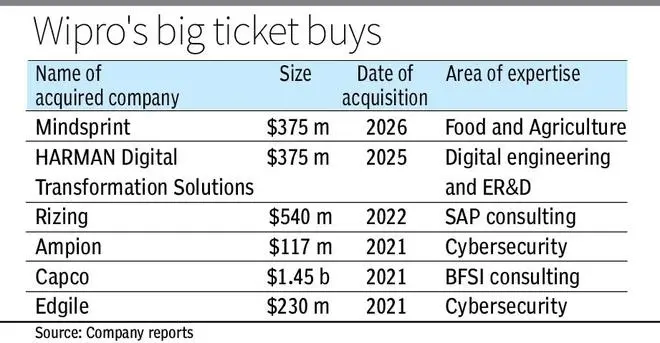
As part of this deal, Wipro will acquire Mindsprint, Olam Group’s IT services arm, for $375 million in an all-cash deal. The transaction is expected to be completed by June 30.
Mindsprint has a global workforce of over 3,200 employees across India, Singapore, the US, UK, and Middle East. It has strong food and agri-business domain experience, supply chain transformation capabilities, and proprietary IP-driven solutions. Mindsprint’s consolidated revenues for CY25 were $135.6 million.
Deepening domain knowledge
According to sources close to the company, the acquisition gives Wipro a strong revenue visibility, with over $100 million annually from Mindsprint, translating to roughly $1 billion over eight years.
“With this acquisition, Wipro gets the expertise and domain knowledge of the food and agri supply chain business. Mindsprint brings the domain knowledge from years of working with Olam, and Wipro has the scale, operational efficiency, as well as the capability to run larger operations. That is broadly the rationale behind this acquisition,” the sources observed.
Alongside, other sources close to the deal said that they do not expect any personnel-related changes or disruptions due to the transaction, at the moment.
While Mindsprint started as a captive of Olam, the latter is well diversified, serving sectors such as manufacturing, life sciences, retail and CPG, BFSI, and logistics.
“This acquisition signals that Wipro wants to compete on domain knowledge and AI-led transformation, not just on cost and headcount. For a company that has struggled with growth, landing a deal of this size also helps change the market narrative around its ability to win large engagements,” said Gaurav Vasu, CEO and Founder, UnearthInsight.
Per UnearthInsight estimates, IT companies are expected to spend $6.5-7 billion on acquisitions in FY27, up from $5 billion last year, with the deal count rising from 25 to 30-35. Average revenue multiples are also expected to inch up to 3-3.5x from 2.5x in 2025, suggesting buyers are willing to pay more for the right assets.
This wave of acquisitions is driven by cyclical pressures and structural shifts in IT services.
Organic growth has slowed, with UnearthInsight projecting 3-4 per cent growth in FY26. In this backdrop, acquisitions offer a faster, more predictable path to expanding capabilities and revenue.
“Wipro’s $1 billion Olam-linked deal reflects a deliberate pivot toward large, annuity-style contracts when its revenue growth has lagged peers in the low single digits. By integrating a client’s captive IT arm, Wipro is locking in multi-year visibility while moving up the value chain into platform ownership and domain-led services,” Anuj Badjate, Managing Director, Badjate Stock shares, explained.
With discretionary spending under pressure, acquiring capabilities in AI, cloud, and digital engineering offers a faster route to growth than building them organically.
Pareekh Jain, Founder and CEO of EIIR Trend, noted that such acquisitions indicate that IT services firms look to build capabilities across geographies, industries, and service lines amid slowing demand and softer valuations. Many smaller firms are open to exits, creating buying opportunities.
“These deals are increasingly tied to large transformation programs, where vendors take on client teams or GCCs as part of the engagement. Billion-dollar deals typically involve rebadging employees, expanding scope, and extending contract duration in exchange for better pricing and outcomes. This also highlights a growing trend: while GCCs have expanded in recent years, those that fail to scale are becoming acquisition targets within transformation deals,” he said.
(with inputs from Sindhu Hariharan)
Published on April 6, 2026