









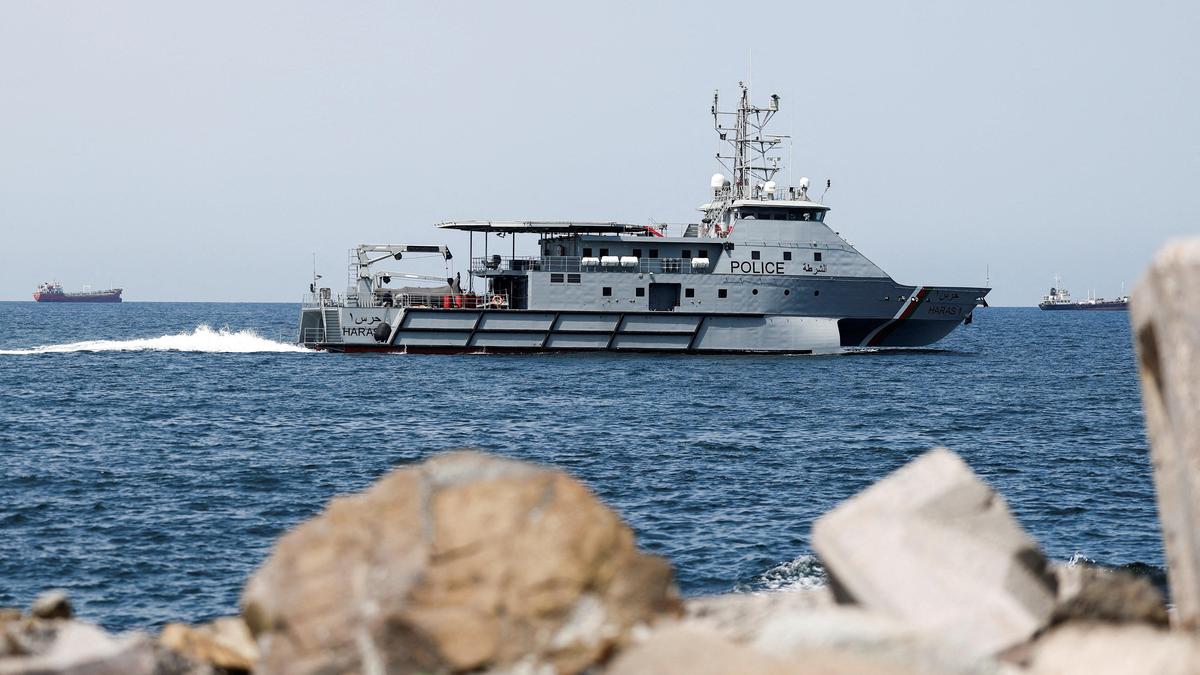
WARY WATERS. Many ships avoid the Strait of Hormuz as the US-Israel war with Iran rages around it | Photo Credit: BENOIT TESSIER
India’s general insurance sector is feeling the heat of the ongoing US-Israel war with Iran, with the conflict spilling over to multiple countries in West Asia.
Shipping activity in the Strait of Hormuz — a vital corridor — has been disrupted and oil shipments remain largely blocked after several tankers were damaged by Iranian strikes. The attacks on ships traversing the Strait of Hormuz has led to a spike in war-risk insurance premiums for marine hull and cargo, as also claims risk. The available insurance capacity has tightened.
Insurance companies have been reassessing marine risk coverage case by case, factoring in vessel routing, ports involved and reinsurer positions.
Primary insurers are either carrying more net exposure or reducing lines on vulnerable voyages.
Where cover is being extended, premiums are aligned with the heightened exposure.
In the first week of March, GIC Re, India’s largest reinsurer, and several major global reinsurance companies issued cancellation notices for the coverage of marine hull and cargo war risks under facultative contracts in certain high-risk zones. The domestic reinsurer continues to cover risk under treaty.
The reinsurance covers for marine hull and cargo war risks under facultative contracts have been restored in most cases now, but at substantially higher rates with increased risk exposure.
War-risk marine hull premiums have largely surged by 300-400 per cent, and quotations are now often valid for only 24–48 hours, given how quickly conditions change, industry sources told businessline.
In a bid to provide relief to shipping lines and cargo owners in this difficult period, the Central government plans to create a ‘Bharat Maritime War Risk Pool’ of $500 million to $1 billion. The government would act as the reinsurer to this pool.
The pool would be available for four to six months initially, but is expected to be extended to meet future contingencies. It may cover protection and indemnity (P&I) liabilities of war risk exposure for Indian vessels and cargo transiting the Strait of Hormuz, according to sources close to the development.
The pool would be on the lines of the Marine Cargo Excluded Territories (MCET) pool, which was formed in 2022 for Russian crude transits in the wake of the Russia–Ukraine war and related sanctions. Managed by GIC Re, it ensures continuity of cover for the Indian insured.
“For our company, the treaty cover with our reinsurer for marine hull and cargo war risks continues because treaties are annual contracts. For facultative contracts, which are on per risk basis, the reinsurers served notices of cancellations, but reinstated them wherever requested, albeit at a higher additional premium,” a top official of a large general insurance company said.
“Global reinsurers have adjusted their positions in high-risk regions. We continue to support clients by administering cover and reducing customer risk exposures. We are reviewing risks voyage by voyage, ensuring that, wherever viable, cover is extended with appropriate terms and premium. This balances prudence with customer support,” said Amarnath Saxena, Chief Technical Officer-Commercial, Bajaj General Insurance.
“Insurers have revised rates to reflect current exposures for hull and war risk, while cargo war cover is offered separately at additional rates. These adjustments ensure sustainability of cover and continued protection for clients even in challenging circumstances,” he added.
Aviation war coverage remains available so far and is being monitored in line with global market developments.
According to Hari Radhakrishnan, an expert from Insurance Brokers Association of India (IBAI), even before the current conflict, West Asia was a high-risk area and insurance rates for marine hull coverage were 0.2-0.5 per cent of the valuation of a ship. “Now the rates have risen to 2-3 per cent. So, we can say 300-400 per cent increase,” Radhakrishnan said.
“Many shipping companies have declared a force majeure, and are cancelling the contract of carriage. They are discharging cargo at the nearest ports and asking consignees to take delivery on their own,” he said.
Gaurav Agarwal, Head-Marine Specialities, Prudent Insurance Brokers, said Indian insurers are either restricting coverage or charging additional premiums for shipments to high-risk areas, where protection must be bought back.
“If an airline or lessor wants affirmative war cover (for instance, for flights over exposed airspace), it must be added through endorsement and carries a steep extra premium — again with very short quote validity, when available,” he explained.
Notably, health and motor insurance together account for more than 70 per cent of the country’s non-life insurance premiums, while marine and aviation are at around 2 per cent and growing gradually.
“Conflict around the Strait of Hormuz has sharply increased war-risk premiums, claims risk, and reinsurance withdrawal, raising costs and reducing profitability, especially for marine hull and cargo,” said Sanjay Agarwal, Senior Director, CareEdge Ratings.
Given the huge risks and high volatility in the marine and aviation sectors, insurers typically cede a substantial portion of the underlying risk to reinsurers, to limit their net exposure.
“As a significant share of the risk is reinsured, any net claims devolving on insurers would remain modest and unlikely to materially affect their profitability or net worth,” Neha Parikh, Vice President and Sector Head-Financial Sector Ratings, ICRA, pointed out.
Published on March 16, 2026
此内容由惯性聚合(RSS阅读器)自动聚合整理,仅供阅读参考。 原文来自 — 版权归原作者所有。