惯性聚合 高效追踪和阅读你感兴趣的博客、新闻、科技资讯
阅读原文 在惯性聚合中打开

推荐订阅源

T
Threat Research - Cisco Blogs
OSCHINA 社区最新新闻
OSCHINA 社区最新新闻
The Register - Security
A
About on SuperTechFans
Cyber Security Advisories - MS-ISAC
L
LangChain Blog
N
Netflix TechBlog - Medium
量子位
博客园 - 三生石上(FineUI控件)
宝玉的分享
宝玉的分享
H
Help Net Security
D
Docker
D
DataBreaches.Net
T
Tailwind CSS Blog
阮一峰的网络日志
阮一峰的网络日志
B
Blog
博客园 - 聂微东
Apple Machine Learning Research
Google DeepMind News
The Cloudflare Blog
F
Full Disclosure
GbyAI
GbyAI
F
Fortinet All Blogs
Last Week in AI
Last Week in AI
Y
Y Combinator Blog
人人都是产品经理
人人都是产品经理
Recent Announcements
博客园 - Franky
MongoDB | Blog
MongoDB | Blog
有赞技术团队
有赞技术团队
博客园 - 叶小钗
小众软件
小众软件
V
Visual Studio Blog
月光博客
月光博客
Stack Overflow Blog
Stack Overflow Blog
The GitHub Blog
The GitHub Blog
Recorded Future
Recorded Future
J
Java Code Geeks
雷峰网
雷峰网
P
Privacy & Cybersecurity Law Blog
C
Cisco Blogs
C
Cyber Attacks, Cyber Crime and Cyber Security
AWS News Blog
AWS News Blog
Webroot Blog
Webroot Blog
美团技术团队
N
News | PayPal Newsroom
G
Google Developers Blog
Security Archives - TechRepublic
博客园_首页
V
Vulnerabilities – Threatpost

Latest BL Data Stories News, Business, Economic Data Stories - BusinessLine | The HinduBusinessLine

Mega IPOs do not always deliver The quick-commerce battle The biggest World Cup yet India is largest source for immigrant founders of US unicorns, but still not shooting for the stars South Korea records high FPI outflows of $69 billion in 2026, followed by India with $26 billion Health insurance coverage crosses 60% of households, NFHS How AT1 bond issuances have hit a rough patch since 2025 Nifty-50 valuation faces test as global capital chases faster earnings growth RBI balance sheet expanded 21% in FY26 led by rising gold valuation Gender parity in government services still a long way away Infrastructure project additions surge in Q4 FY26 led by highway projects RBI records highest-ever dollar sales to defend rupee in FY26 India sees 15% jump in education loans, touches decade-high ₹8.58 lakh crore in FY26 Fuel price hikes renew focus on high state taxes on petrol and diesel Stolen identities fuel cyberattacks Quick-commerce firms spend ₹98-100 per order despite increasing dark stores, says Bernstein research IPL economy AI apps, UPI drive India’s digital shift Gold bars and coins make up 41% of gold demand in January-March 2026 How FIIs and DIIs are taking opposing positions Southern States recorded inflation above national average in April 2026 Gold held by Indian gold ETFs up 79% in the past year India’s forex reserves contract 5% since March, one of the highest among oil importing EMs Tamil Nadu’s winners: Youngest and wealthiest Profile of the whistle brigade SIR impact on close contests: How sub-10,000 margins reshaped the electoral map Indian firms boost global acquisitions to $17.3 billion led by Sun Pharma deal External commercial borrowings fall 25% in FY26 amid currency risks, shift to domestic funding Gaps in financial maturity Palash Rana tops wealth chart in Bengal Phase 2 with ₹104 crore-plus assets Snowballing of debt Vijay the second richest candidate in TN polls with ₹648 crore; Leema Rose Martin leads with ₹5,800 crore Tamil Nadu under DMK: Rich but indebted POSH complaints edge higher, but experts fear significant underreporting Three terms of Trinamool Congress: Stagnation follows initial growth West Bengal Assembly Polls Phase 1: AITC tops crorepati candidates Nifty 50 outperforms peers during West Asia shock, remains over-valued Nari Shakti: What is the share of women in parliament & assemblies? IP registrations see sharp swings Inherent strength: Company additions soar to decade high in FY26 Women voters powered high turnouts in Assam, Keralam and Puducherry polls India powers into nuclear Stage II LDF: Losing the plot? Tamil Nadu elections 2026: Big ideas, bigger pledges Kerala Polls 2026: Reji Cheriyan tops rich list with ₹218 cr assets Assam’s financial and social scorecard Rahul Roy and Mohammed Badruddin Ajmal are the wealthiest candidates in Assam assembly election India Inc steps up CSR spend Unrealised tax demands rise to ₹38 lakh cr by FY25-end Normalisation phase slowed PNG capacity growth to 2.23% in FY25 Redefining identity and access Why the reduction in SED Whistle-blower complaints rise across private banks in FY25 India close to rock-bottom in happiness rankings Rupee’s continuing decline takes real effective exchange rate to 12-year low Large lenders rein in retail loan GNPAs in FY26 LNG crisis Ongoing war set to impact ODI flows into UAE Strategy of poll-bound States: Cash transfers to woo women India’s external debt at a more comfortable level compared to previous balance of payments crises Women at the Oscars IndiGo dominates pilot count, but SpiceJet stands out on pilot-to-aircraft ratio How smartphones became India’s largest export category in 2025 Growing vulnerabilities US-Iran war & Oil Shocks More women taking charge of investments Services exports gain ground as merchandise trade loses momentum Largest States show variations in growth and recovery post GST 2.0 Share of NOTA slightly higher in State Assembly election in 2025 Conflict zones Growth in bank credit to micro and small industry at 29.2% in first 10 months of FY26 Outward remittances under LRS decline for second straight year in FY26 Indian student growth to the US slows by half amid cost and visa pressures UPI versus cash Digital payments growth moderates to 11%, as adoption matures SC ruling highlights the chasm between official records and ground reality in menstrual health and hygiene in schools Nifty50 firms hit by ₹13,161 cr as labor codes raise employee costs Number of transactions under Direct Benefit Transfers decline sharply in FY26 States’ devolutions at 39% trail Finance Commission’s vision of 41% Indian airlines face rising compensation amid losses India’s crude import bill to rise as Russian crude still cheaper by 7 to 12 per cent compared to US and gulf suppliers Debt crisis in advanced economies Measuring the impact of women-centric policies US-India trade deal to lift tariff-hit export sectors Sixteenth Finance Commission: Slight course correction but not a paradigm shift Budget buzzwords map shifting priorities Feeling the heat Not much on the plate for farmers Mission AI Solar powered renewable transition Lacklustre show by indirect taxes More needed for employment PSU dividends take the lead Good momentum on flagship schemes Direct taxes hit Subsidy bill weighs on the Budget Stress in State finances Contours of the landmark India-EU FTA Transmission of rate cut only half complete in public sector banks Republic Day at a glance
NRI deposit inflows fall 16% in FY26 due to weak rupee
2026-02-26 · via Latest BL Data Stories News, Business, Economic Data Stories - BusinessLine | The HinduBusinessLine

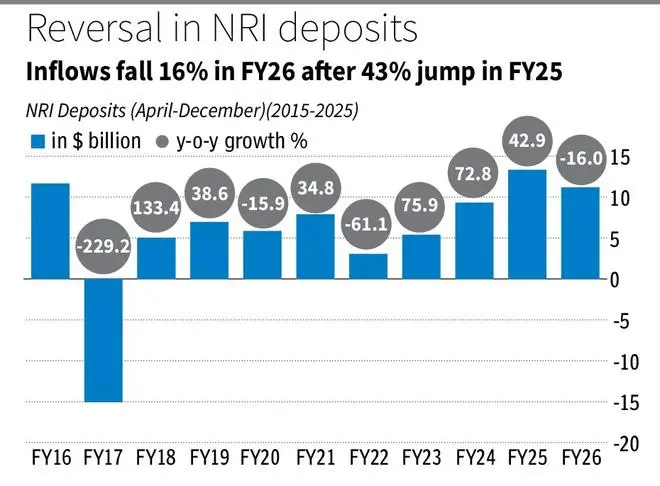
NRI deposit inflows declined 16 per cent to $11.20 billion during April-December FY26, reversing a sharp 42.8 per cent surge to $13.33 billion in the corresponding period of FY25.

The moderation comes after two years of strong growth. Inflows had risen 72.7 per cent in FY24 and 42.8 per cent in FY25, marking a sharp recovery from the 61.1 per cent contraction recorded in FY22. Over the past decade, flows have remained episodic, swinging between double-digit growth and sharp contractions.

“Growth in NRI deposits has always been very episodic and inconsistent,” said Prof Anil Sood of the Institute for Advanced Studies in Complex Choices (IASCC). He noted that inflows had stabilised at around $6 billion annually between 2017-18 and 2022-23 before rising to $9 billion in 2023-24 and $13 billion in 2024-25. The current reduction may just be bringing flows back to the normal level of less than $10 billion.
Vivek Iyer, Partner and Financial Services Risk Advisory Leader, Grant Thornton Bharat, attributed the latest slowdown to currency expectations. “NRI deposits slowed down because of an expectation of a weaker rupee amid global geopolitical uncertainties. It was more of a timing game to ensure that more rupees were received for the same amount of dollars,” he said, adding that the change appears tactical rather than structural.

FCNR (B) deposits decline

Category-wise data shows that the decline in overall NRI deposit flows was led by FCNR(B) accounts, where inflows declined sharply by 68.4 per cent year-on-year to $2.04 billion in FY26, compared to $6.46 billion in the same period last year.

FCNR(B) deposits are foreign currency-denominated term deposits that protect investors from exchange rate risks, as both principal and interest are maintained in foreign currency.
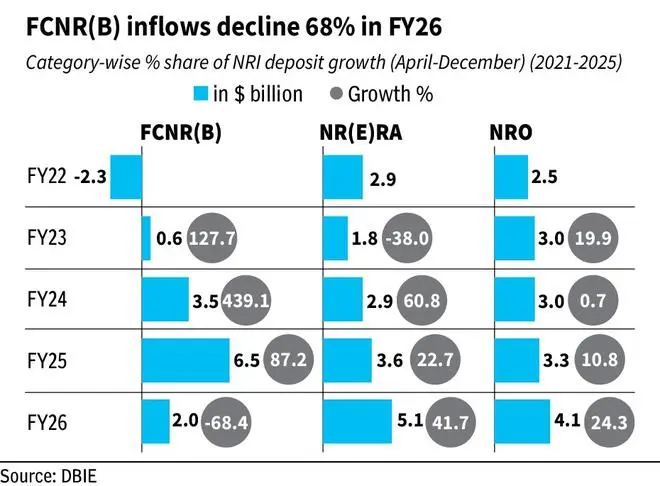
In contrast, NRE deposits grew 41.7 per cent to $5.06 billion in FY26, up from $3.57 billion a year earlier. These accounts are rupee-denominated deposits where both principal and interest are fully repatriable and tax-free in India.

Meanwhile, NRO accounts, which are rupee-denominated accounts used to manage income earned in India, such as rent or dividends, and offer limited repatriation benefits, expanded 24.3 per cent to $4.09 billion in FY26, compared to $3.29 billion in the corresponding period last year.

Nearly 80 per cent of NRI deposits are held in repatriable accounts — FCNR(B) and NRE — making them sensitive to interest rate differentials and currency expectations. According to Sood, macroeconomic stability combined with relatively higher interest rates, driven at times by RBI incentives, has historically supported inflows.

Experts pointed out that FCNR(B) deposits have historically been more volatile, as investors in these foreign currency accounts are more yield-sensitive and wary of exchange rate risks. In contrast, NRE deposits, which are largely held by workers with long-term ties to India, tend to be more stable and less sensitive to short-term currency fluctuations.

They also added that in a phase of rupee depreciation, NRE accounts, being rupee-denominated, become more attractive as they translate into higher rupee returns for the same dollar inflow.

Looking ahead, analysts expect flows to stabilise rather than surge. “We may see stable flows only if INR is stable and the RBI does not cut policy rate,” Sood said, cautioning that rate cuts or expectations of depreciation could deter deposits.

More Like This

Lower DBT outlays also coincide with reduced budgeted spending on fertilizer and food subsidies, reflecting the government’s broader fiscal consolidation push

The divisible pool of Centre’s GTR, that is available to the States for devolution, is derived by subtracting the cess and surcharges, and taxes accruing to the Union Territories from the GTR

The 16th FC has also re-defined this demographic change to account for population growth between 1971 and 2011, instead of relying on change in Total Fertility Rates, as it earlier used to

smolaw11

Published on February 26, 2026