









The Hindu | Photo Credit: The Hindu
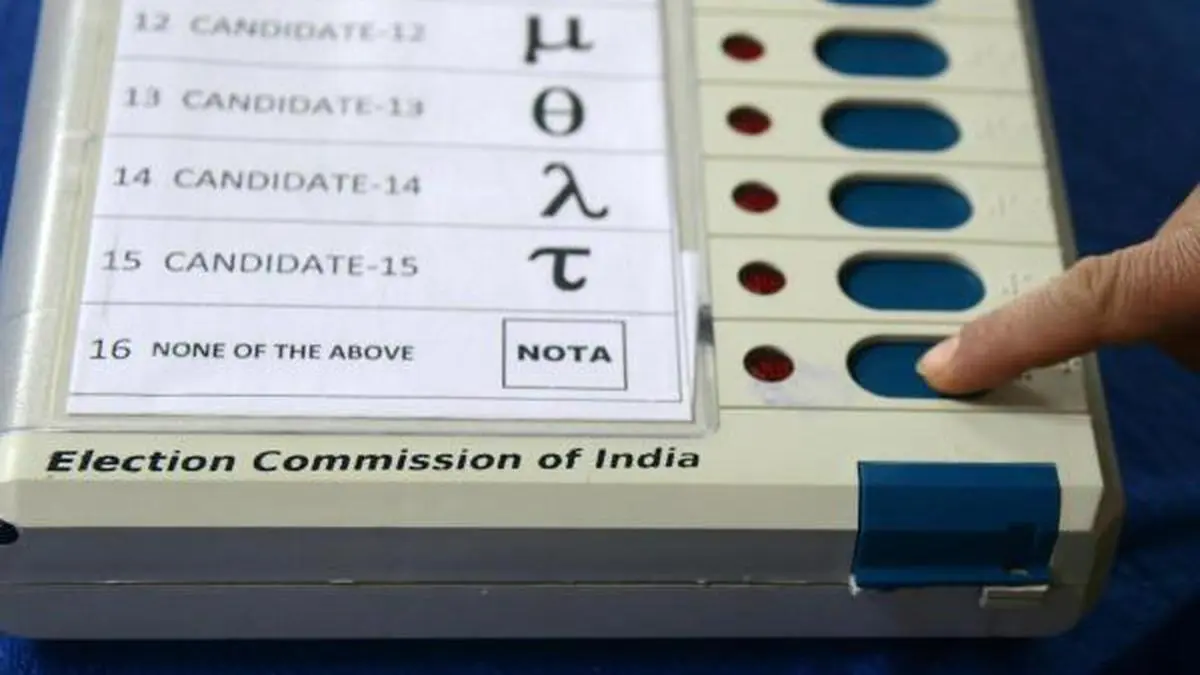
‘None of the Above’ (NOTA) option in elections, wherein a voter can vote in the election but not choose any of the candidates, is once more in the news after a recent Supreme Court observation. While hearing a plea on making the NOTA option available even when only one candidate is standing in the election, the Supreme Court raised doubts about the effectiveness of the NOTA option.
An analysis of the data reveals that while the share of NOTA votes in Union elections has been declining over the last three Lok Sabha elections, there is a small increase in NOTA’s share in the State Assembly elections held in 2025.
More than a decade after its introduction, electoral data show limited increase in the use of NOTA at the national level. In the Lok Sabha elections, NOTA secured 1.07 per cent of votes in 2014, which amounted to 60 lakh votes. In the 2019 elections, the share was 1.05 per cent with 65.1 lakh votes and 0.98 per cent in 2024 with 63.7 lakh votes.
While the absolute numbers in Lok Sabha elections are significant, the vote share has largely hovered around the 1 per cent mark.
The proportion of NOTA votes, however, moved higher in the 2025 State Assembly elections. Bihar recorded 1.81 per cent of votes for NOTA in 2025, marginally higher than the 1.68 per cent share in the previous assembly election. The increase, though modest, stands out against the relatively flat trend seen in recent Lok Sabha polls.
Sajjan Kumar, an independent political analyst, said such marginal increases reflect voter sentiment rather than a structural shift in electoral behaviour. “Where dissatisfaction does not translate into credible political alternatives, some voters may use NOTA to register discontent,” he said, describing it as a limited but visible form of protest.
Looking at previous Assembly elections, the trend has been uneven. In 2022, Gujarat recorded 1.57 per cent NOTA votes, up from 0.23 per cent in the previous election, while Uttar Pradesh rose to 0.69 per cent from 0.20 per cent earlier.
However, several States saw declines. Share of NOTA votes in assembly elections in Madhya Pradesh fell from 1.42 per cent to 0.98 per cent, Rajasthan from 1.31 per cent to 0.96 per cent, and Maharashtra from 1.34 per cent to 0.71 per cent.
Kumar said the expectation that NOTA would improve candidate quality, measured by integrity, absence of criminal charges and commitment to public service, was based on the assumption that voters would move towards more rational, performance-based choices.
In practice, electoral mobilisation continues to revolve around caste, community, ethnicity and religious identity. “Politics in theory and politics in practice are two different trends,” Kumar noted, suggesting that the anticipated emergence of a rational voter capable of pressuring parties into fielding better candidates has not materialised.
Experts stress that NOTA was never a sufficient condition for reform on its own, but dependent on broader shifts in political culture. While it has not delivered the transformative impact once envisaged, it remains an institutional experiment whose relevance could evolve.
Published on March 2, 2026
此内容由惯性聚合(RSS阅读器)自动聚合整理,仅供阅读参考。 原文来自 — 版权归原作者所有。