


The 16th Finance Commission report placed before the Parliament on the Budget day has sought to stick to its core principle of equitable redistribution of resources among the poorer States. While the formula for arriving at the devolution has been changed across parameters, it has not resulted in material change in the share among States.
The commission has retained the vertical devolution share at 41 per cent but the weights have been changed in various parameters.
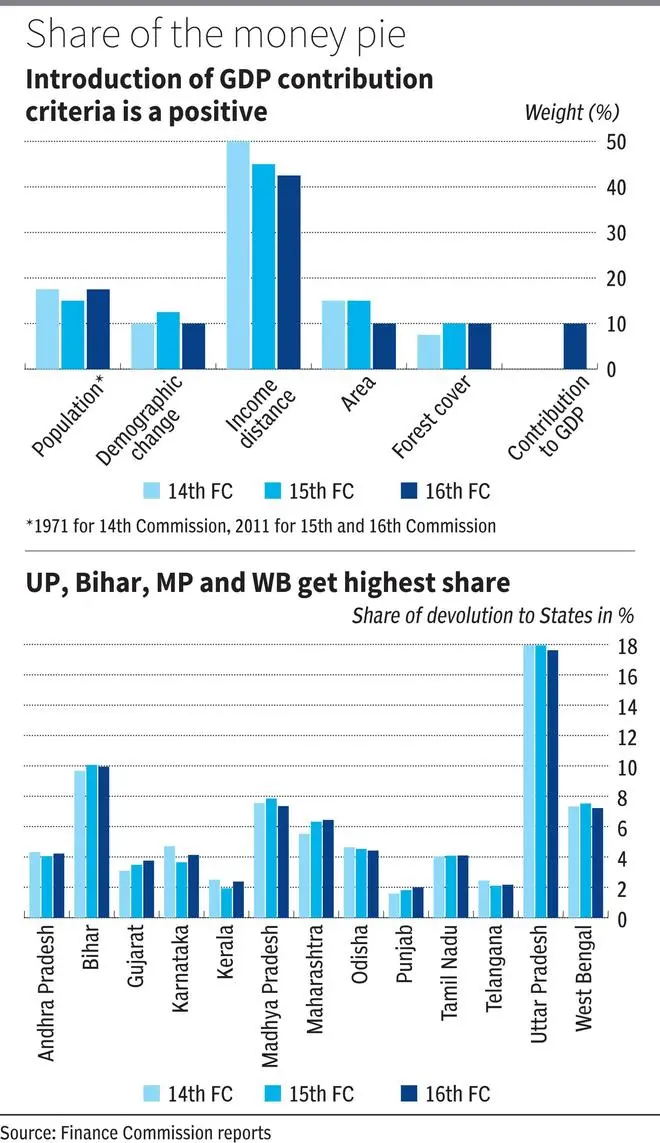
The most significant change in the formula is the introduction of the new horizontal criterion to reward State’s contribution to the overall economy. This ensures that the fast-growing States are rewarded. Rewarding larger States in terms of area is not a great idea and the reduction in this weight from 15 per cent to 10 per cent is a good move.
But the positives have been negated by increasing the weightage for population and decreasing that of demographic change.
Income distance criterion (the gap between a State’s per capita income and the State with the highest per capita income), still retains the highest weight, though it has reduced slightly from 45 to 42.5 per cent. This limits changes in the overall share among the States.
The 16th FC has also re-defined this demographic change to account for population growth between 1971 and 2011, instead of relying on change in Total Fertility Rates, as it earlier used to.
Dr M Govinda Rao, a former member of the 14th Finance Commission, said it is a good and balanced report overall and does not disturb the status quo. The ‘GDP contribution’ factor seems to have been brought in to appease the Southern States that have been demanding it. However, the ‘Income Distance’ factor still holds a large share, and one must consider that the character of the per capita income in some States is such that it does not contribute to consumption leading to low GST revenue, such as in the case of Tamil Nadu.
Share largely unchanged
While the share of Southern States like Karnataka, Kerala, AP, Telangana and Tamil Nadu saw a marginal growth due to the introduction of the GDP Contribution criteria, most of them still get a share smaller than their shares under 14th FC, given they have higher per capita income and have managed to implement population control measures.
Uttar Pradesh (17.6 per cent), Bihar (9.9 per cent), Madhya Pradesh (7.3 per cent), and West Bengal (7.2 per cent), which have seen a slight decline in share in the 16th FC, still hold a lion’s share of the grants, essentially due to the large weightage given to the ‘Income Difference’ criteria.
Dr KR Shanmugham, former director, Madras School of Economics, said that the equity-efficiency balance, which was earlier at 45 per cent-15 per cent ratio, is now at 42.5 per cent-12.5 per cent, thanks to the introduction of the GDP Contribution criteria. This moves the needle towards rewarding high growth, but is still at some distance from the demand of the States to take it higher.
Published on February 2, 2026