







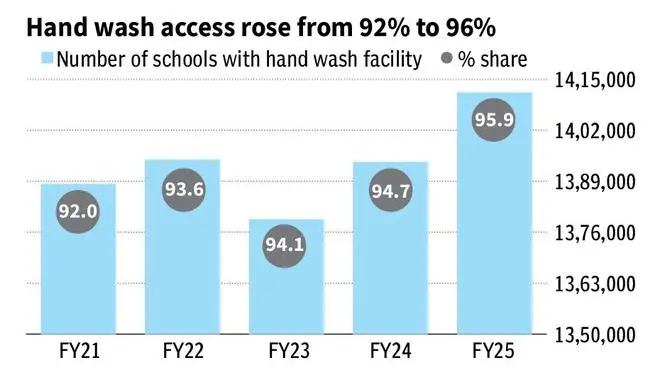
More than 96 per cent of India’sschools report having functional girls’ toilets, and access to handwashing facilities has improved from 92 per cent in FY21 to nearly 96 per cent in FY25.
On paper, India’s school sanitation infrastructure appears largely robust. Yet the Supreme Court’s recent judgement recognising menstrual health and hygiene (MHH) as part of the fundamental right to live with dignity under Article 21 highlights a persistent gap between reported infrastructure and girls’ lived realities.
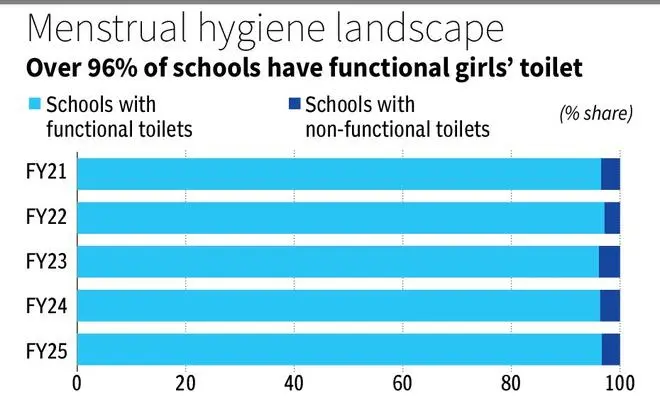
Data from UDISE+ show that the share of schools with functional girls’ toilets has consistently remained above 96 per cent over the last five years. Handwashing access has expanded to over 14 lakh schools.
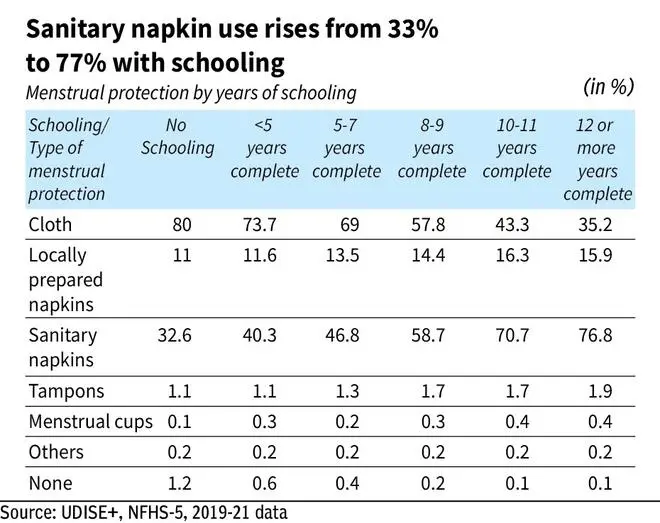
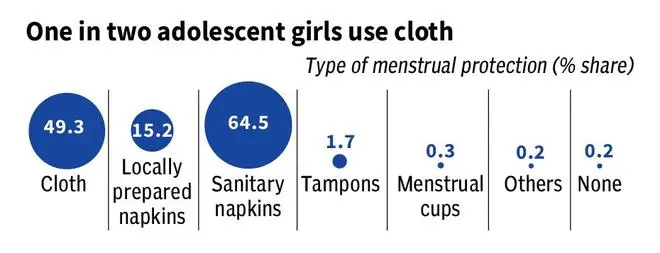
However, national health data paints a more complex picture. According to NFHS-5, nearly one in two adolescent girls aged 15-19 still use cloth during menstruation, while only 64.5 per cent use sanitary napkins.
Deeper issues
Experts suggest that access on paper often masks deeper usability issues. “A large number of schools now have girls’ toilets as part of their basic infrastructure. However, usability and maintenance remain persistent challenges,” says Manjaree Pant, Social and Behaviour Change Specialist, UNICEF. Toilets are frequently blocked, lack water or soap, have broken locks, or are kept locked altogether to prevent damage, leaving them inaccessible for girls.
Rushabh Hemani, WASH Specialist, UNICEF Rajasthan, echoes this concern, stressing that the issue extends beyond products. “This is not just about access to menstrual health products, it is about an enabling ecosystem,” he says. The choice of use of menstrual hygiene products should rest with the end user including reusable absorbent clean cloth, which can be used safely with appropriate hygienic cleaning with soap, water and sun-drying. This may not be feasible in schools, which also contributes to absenteeism.
Even when sanitary pads are distributed, barriers persist. “Stock-outs, irregular distribution, or having to ‘ask’ publicly, often in the absence of female staff, creates hesitation and stigma,” Hemani explains. Disposal is another major deterrent. “Pads create waste, and if disposal is unsafe or humiliating, girls avoid pads even if they are free. Functional incinerators are still very limited,” he adds.
The consequences are far-reaching. Studies cited in the Supreme Court judgment show that nearly one-third of girls miss school during menstruation, with repeated absenteeism increasing the risk of permanent dropouts. For girls facing poverty or disability, these barriers multiply, undermining bodily autonomy and equal access to education.
Experts are clear that India has come a long way, from the near absence of toilets and conversations around menstruation to a phase where facilities, data, and legal recognition now exist. But the Supreme Court’s judgment makes one thing explicit: progress cannot stop at infrastructure counts. With schools increasingly becoming spaces for health education and care, the moment offers an opportunity to gradually turn constitutional intent into everyday dignity for girls.
Published on February 10, 2026