


惯性聚合 高效追踪和阅读你感兴趣的博客、新闻、科技资讯
阅读原文 在惯性聚合中打开

推荐订阅源

P
Proofpoint News Feed
Blog — PlanetScale
Blog — PlanetScale
GbyAI
GbyAI
C
Check Point Blog
腾讯CDC
Stack Overflow Blog
Stack Overflow Blog
Cyber Security Advisories - MS-ISAC
The GitHub Blog
The GitHub Blog
A
About on SuperTechFans
Recent Announcements
L
LangChain Blog
Microsoft Azure Blog
小众软件
小众软件
J
Java Code Geeks
博客园_首页
Jina AI
Jina AI
美团技术团队
H
Help Net Security
MyScale Blog
MyScale Blog
Engineering at Meta
Engineering at Meta
奇客Solidot–传递最新科技情报
奇客Solidot–传递最新科技情报
人人都是产品经理
人人都是产品经理
Y
Y Combinator Blog
S
SegmentFault 最新的问题

Latest BL Data Stories News, Business, Economic Data Stories - BusinessLine | The HinduBusinessLine

Mega IPOs do not always deliver The quick-commerce battle The biggest World Cup yet India is largest source for immigrant founders of US unicorns, but still not shooting for the stars South Korea records high FPI outflows of $69 billion in 2026, followed by India with $26 billion Health insurance coverage crosses 60% of households, NFHS How AT1 bond issuances have hit a rough patch since 2025 Nifty-50 valuation faces test as global capital chases faster earnings growth RBI balance sheet expanded 21% in FY26 led by rising gold valuation Gender parity in government services still a long way away Infrastructure project additions surge in Q4 FY26 led by highway projects RBI records highest-ever dollar sales to defend rupee in FY26 India sees 15% jump in education loans, touches decade-high ₹8.58 lakh crore in FY26 Fuel price hikes renew focus on high state taxes on petrol and diesel Stolen identities fuel cyberattacks Quick-commerce firms spend ₹98-100 per order despite increasing dark stores, says Bernstein research IPL economy AI apps, UPI drive India’s digital shift Gold bars and coins make up 41% of gold demand in January-March 2026 How FIIs and DIIs are taking opposing positions Southern States recorded inflation above national average in April 2026 Gold held by Indian gold ETFs up 79% in the past year India’s forex reserves contract 5% since March, one of the highest among oil importing EMs Tamil Nadu’s winners: Youngest and wealthiest Profile of the whistle brigade SIR impact on close contests: How sub-10,000 margins reshaped the electoral map Indian firms boost global acquisitions to $17.3 billion led by Sun Pharma deal External commercial borrowings fall 25% in FY26 amid currency risks, shift to domestic funding Gaps in financial maturity Palash Rana tops wealth chart in Bengal Phase 2 with ₹104 crore-plus assets
Nifty50 firms hit by ₹13,161 cr as labor codes raise empl...
2026-02-17 · via Latest BL Data Stories News, Business, Economic Data Stories - BusinessLine | The HinduBusinessLine
Workforce-heavy companies such as TCS, Larsen & Toubro, Infosys and HCL Technologies reported significant provisioning increases. Analysts say the reforms may raise long-term employee costs while boosting retirement savings.

Workforce-heavy companies such as TCS, Larsen & Toubro, Infosys and HCL Technologies reported significant provisioning increases. Analysts say the reforms may raise long-term employee costs while boosting retirement savings. | Photo Credit: iStockphoto

The implementation of the new labour codes from November 21, 2025, has required companies to make large, one-time adjustments to their books in the third quarter of FY26 to increase the reserves maintained for employees’ social security benefits.

businessline analysis of the stand-alone results of companies in the Nifty50 index for the third quarter of FY26 shows that these firms have incurred additional expenditure amounting to ₹13,161 crore due to the revised rules.

The adjustment is required because the new labour code stipulates that the basic salary must constitute at least 50 per cent of the overall salary. This impacts the provident fund and other statutory benefits. The other important change is that gratuity must be paid to all fixed-term employees after one continuous year of service, down from five years earlier.

Workforce-Heavy Firms hit

TCS, due to its large workforce, leads the list of companies that have taken the biggest hits. TCS reported, “incremental impact consisting of gratuity of ₹1,816 crore and long-term compensated absences of ₹312 crore,” due to the new code. Larsen & Toubro followed with an increase in employee benefits of ₹1,791 crore. Other IT companies, such as Infosys (₹1,146 crore), HCL Technologies (₹948 crore), and Wipro (₹303 crore), also witnessed a significant increase in employee expenses.
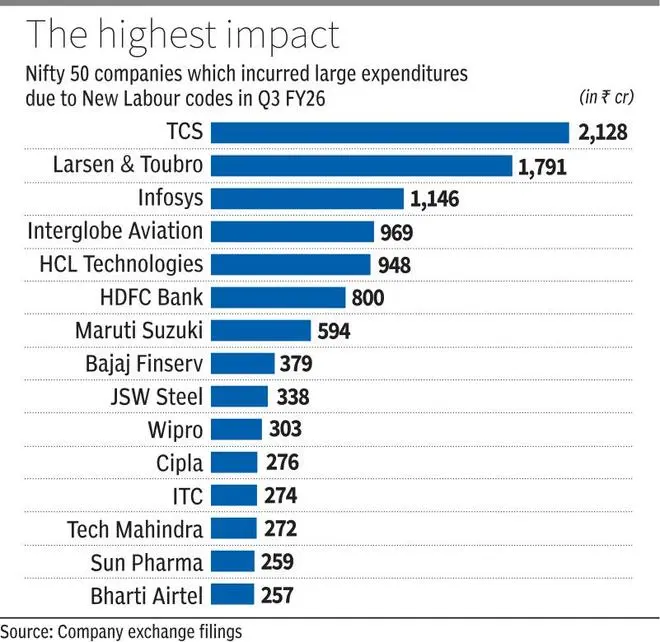
Other companies with high provisioning due to the labour code were InterGlobe Aviation at ₹969 crore, HDFC Bank at ₹800 crore and Maruti Suzuki with ₹594 crore.

No Material Impact

A second group of big employers, including Reliance Industries, SBI, Power Grid, ONGC, NTPC, Coal India, and Eternal, anticipated a negligible financial impact due to the new labour code in Q3 FY26. According to Reliance Industries, “The incremental impact of these changes assessed by the company on the basis of the information available, is not material.”

SBI, on the other hand, indicated that, “based on the broad assessment carried by the management, the Bank continues to comply with the major provisions and any consequential impact arising therefrom will be assessed and appropriately accounted upon such notification.”

Adani Enterprises acknowledged the reforms in its earnings review but did not separately quantify the financial impact. Meanwhile, Axis Bank reported an additional outgo of ₹25 crore, while providing for an estimated future cost of ₹434 crore for the implementation of the new labour code.

According to Neha Jain, of CHOICE International, “India’s four Labour Codes represent the most significant overhaul of the country’s employment framework in decades. While full implementation is still underway, for white-collar heavy sectors, this could raise long-term employee costs by 3–8 per cent, while also increasing retirement savings for employees.”

Published on February 16, 2026