


惯性聚合 高效追踪和阅读你感兴趣的博客、新闻、科技资讯
阅读原文 在惯性聚合中打开

推荐订阅源

B
Blog RSS Feed
WordPress大学
WordPress大学
博客园_首页
罗磊的独立博客
D
Docker
N
Netflix TechBlog - Medium
博客园 - Franky
Hugging Face - Blog
Hugging Face - Blog
D
DataBreaches.Net
I
InfoQ
L
LangChain Blog
GbyAI
GbyAI
V
V2EX
博客园 - 聂微东
P
Proofpoint News Feed
博客园 - 【当耐特】
腾讯CDC
奇客Solidot–传递最新科技情报
奇客Solidot–传递最新科技情报
量子位
Martin Fowler
Martin Fowler
有赞技术团队
有赞技术团队
U
Unit 42
博客园 - 司徒正美
大猫的无限游戏
大猫的无限游戏

Latest Business News, Business News India Today | The HinduBusinessLine

Draft CAFE-3 Norms: Govt eases penalties, focuses on carbon credit trading for auto sector Modi seeks opposition backing to implement women’s reservation before 2029 polls West Asia crisis: Ludhiana handtool export units face labour, gas supply shortages, high input costs Patent application filings in India rise 30.2% to 1.43 lakh in 2025-26: Goyal Meet the man with 138 degrees: Dashrath Singh, an ex-serviceman, earns latest qualification from IGNOU Europe missed AI bus, but India has potential to catch up: Former WEF Director AIG Hospitals, ICMR team up for digital health innovation Juno Joule Bio Fuels begins construction of compressed bio-gas project in Telangana Legendary playback singer Asha Bhosle dies at 92 Signature Global cuts net debt by 77% to ₹200 crore in FY26 Iran aims to restore majority of refining capability within two months Supreme Court to hear on Monday pleas related to SIR of electoral rolls in West Bengal US, India hold engagements to advance defence cooperation Trump shares article suggesting option with him to enforce naval blockade on Iran NCLAT reaffirms project-specific insolvency proceedings against realty firms Iran-US talks in Pakistan ended without deal as Tehran cites ‘excessive demands’ from US Two supertankers U-turn in Hormuz as US-Iran talks break down Time has come to implement Women's Reservation Act: PM Modi's letter to LS, RS floor leaders Iran war diverts US military, attention from Asia ahead of Trump's summit with China's leader Trump says China will have big problems if it ships arms to Iran India will soon become self-reliant in defence sector, find itself among leading nations of the world: Rajnath Singh Pakistan to continue facilitating US-Iran talks, says Dar; urges ceasefire More than 2,000 people killed by Israeli strikes in Lebanon during Israel-Hezbollah war: officials Iran denies US claims of mine clearing ships’ passage through Strait of Hormuz AI to reduce uncertainties and expand opportunities - RBI DG EAM Jaishankar meets members of Indian community in UAE 4 ways war in Iran has weakened United States in great power game US-Iran talks fail after 21 hours in Islamabad, JD Vance cites nuclear deadlock Delhi EV Policy: Electric 3-Wheelers Only by 2027, 2-Wheelers by 2028 Islamabad talks: US and Iran begin negotiations aimed at ending West Asia conflict
Poor progress in Deep Ocean Mission
M Ramesh · 2026-04-17 · via Latest Business News, Business News India Today | The HinduBusinessLine
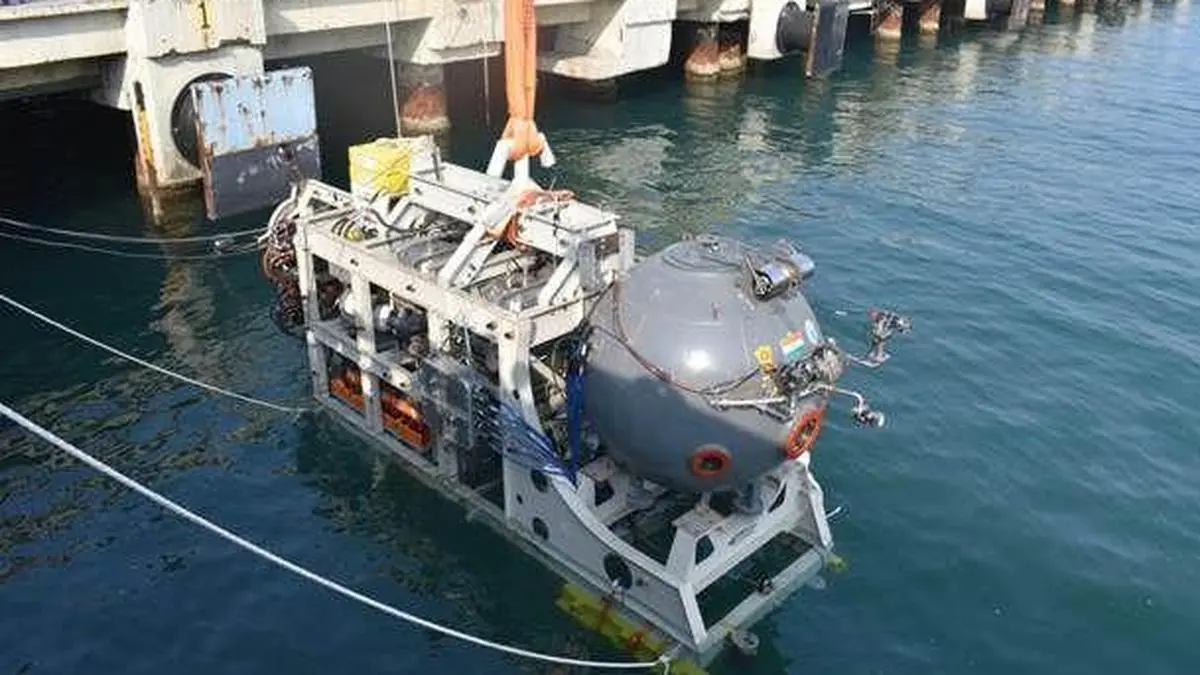
The National Institute of Ocean Technology has developed MATYSA 6000

The National Institute of Ocean Technology has developed MATYSA 6000

The ₹4,077-crore Deep Ocean Mission, launched in 2021 to explore and eventually mine critical minerals from polymetallic nodules on the Indian Ocean bed, has made limited progress. With the current year marking the end of the programme, only about 35 per cent of the allocated budget has been spent by the Ministry of Earth Sciences.

A Parliamentary Standing Committee on Science and Technology Environment Forests and Climate Change, which examined the ministry’s demands for grants, noted “with concern” that progress “does not appear to be commensurate with the objectives and timelines originally envisaged.”

In a recent report, the committee said that “the pace of progress under certain critical verticals of the Mission needs to be significantly accelerated” to achieve intended outcomes within a reasonable timeframe.

Polymetallic nodules—potato-shaped mineral-rich concretions—are found scattered across parts of the ocean floor. The International Seabed Authority has allotted India an area of 75,000 sq km in the Indian Ocean for exploratory work. In December, the ministry told Parliament that this area is estimated to hold 366 million tonnes of nodules, containing 0.14 per cent cobalt, 1.14 per cent nickel, 1.09 per cent copper and 25.2 per cent manganese.

The National Institute of Ocean Technology, under the ministry, has designed a deep-sea mining system capable of operating at depths of up to 5.5 km. It has also developed MATYSA 6000, a human submersible for deep-sea exploration.

However, a fully-integrated mining system is yet to be realised.

The ministry attributed the underutilisation of funds to lower spending in the initial phase, citing the “preparatory nature of activities.” Expenditure stood at 40 per cent and 32 per cent of allocations in 2021-22 and 2022-23, respectively, before rising to 48 per cent and 98 per cent in the subsequent two years.

The committee has recommended clearly defined and measurable milestones across the Mission’s six verticals, along with fixed timelines and a structured monitoring mechanism to track progress and address bottlenecks.

Commercial mining

Commercial deep-sea mining is not yet feasible, as the International Seabed Authority is still finalising the ‘Exploitation Code’.

Mining polymetallic nodules is only one objective of the Mission. Others include ocean climate advisory services, technologies for exploring and conserving deep-sea biodiversity, harnessing energy and freshwater from the ocean, and setting up an advanced marine biology station.

The ministry has reported progress in some areas. For instance, 1,845 deep-sea microbes, including previously unknown species, have been isolated from samples in India’s exclusive economic zone. The Centre for Marine Living Resources and Ecology has also surveyed 25 seamounts in the Lakshadweep and Andaman and Nicobar regions, documenting 195 deep-sea species.

Published on April 16, 2026