







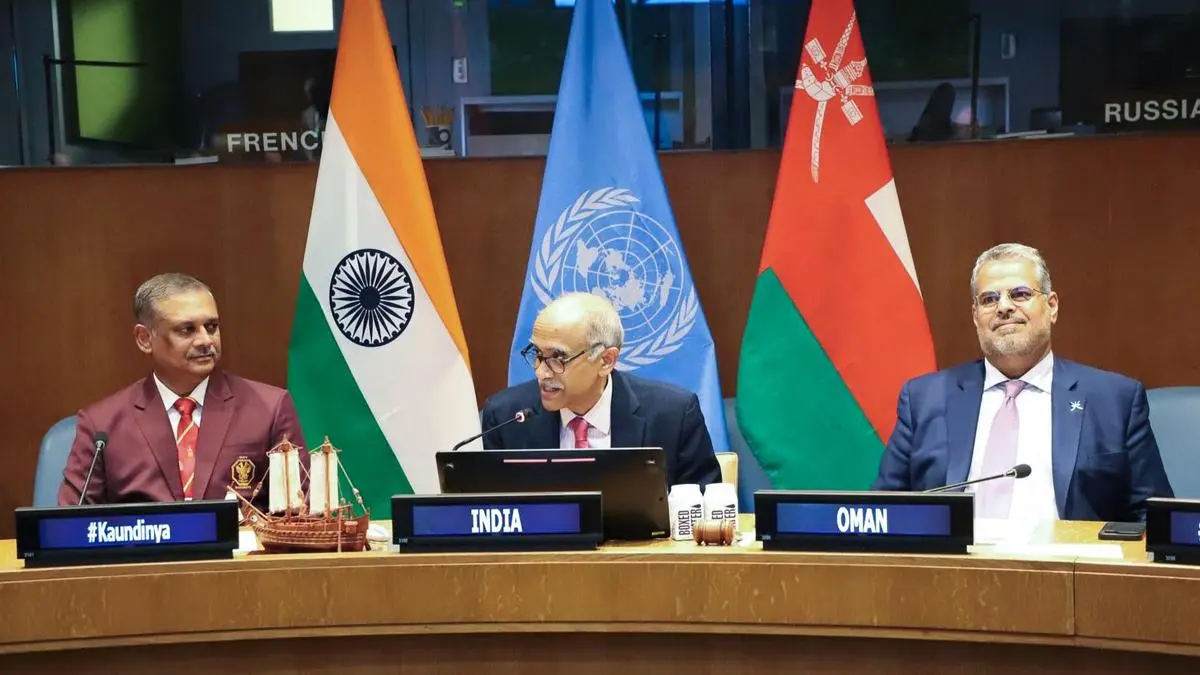
Permanent Representative of India to the United Nations, Parvathaneni Harish (file photo) | Photo Credit: @IndiaUNNewYork/ANI
India called out divisions among permanent veto-wielding members of the UN Security Council at a meeting here chaired by China and emphasised that the Council must be a living instrument, "not a fossil" whose "frozen" architecture is akin to running advanced AI technologies on a 1945 version of the computer.
"The period of heightened activism of the Council has now faded, and the world is now characterised by fragmentation and confrontation. We have a divided Council at the level of permanent veto-wielding members. The calls for enhancing efficiencies and productivity at the UN are more pronounced than ever," India's Permanent Representative to the UN, Ambassador Harish Parvathaneni, said.
Parvathaneni was addressing the Security Council debate on "Upholding the purposes and principles of the UN Charter and strengthening the UN-centred international system", chaired by China under its presidency of the 15-nation UN body for the month of May. Chinese Foreign Minister Wang Yi presided over the opening session of the debate on Tuesday morning. China, France, Russia, the United Kingdom and the United States are the five permanent veto-wielding members of the UNSC.
Parvathaneni said concerns related to legitimacy, efficacy and relevance of the UN are growing, particularly the role of the Security Council in delivering on its mandate of maintenance of international peace and security.
India underlined that "central" to the UN's current challenges is an architecture that is "frozen" in the 1940s. "It is akin to running advanced AI technologies on the 1945 version of the computer called the Electronic Numerical Integrator. Lack of progress in inter-governmental negotiations on Council reforms is indicative of entrenched interest of several member states to maintain the status quo and retain the eight decade-old UNSC architecture," Parvathaneni said.
India stressed that the UNSC architecture that is "frozen" in time must make way for purposeful reform, reflecting contemporary geopolitical realities.
"Sacrifices made in the Second World War alone cannot justify an archaic and antiquated design for perpetuity," the Indian envoy said, making a reference to the victorious Allied Powers of the Second World War who have retained their privileged veto-wielding status in the Council as permanent members ever since.
"We cannot shield the permanent category of membership from any review or reform forever while calling for enhanced representation of developing countries and under- and un-represented geographies only in the elected category of membership,” Parvathaneni said.
India called for expanding the permanent category of UNSC membership, saying this alone will change the decision-making process of the Council. "Not adapting to changed circumstances would further diminish the authority, the credibility, legitimacy and effectiveness of the UN Security Council," Parvathaneni said.
India also underlined the importance of making the UNSC "more transparent", saying the Council "must be a living instrument, not a fossil. More than any other member state, the permanent members must deliberate on this matter".
India has been at the forefront of years-long efforts for achieving reform of the Security Council, including expansion in both its permanent and non-permanent categories, saying the 15-nation Council, founded in 1945, is not fit for purpose in the 21st century and does not reflect contemporary geopolitical realities. New Delhi has consistently underscored that it rightly deserves a permanent seat at the horse-shoe table. India last sat at the UN high-table as a non-permanent member in 2021-22.
Emphasising that the UN cannot be indifferent to the "fundamental evolutionary principle" of being "adaptable", India also highlighted that a critical challenge the UN faces today is one of double standards. "These are characterised not only by inconsistent application of principles in different situations, but also by inconsistency between words and actions. Brute force and power do not deliver stronger multilateralism or global public good," Parvathaneni said.
India emphasised that even though the UN was established, it did not put an end to colonialism. "The global politics of colonialism that prevailed during the time ensured that India was not duly recognised for the significant sacrifices we made" in the Second World War, in which more than 25 lakh Indian soldiers fought alongside the Allied Powers and over 87,000 Indian soldiers made the supreme sacrifice.
Published on May 27, 2026
此内容由惯性聚合(RSS阅读器)自动聚合整理,仅供阅读参考。 原文来自 — 版权归原作者所有。