









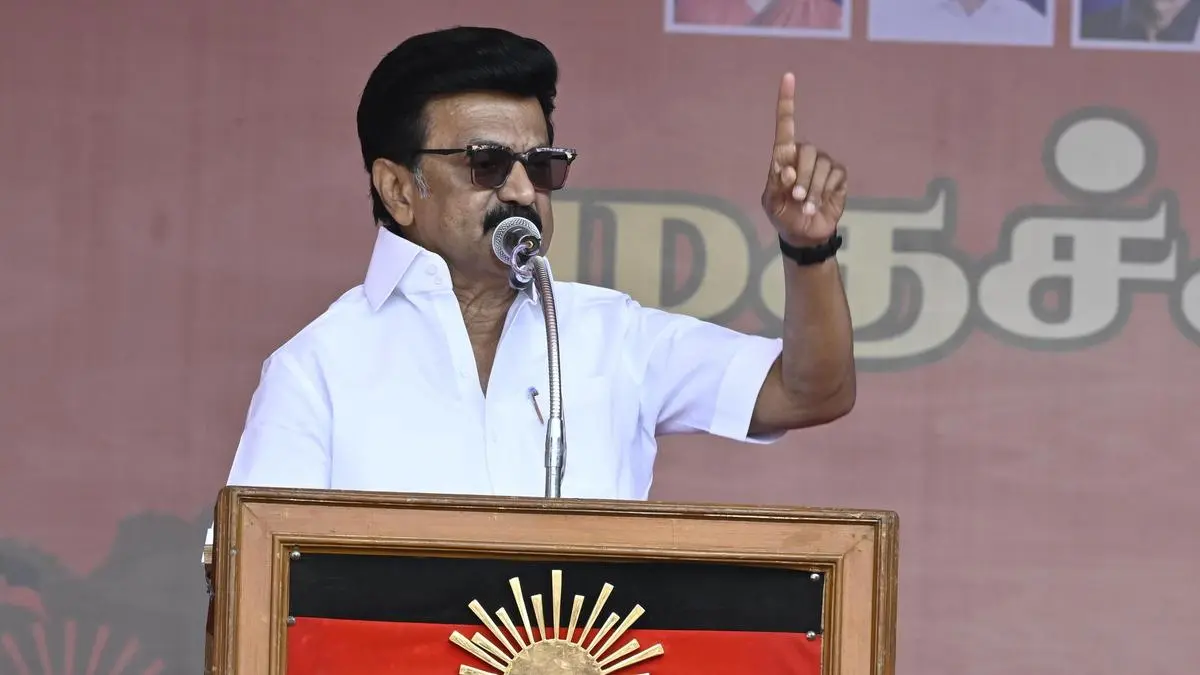
File picture: Tamil Nadu Chief Minister and DMK president M.K. Stalin addressing a public meeting during an election campaign in Erode, Tamil Nadu, earlier this month. | Photo Credit: GOVARTHAN M
M K Stalin-led Dravida Munnetra Kazhagam (DMK) began its latest term in May 2021, when the country was still in the grip of the Covid-19 pandemic. But growth in Tamil Nadu gathered pace from 2023-24, led by manufacturing and exports, and supported by services. Per-capita GSDP growth has also been among the best in the country in the last two years.
But the DMK’s management of the finances leaves much to be desired. High spending on subsidies and grants is resulting in the State borrowing heavily and piling up a large debt. This is impacting capital investments as well as spending on essentials such as education and health.

Tamil Nadu, with a strong industrial base, thriving services sector, good port connectivity and high degree of urbanisation, has been among the top performers among Indian States for many years now. It recently moved to the second spot in terms of GSDP, after Maharashtra. Growth in the first two years of the DMK’s term was tepid due to the pandemic impacting MSMEs, smaller businesses and the agriculture sector. But the economy has picked up pace since 2023-24, with growth in 2024-25 at 11.2 per cent — the fastest among Indian States. Per-capita GSDP has also been growing strongly, with the figure for 2024-25 standing at ₹1,96,309, far above the national average of ₹1,33,601.

Tamil Nadu has been in a sweet spot since FY23, with both manufacturing sector which accounts for 33 per cent of the GSVA and the services sector (54 per cent of GSVA) managing to clock high growth. Manufacturing benefited due to the thrust on electronics and automobiles, led by smartphone and electric vehicles. Though services sector in India has been facing challenges due to AI adoption, the setting up of global capability centres in Chennai and other cities of Tamil Nadu has ensured continued growth in this space. The State is ranked fifth in garnering FDI flows between 2019 and 2025.
Despite this strong growth in the economy, the DMK government’s management of the State Finances has been found wanting. Though the State has the potential to raise enough revenue to fund its expenses, its thrust on welfarism results in sub-optimal revenue collection, resulting in large deficit and debt.
Its fiscal deficit has been largely under control, hovering between 3 and 3.5 per cent since the pandemic. But the DMK government has been piling on a large debt. Tamil Nadu’s accumulated debt of ₹10,42,858 crore towards the end of March 2026 is the highest among all States and UTs. The debt has been growing at a faster rate since 2021, with TN overtaking Maharashtra, UP and Karnataka in outstanding debt in this period.

As a result, the debt to GSDP ratio has been at elevated levels over the last five years. This ratio had been well under the FRBM mandate of 25 per cent, prior to 2020.
The quality of expenditure is also a concern, with higher spending on subsidies and social welfare measures, while allocations to education and health have declined over the last five years. Capital outlay as a percentage of GSDP has remained stagnant at 1.5 per cent over the last three years, and development expenditure as a percentage of GSDP is also quite low, around 7 per cent in FY26.
Published on April 21, 2026
此内容由惯性聚合(RSS阅读器)自动聚合整理,仅供阅读参考。 原文来自 — 版权归原作者所有。