


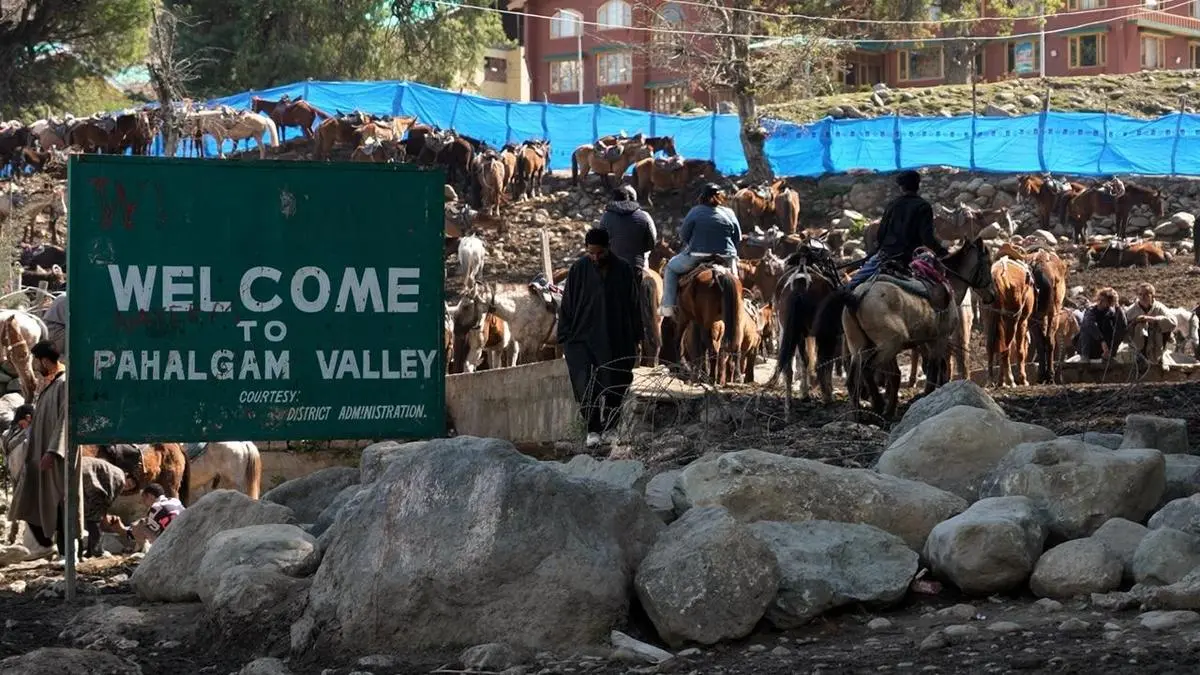
Pahalgam Pony Owners Union head said that 5,500 ponywallahs in the area depend on tourism
Most taxis at Tourist Taxi Stand No 2 in Pahalgam sit idle, as tourist arrivals remain subdued compared with levels before April 22 last year.
The decline follows the deadly attack in the nearby Baisaran meadows, where terrorists killed 25 tourists and a civilian, dealing a severe blow to the region’s tourism-dependent economy.
One year on, the impact persists. “Our work has reduced to around 60 per cent,” said Gulzar Ahmad, vice president, Taxi Stand Number 1, pointing to a prolonged slump in visitor numbers.
The stand has a fleet of around 600 cabs, while another facility in the area, Taxi Stand No. 1, has about 250 vehicles.
“The attack has upended business here. In the first few months after it, Pahalgam had turned into a ghost town, with hardly any tourists showing up,” he said.
Baisaran Valley and Chandwari have been off-limits to tourists since the attack. Although Chandwari was briefly reopened, locals said it was shut again about two months ago.
“Tourists won’t come if your key attractions are closed,” said a hotelier.
Abdul Waheed Wani, president of the Pahalgam Pony Owners Union, echoed similar concerns, saying many ponywallahs were forced to sell their animals as they could no longer afford to feed them after the attack.
“Still, we are struggling with work,” he said. Wani was among the first responders, who had ferried injured people to hospital. He said about 5,500 pony operators depend on tourism in the area.
Qazi Tauseef, spokesperson of Kashmir Economic Alliance, said that the attack dealt a blow not only to tourism but to the broader business ecosystem of the Valley.
“Even a year later, the ripple effects are visible particularly in key destinations like Pahalgam where footfall has yet to fully recover,” he added.
He believes that the sustained recovery depends on two critical factors – restoration of consistent tourist confidence and stronger institutional support.
Arrivals drop by over half
Between May 2025 and April 2026, Pahalgam recorded around 4,51,000 domestic tourists, marking a drop of 65 to 70 per cent compared with earlier years, when annual footfall typically ranged between 1.2 million and 1.5 million.
According to official data, 34,98,702 tourists visited Kashmir in 2024, including 34,55,048 domestic travelers and 43,654 foreign visitors. In 2025, arrivals fell to 11,16,043, of which 10,93,050 were domestic tourists and 22,993 were foreign visitors — an overall decline of about 68 per cent.
Still out of bounds
One year on, several tourist destinations across Jammu and Kashmir remain closed to visitors.
Following the attack, authorities shut at least 48 destinations. While 41 have since been reopened in phases after security reviews, the rest remain closed, weighing on local businesses.
“We have suffered terribly since the attack. This area continues to remain off-limits to visitors,” said a cab driver from Aharbal.
Chief Minister Omar Abdullah told the Jammu and Kashmir Assembly on February 19 that all the sites would be reopened by May.
Officials said further reopening would depend on comprehensive security assessments and the implementation of safety protocols to ensure the secure movement of visitors.
Published on April 21, 2026
此内容由惯性聚合(RSS阅读器)自动聚合整理,仅供阅读参考。 原文来自 — 版权归原作者所有。