








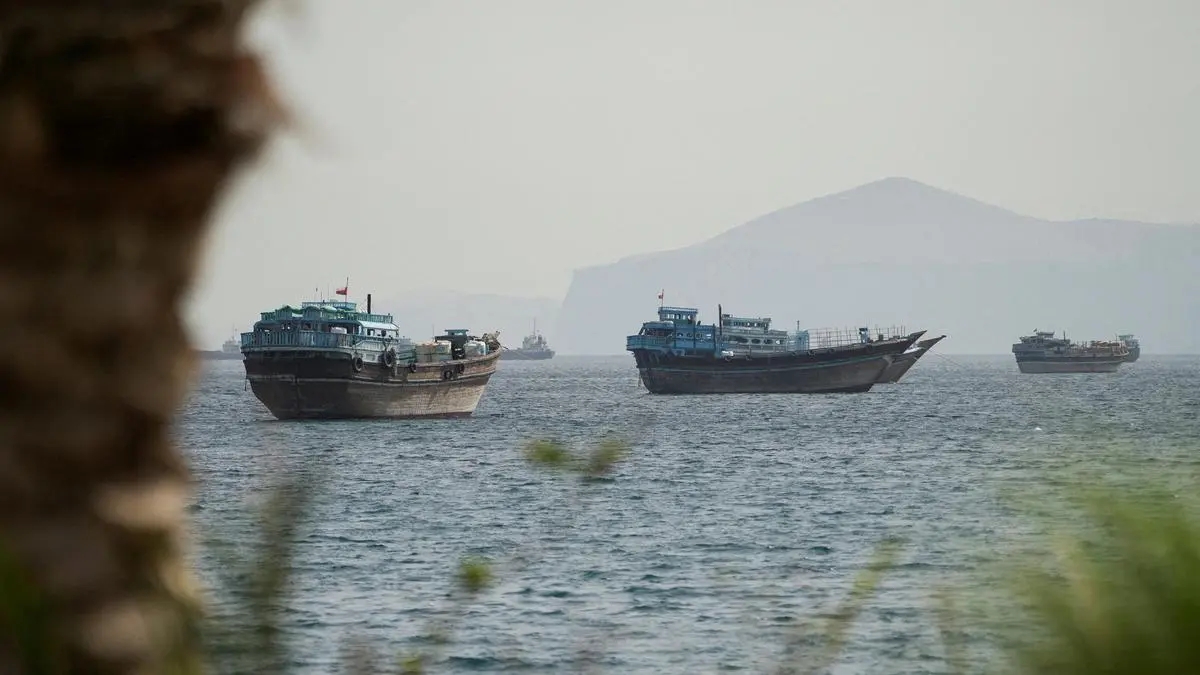
Iran said the framework is not finalised and any agreement would require tangible verification before implementation. | Photo Credit: STRINGER
As tensions in the Middle East approach a critical juncture, reports have surfaced regarding a draft memorandum of understanding between the United States and Iran aimed at de-escalating the ongoing conflict, Iranian state media reported on Wednesday.
With President Trump convening senior officials to finalise a potential agreement, the proposal offers a roadmap for restoring stability in the vital Strait of Hormuz while navigating the complexities of regional military presence.
According to Iran’s state television, the preliminary document outlined a multi-layered peace process designed to wind down hostilities and address the primary economic and security concerns.
Iran would restore commercial shipping through the Strait of Hormuz to pre-war levels within 30 days. Under this arrangement, transit would be managed by Iran in coordination with Oman, though the current draft reportedly excludes US military vessels from this specific transit framework.
Draft US-Iran framework aims to de-escalate Gulf tensions
Iran may restore Hormuz commercial shipping within 30 days
US could withdraw forces from Iran’s surrounding region
Proposed deal includes lifting of naval blockade
Iran and Oman may jointly manage Strait of Hormuz traffic
Final agreement could be formalised through UN Security Council resolution
Tehran says no deal without “tangible verification” of US actions
In a reciprocal move, the United States has committed to withdrawing military forces from Iran’s “surrounding environment,” with the specifics of whether this applies to regional deployments or permanent bases left to further negotiation.
The US would be expected to lift the current naval blockade, a move seen as essential to normalising commercial activity. If a final agreement is ratified within a 60-day window, the deal would be formalised through a binding UN Security Council resolution.
The latest proposal suggests that Iran and Oman would assume joint oversight of shipping lanes and traffic management within the narrow waterway. This chokepoint is vital to global energy security, facilitating the transit of nearly a fifth of the world’s oil and liquefied natural gas (LNG) supplies.
The breakthrough comes at a time of mounting international anxiety regarding disrupted energy supplies and spiked crude prices, triggered by months of volatile conflict across the Gulf region.
The urgency of these negotiations is underscored by significant domestic and global pressures. The closure of the Strait of Hormuz, a global energy chokepoint, has already resulted in approximately 20 per cent of global energy supplies failing to reach markets, alongside severe disruptions to fertiliser distribution, threatening global food security.
For President Trump, the deal represents a potential “victory” ahead of critical midterm elections. While he projects confidence in the negotiations, he faces mounting pressure from both political allies and critics who fear the deal may leave Iran’s hardline leadership emboldened despite current economic strains.
Iranian President Masoud Pezeshkian has framed the conflict as an “economic war,” accusing Washington of targeting the livelihoods of the Iranian people, a sentiment echoed by the IRGC, which maintains that while renewed direct warfare is unlikely due to perceived American weakness, they remain prepared to defend their territory.
While diplomatic efforts intensify, the broader security environment remains volatile. Despite the ongoing dispute, the IRGC reports that 23 vessels successfully traversed the Strait of Hormuz with its coordination in the last 24 hours.
The push for peace with the US contrasts sharply with the intensity of operations elsewhere in the region. Recent Israeli airstrikes in southern Lebanon and the Bekaa Valley have resulted in significant casualties, and the Israeli military reported the killing of a senior Hamas leader in Gaza, signalling that the broader regional instability remains largely unaddressed by the current US-Iran framework.
Moreover, the Iranian officials emphasise that the framework is currently unofficial and preliminary. Tehran has signalled that it will not proceed with any final commitments without “tangible verification” of US actions.
Recent disclosures indicate that negotiators from both factions have been refining a comprehensive 14-point understanding designed to cease active hostilities and unblock maritime trade routes.
Iranian authorities have clarified that the framework, emerging from discussions around the Islamabad memorandum, is not yet finalised. Tehran explicitly maintained that no progressive steps would be implemented without “tangible verification”.
Nevertheless, reports suggest that the proposed understanding could create a vital new window to allow negotiators to work toward a broader, long-term settlement.
Published on May 27, 2026
此内容由惯性聚合(RSS阅读器)自动聚合整理,仅供阅读参考。 原文来自 — 版权归原作者所有。