
惯性聚合 高效追踪和阅读你感兴趣的博客、新闻、科技资讯
阅读原文 在惯性聚合中打开

推荐订阅源

酷 壳 – CoolShell
酷 壳 – CoolShell
D
Docker
Microsoft Security Blog
Google DeepMind News
M
MIT News - Artificial intelligence
P
Proofpoint News Feed
Engineering at Meta
Engineering at Meta
Y
Y Combinator Blog
Vercel News
Vercel News
F
Fortinet All Blogs
B
Blog
Recent Announcements
A
About on SuperTechFans
GbyAI
GbyAI
T
The Blog of Author Tim Ferriss
钛媒体:引领未来商业与生活新知
钛媒体:引领未来商业与生活新知
博客园 - Franky
MongoDB | Blog
MongoDB | Blog
Stack Overflow Blog
Stack Overflow Blog
B
Blog RSS Feed
C
Check Point Blog
Cyber Security Advisories - MS-ISAC
V
Visual Studio Blog
月光博客
月光博客

Latest Business News, Business News India Today | The HinduBusinessLine

First edition of Indian Navy’s biannual Commanders’ Conference 2026 to start from Tuesday Modi seeks opposition backing to implement women’s reservation before 2029 polls West Asia crisis: Ludhiana handtool export units face labour, gas supply shortages, high input costs Patent application filings in India rise 30.2% to 1.43 lakh in 2025-26: Goyal Meet the man with 138 degrees: Dashrath Singh, an ex-serviceman, earns latest qualification from IGNOU Europe missed AI bus, but India has potential to catch up: Former WEF Director AIG Hospitals, ICMR team up for digital health innovation Juno Joule Bio Fuels begins construction of compressed bio-gas project in Telangana Legendary playback singer Asha Bhosle dies at 92 Signature Global cuts net debt by 77% to ₹200 crore in FY26 Iran aims to restore majority of refining capability within two months Supreme Court to hear on Monday pleas related to SIR of electoral rolls in West Bengal US, India hold engagements to advance defence cooperation Trump shares article suggesting option with him to enforce naval blockade on Iran NCLAT reaffirms project-specific insolvency proceedings against realty firms Iran-US talks in Pakistan ended without deal as Tehran cites ‘excessive demands’ from US Two supertankers U-turn in Hormuz as US-Iran talks break down Time has come to implement Women's Reservation Act: PM Modi's letter to LS, RS floor leaders Iran war diverts US military, attention from Asia ahead of Trump's summit with China's leader Trump says China will have big problems if it ships arms to Iran India will soon become self-reliant in defence sector, find itself among leading nations of the world: Rajnath Singh Pakistan to continue facilitating US-Iran talks, says Dar; urges ceasefire More than 2,000 people killed by Israeli strikes in Lebanon during Israel-Hezbollah war: officials Iran denies US claims of mine clearing ships’ passage through Strait of Hormuz AI to reduce uncertainties and expand opportunities - RBI DG EAM Jaishankar meets members of Indian community in UAE 4 ways war in Iran has weakened United States in great power game US-Iran talks fail after 21 hours in Islamabad, JD Vance cites nuclear deadlock Delhi EV Policy: Electric 3-Wheelers Only by 2027, 2-Wheelers by 2028 Islamabad talks: US and Iran begin negotiations aimed at ending West Asia conflict
Draft CAFE-3 Norms: Govt eases penalties, focuses on carb...
By S Ronendra Singh · 2026-04-12 · via Latest Business News, Business News India Today | The HinduBusinessLine
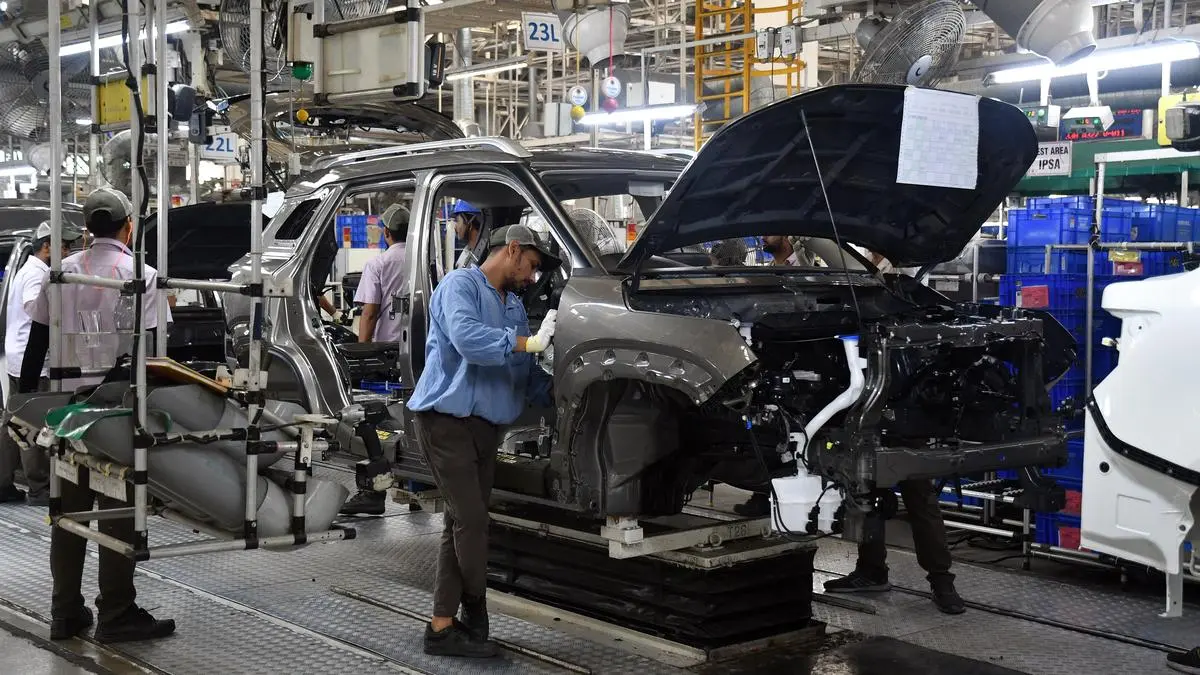
As per the draft, OEMs are permitted to offset any debit balance accumulated in their passbooks through the purchase of credits from the Bureau of Energy Efficiency (BEE).

As per the draft, OEMs are permitted to offset any debit balance accumulated in their passbooks through the purchase of credits from the Bureau of Energy Efficiency (BEE). | Photo Credit: KAMAL NARANG

The government has proposed a more flexible compliance framework under the draft Corporate Average Fuel Efficiency-3 (CAFE-3) norms, easing penalty norms and allowing automakers to trade carbon credits to meet emission targets, sources told businessline.

The revised framework shifts the focus away from the earlier small-car versus large-vehicle debate and instead prioritises reducing overall fleet emissions. The objective is to push original equipment manufacturers (OEMs) to produce vehicles with lower CO₂ emissions while accelerating adoption of electric vehicles (EVs), hybrids, and alternative fuels such as biofuels, in line with India’s net-zero target for 2070.

The five-year plan for CAFE-3 norms will kick in from April 2027 and will cover the financial years 2027-28 to 2031-32.

Key feature

A key feature of the draft norms is the introduction of a market-based compliance mechanism. Automakers that exceed emission reduction targets will be allowed to trade surplus carbon credits with manufacturers that fall short, subject to mutually agreed terms.

Under the draft, the outcome of such credit trading must be completed and reported to the designated agency responsible for monitoring compliance.

For instance, manufacturers that overachieve emission targets could monetise surplus credits by transferring them to companies struggling to meet prescribed limits, thereby reducing compliance costs across the industry. The move signals a shift toward flexibility-driven regulation, aimed at securing industry buy-in while maintaining pressure on manufacturers to progressively reduce fleet emissions.

When calculating the weighted average CO2 of an OEM, clean vehicles such as electric vehicles (EVs), hybrids, plug-in hybrids, flex-fuel or flex-fuel hybrid vehicles, are assigned higher weightage. When a lower CO2 car is given higher weightage, it helps reducing overall weighted average CO2 of an OEM, thereby benefitting the OEM.

As per the draft, OEMs are permitted to offset any debit balance accumulated in their passbooks through the purchase of credits from the Bureau of Energy Efficiency (BEE).

“The price per gram of CO₂/km of such credits shall be as prescribed for each reporting period — FY28–₹2,500; FY29–₹3,000; FY30–₹3,500; FY31–₹.4,000; and FY32–₹4,500,” it stated.

For performance assessment, the annual average of actual fuel consumption for OEM would be calculated on the Modified Indian Driving Cycle (MIDC), a laboratory-based chassis dynamometer test cycle used to certify fuel efficiency and emissions for passenger vehicles, similar to the New European Driving Cycle (NEDC).

“The government has addressed the automobile industry’s grievances, shifting focus from penalising manufacturers to incentivising a greener transition. This latest draft prioritises the promotion of low-emission vehicles, including EVs, hybrids, and biofuels, as a core strategy to meet India’s 2070 carbon-neutral target,” said an automobile expert.

Published on April 12, 2026