




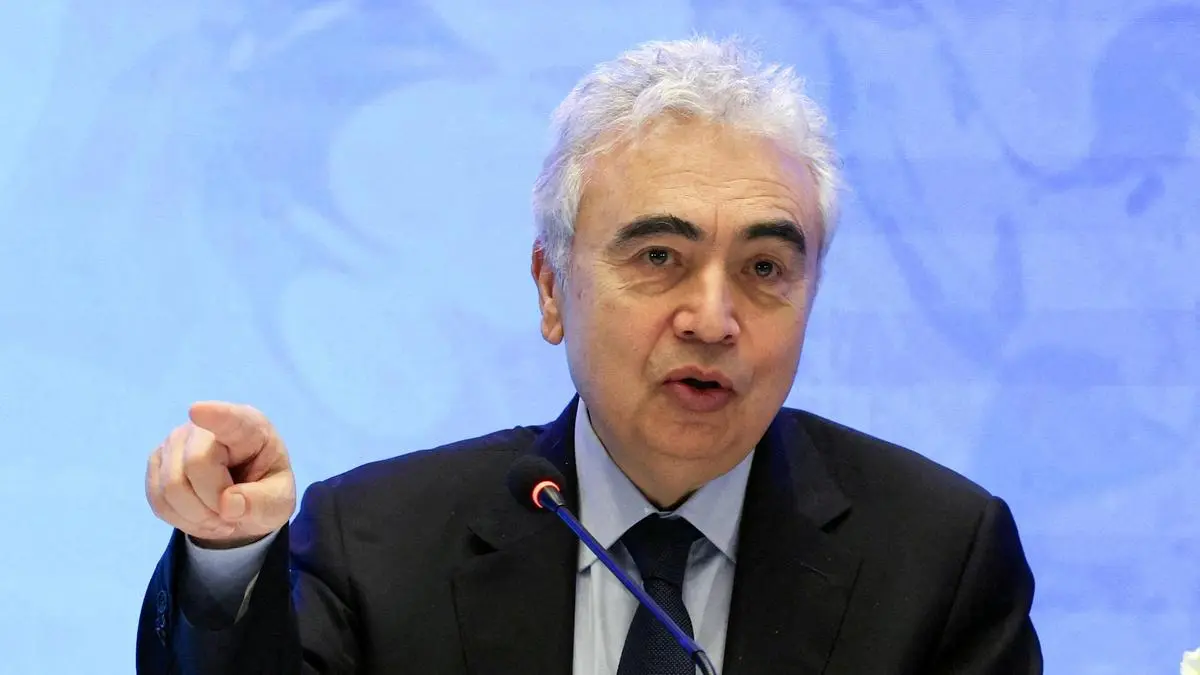
International Energy Agency (IEA) Executive Director Fatih Birol | Photo Credit: DILARA SENKAYA
Europe has “maybe six weeks or so” of remaining jet fuel supplies, the head of the International Energy Agency said Thursday in a wide-ranging interview, warning of possible flight cancellations “soon” if oil supplies remain blocked by the Iran war.
IEA Executive Director Fatih Birol painted a sobering picture of the global repercussions of what he called “the largest energy crisis we have ever faced,” stemming from the pinch-off of oil, gas and other vital supplies through the Strait of Hormuz.
“In the past there was a group called Dire Straits.' It's a dire strait now, and it is going to have major implications for the global economy. And the longer it goes, the worse it will be for the economic growth and inflation around the world,” he told The Associated Press.
The impact will be “higher petrol (gasoline) prices, higher gas prices, high electricity prices,” said Birol, speaking in his Paris office looking out over the Eiffel Tower.
Economic pain will be felt unevenly and “the countries who will suffer the most will not be those whose voice are heard a lot. It will be mainly the developing countries. Poorer countries in Asia, in Africa and in Latin America,” said the Turkish economist and energy expert who has led the IEA since 2015.
But without a settlement of the Iran war that permanently reopens the Strait of Hormuz, “Everybody is going to suffer,” he added.
“Some countries may be richer than the others. Some countries may have more energy than the others, but no country, no country is immune to this crisis,” he said.
Nearly 20 per cent of the world's traded oil passes through the Strait of Hormuz in peacetime. Birol warned that not reopening the waterway within weeks could compound the repercussions for global energy supplies.
“In Europe, we have maybe six weeks or so (of) jet fuel left,” he said. “If we are not able to open the Strait of Hormuz... I can tell you soon we will hear the news that some of the flights from city A to city B might be cancelled as a result of lack of jet fuel.” He added: “Many government leaders tell me that if Hormuz is not open until (the) end of May, many countries — starting from the weaker economies — are going to face huge challenges, and this will go from the high inflation numbers to coming close to slow growth or even to recession in some cases.” Birol spoke out against the so-called “toll booth” system that Iran has applied to some ships, letting them travel through the strait for a fee. He said allowing that to become more permanent would run the risk of setting a precedent that could then be applied to other waterways, including the vital Malacca Strait in Asia.
“If we change it once, it may be difficult to get it back,” he said. “It will be difficult to have a toll system here, applied here, but not there.” “I would like to see that the oil flows unconditionally from the point A to point B,” he said.
More than 110 oil-laden tankers and over 15 carriers loaded with liquefied natural gas are waiting in the Persian Gulf and could help ease the energy crisis if they could escape through the Strait of Hormuz to world markets, Birol said, adding: “But it is not enough.” Even with a peace deal, war-damage to energy facilities means it could be many months before pre-conflict levels of production are restored, he said.
“Over 80 key assets in the region have been damaged. And out of these 80, more than one third are severely or very severely damaged,” he said.
“It will be extremely optimistic to believe that it will very quick,” Birol said. “It will take gradually, gradually, up to two years to come back where we were before the war.” Birol said it is incomprehensible that “a couple of hundred men with guns” — apparently referring to Iranian forces — are able to hold hostage the global economy.
He said his Paris-based agency, which advises governments on energy policy and helped coordinate a record release of emergency oil reserves earlier in the crisis, has warned for years about the critical importance of the Strait of Hormuz.
The global shock could spur the embrace of other energy technologies, including nuclear power, and “will reshape the global energy map for the next years to come,” he said.
On his office shelves, Birol has a couple of soccer balls — he's a devoted supporter of the Turkish club Galatasaray — and other memorabilia, including a photo of his late father playing soccer, and reams of books. One in particular stood out for its timely title: Oil, Power and War.
“Energy and geopolitics have been always interwoven,” Birol said. “But I have never, ever seen... such a dark and long shadow of geopolitics." He added: "Unfortunately, energy is at the heart of many conflicts which, again, makes me, as an energy person, rather sad, to be honest.”
Published on April 17, 2026
此内容由惯性聚合(RSS阅读器)自动聚合整理,仅供阅读参考。 原文来自 — 版权归原作者所有。