







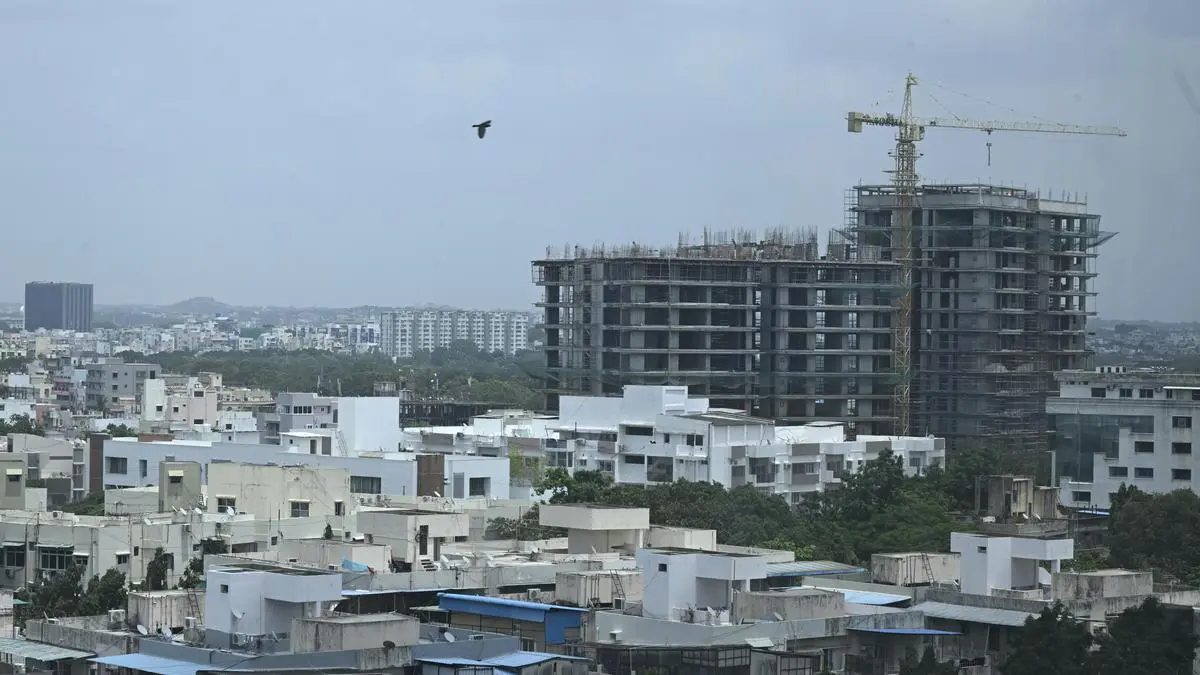
According to ANAROCK, Grade A office demand across the top seven cities rose 17% year-on-year to 58.2 million sq. ft. in 2025 | Photo Credit: RAMAKRISHNA G
India’s office market is no longer moving in one direction; it is clearly splitting into two distinct tracks. On one side, Grade A assets are tightening their grip on demand; on the other, mid-tier buildings are steadily losing relevance. This divergence is not cyclical, it is structural, observe industry leaders.
Data backs this observation. According to ANAROCK, the demand for premium office space continues to accelerate. Grade A office demand across the top seven cities rose 17 per cent year-on-year to 58.2 million sq. ft. in 2025. Southern markets lead this momentum, with Bengaluru (14.95 million sq. ft.), Hyderabad (8.5 million sq. ft.), and Chennai (5.9 million sq. ft.) accounting for a significant share of absorption.
Vacancy levels are also tightening, with the overall rate easing to 16.1 per cent, and Chennai emerging as the most resilient market at 8.8 per cent.
What is driving this shift is not just demand, but the nature of demand. Leasing activity is increasingly led by global capability centres (GCCs), multinational corporations, and flex space operators. These occupiers are prioritising quality, scalability, and future-ready infrastructure, factors that mid-tier buildings often struggle to match.
Grade A assets, with their ESG certifications, integrated amenities, and institutional-grade design, are commanding rental premiums of up to 20 per cent, yet continue to see strong uptake.
“Grade A continues to hold strong, both in terms of occupancy and rentals, largely because companies are consolidating into better quality, future-ready workspaces,” said Ashok Kularia, Managing Director at ANJ Group. In contrast, demand for mid-tier assets has become far more selective, with landlords often having to offer flexible terms to close deals.
The divergence is also visible in supply trends. Total office completions touched 52 million sq. ft. in 2025, up 8 per cent year-on-year, with a significant portion skewed towards Grade A developments. Southern cities, particularly Bengaluru and Hyderabad, accounted for 52 per cent of new supply, while Pune saw a sharp 103 per cent jump in deliveries. Chennai, too, recorded a 72 per cent increase in supply, underscoring developer preference for high-quality assets.
“The office market isn’t moving in one direction anymore, it’s clearly split,” said Aditya Chellaram of Featherlite Developers. “Grade A buildings are getting absorbed steadily, while mid-tier assets are finding it harder to stay relevant. The conversation with tenants rarely starts with rent anymore.”
For mid-tier assets, the challenge is becoming structural. Nearly half of India’s office stock is over a decade old, and increasingly misaligned with evolving tenant expectations.
As Shravan Nawany of Nawany Group pointed out, what was considered Grade A a decade ago no longer meets today’s benchmarks. While some buildings can be upgraded through retrofitting, unlocking potential rental upside of 20–40 per cent, others may require more extensive overhauls, particularly in core infrastructure and building systems.
Vacancy in mid-tier assets, especially in suburban clusters, remains elevated, with landlords offering rent-free periods and fit-out support to attract tenants. Demand here is largely driven by SMEs, MSMEs, and mid-tier IT/BPM firms, while flex operators are also emerging as key occupiers.
The shift, however, appears durable. With annual leasing of 70–80 million sq. ft. increasingly led by Grade A assets, the gap between premium and mid-tier offices is widening, not just in rents, but in relevance. For developers and landlords, the choice is becoming clearer: upgrade meaningfully or risk being left behind.
Published on May 6, 2026
此内容由惯性聚合(RSS阅读器)自动聚合整理,仅供阅读参考。 原文来自 — 版权归原作者所有。