惯性聚合 高效追踪和阅读你感兴趣的博客、新闻、科技资讯
阅读原文 在惯性聚合中打开

推荐订阅源

C
Cisco Blogs
Cyberwarzone
Cyberwarzone
Exploit-DB.com RSS Feed
SecWiki News
SecWiki News
Martin Fowler
Martin Fowler
T
Tor Project blog
N
Netflix TechBlog - Medium
C
Cybersecurity and Infrastructure Security Agency CISA
V
Vulnerabilities – Threatpost
V
Visual Studio Blog
GbyAI
GbyAI
PCI Perspectives
PCI Perspectives
D
DataBreaches.Net
Jina AI
Jina AI
H
Heimdal Security Blog
云风的 BLOG
云风的 BLOG
P
Privacy International News Feed
A
About on SuperTechFans
J
Java Code Geeks
美团技术团队
H
Hackread – Cybersecurity News, Data Breaches, AI and More
N
News | PayPal Newsroom
有赞技术团队
有赞技术团队
MyScale Blog
MyScale Blog
博客园 - 司徒正美
C
Check Point Blog
T
Threat Research - Cisco Blogs
Attack and Defense Labs
宝玉的分享
宝玉的分享
AI
AI
Simon Willison's Weblog
C
Cyber Attacks, Cyber Crime and Cyber Security
I
Intezer
P
Proofpoint News Feed
Blog — PlanetScale
Blog — PlanetScale
Apple Machine Learning Research
Hugging Face - Blog
Hugging Face - Blog
The Last Watchdog
The Last Watchdog
freeCodeCamp Programming Tutorials: Python, JavaScript, Git & More
Vercel News
Vercel News
I
InfoQ
阮一峰的网络日志
阮一峰的网络日志
Cisco Talos Blog
Cisco Talos Blog
W
WeLiveSecurity
Hacker News: Ask HN
Hacker News: Ask HN
Recent Commits to openclaw:main
奇客Solidot–传递最新科技情报
奇客Solidot–传递最新科技情报
D
Docker
博客园 - Franky
Security Archives - TechRepublic

Corporate File Specials, Corporate News & Insights | The HinduBusinessLine

Eating together at work How TAFE is driving Technology and Talent Transformation? Cars24 flattens out Corporate trust in AI declines If you are reachable, you’re breachable: Zscaler’s Jay Chaudhry Global funds snap Indian stock selling streak as oil shock ebbs Monday Motivation: A vine of help is always there Why FMCG giants buy D2C brands Market leaders outpace the auto pack Horiba India’s growing yen for tests India dominates skilled migration flow Future of work Narasu’s Coffee’s besh! besh! rejuvenation RITES of passage to hyper-competition Corporate ‘austerity’ can’t cut it Freedom does not create failure or excellence - it reveals character The Art of Letting Go - at every stage, not just when we retire Fiduciary feuds threaten Tata’s legacy How Diageo’s doubled investment is scaling up Sober AI and office space Air India: Flying from turbulence to turnaround How India’s ethanol hedge is paying back How Indian IT majors are decoding AI When we are starstruck! Fire me if I fail: Pirojsha Godrej Tech giant Adobe opens seventh office in India Costly, but AI is not yet a bubble JAL insolvency sees corporate titans cross swords New hope at HOEC These old reunions – Quo Vadis? GST reform is sweet news for Perfetti Van Melle India What an Oracle foretells about jobs and careers in the AI era Less engaged workforce TVS Motor bikes into global third spot Building Lalit hotels with emotion Lupin goes for bigger bites of innovation Does greater online penetration destroy profitability? From 200 hotels to 500: Radisson’s blueprint for growth in India AI talent transformation at LTM Ikea’s DIY plans for India How should CEOs respond to the West Asian crisis Finding a niche in air, water and carbon The Pygmalion effect on cricket and work! The hidden hub transforming rural livelihoods From agarbatti to aerospace — the radiating scent of success ‘We have to start thinking of AI as a public good’ How Suzlon’s ‘decoupling’ gambit is paying dividends ‘Biz leaders must find ways of using AI to deliver value for consumers’ Tariff-driven exim: Access does not guarantee success Behind the hype of Indian CEOs dominating global corporate giants Rane group looks for a resurgence Where can you find new jobs today? Gig workers and the cost of speed Profitability of start-ups is a measure of their efficiency: Kanwal Rekhi, founder of TiE ITC reaches Cloud: Get Biryani & Makhana delivered to your door! How InMobi’s Naveen Tewari got inspired by Mukesh Ambani Global opportunities ahead, but China is a competitive threat The shape of biz and trade blocs to come Right to disconnect: A bridge too far? How Shailesh Chandra put the spark back in Tata Motors Indian arms of MNCs find place in the sun How Sunil Munjal is ‘Heroing’ arts, culture and education Rise in fair pay perception Ageing as a corporate barrier BKT wheels into consumer segment How Balaji Wafers feeds Gujarat’s growth into a snack powerhouse Storytellers for the new age Temporary lull in hiring Nadir Godrej — the Renaissance man Hatsun earns its place in the sun Leadership is about hope and resilience Sandeep Goyal’s art of the audacious deal Motivation and career moves A fifth-gen scion steers a born-again conglomerate Exit dialogue: What would you consider a decent severance pay? From Matunga’s chawl to Crisil’s corner office Rebranded, TSF group lays road for future Can Rapido play spoilsport in the food delivery party? Wanted: A country without job fears! Lack of reliable tech a big pain point for Indians A guide to second innings Behind the rise and rise of SME IPOs on BSE A tale of two sisters, two States, two chains Vedanta holds course on bumpy demerger process How Bharat Kaushal is leading Hitachi India through its character change Schwing Stetter India has concrete plans in place The visual disconnect Real money gaming: Down but not out, and taking new bets Tyre to tech: Inside Anant Goenka’s leadership journey Weighing the rewards balance of a risky job Age of AI: It’s still human-first in corporate corridors ‘Minding’ its own business Google’s silver move ‘Colombo can be a good location for Indian corporate events’
Firing up venture capital
2025-08-17 · via Corporate File Specials, Corporate News & Insights | The HinduBusinessLine

It’s been 10 years since Fireside Ventures was set up by Kanwaljit Singh, who had earlier cut his teeth on consumer marketing at HUL and Intel before plunging into investing with Carlye Group and Helion Venture Partners. The first fund of Fireside Ventures was $50 million, and the portfolio companies included boAt, Mamaearth, and Vahdam among others. The second fund was $118 million, with investments in 13 companies; the third fund was $250 million, with investments in 25 companies.

Three funds and several successful exits later, you ask Singh how Fireside’s journey of investing has evolved. How have the three funds differed from each other? Were there any differences in the investing strategies?
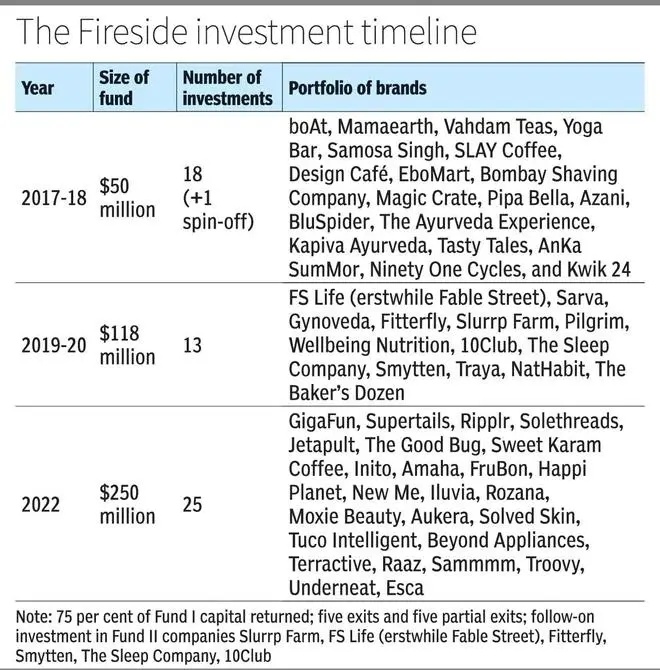
The response is in the affirmative. There have been significant changes — in ticket size, the type of companies that were funded, the scope of investment, the size of the team (there are five partners now), and so on. When they started, the modest ambition was to scale start-ups to ₹100 crore, but today that target has been upped to ₹1,000 crore.

But the most important evolution, says Singh, is that Fireside is now fully focused on being a responsible investor, educating portfolio companies on ‘environmental, social, and governance’ or ESG factors, sustainability and diversity. “We can’t solve the world’s problems, but we are trying very hard,” he says.

But let’s rewind to fund one.

“In 2015, my intuition was that there was an opportunity to build great new-age brands in India for the young millennial generation, using digital as the primary medium. So in fund one, the investment strategy was focused on digital-first brands that targeted urban millennial consumers,” he says.

‘Exitable’ factor

In the first fund, he adds, the investment would be in multi-stages. “We would write the first cheque of $1 million very early and then, once the company was a little more established, pump in, say, $3 million. We thought this way we could work with the companies throughout, helping shape their foundation and growth.”

The hypothesis, he elaborates, was that you could build a good business so that it becomes “exitable” either to large private equity players wanting to take it to the next level or to strategic acquirers. “That was the scope of our thinking,” says Singh.

Fireside’s investing model was to come in with a 10 per cent stake, and increase ownership gradually to 20 per cent over time. But, Singh explains, they found increasing ownership bit by bit was not that easy, as often the portfolio companies would have got investment from elsewhere too, or the valuation would have gone up.

Which is why, for its second fund, the venture capital firm raised $120 million (₹860 crore). Now, instead of 10 per cent at the start, they could come in at 20 per cent. There were other differences too. Instead of focusing purely on fast-moving consumer goods, Fireside expanded the scope to other categories — home, lifestyle, and fashion, among others. And since this fund happened during the early days of Covid, healthcare naturally also became a focus area. Thus investments happened in Fitterfly, Gynoveda and Wellbeing Nutrition.

“We also defined the consumer differently — looking beyond the young millennial, and at segments beyond digital and metros and urban areas,” says Singh. A classic case, he says, was The Sleep Company, which worked offline and online and had 150 stores spread across markets. Another example was Pilgrim, a beauty brand with sharp price points that had customers drawn from small-town India.

Around this time, says Singh, Fireside also began questioning whether it could become a more responsible investor. “So we got somebody on board as our ESG officer. We found founders who were very conscious about the environment, about diversity, sustainability, governance.”

But, he says, they also needed guidance. So Fireside got a full-time resource to work with companies on cutting down wasteful packaging and focusing on planet-friendly measures. “The good news is that many of our companies have been conscious about it from day one, like the tea company Vahdam. The company actually uses a percentage of its revenue to educate children of tea pickers,” says Singh.

Fireside also became a signatory to the United Nations Principles for Responsible Investing (UNPRI). “We collect data from all our companies and publish reports,” he says, adding that they also do an impact report.

Small-town business

By Fund 3, Fireside was also embracing companies that were going far deeper into small-town India. “We started looking at Tier 3, Tier 4.” He points to Rozana as having an interesting model — creating a network of local individuals (such as anganwadi workers) who act as peer partners, delivering products and thus bridging the digital divide.

The consumer segment also expanded — Fireside began looking at companies catering to older women as a segment — for instance, products and services for issues like menopause, longevity. And way beyond its initial focus on digital-first companies. For instance, now Fireside has invested in a lab-grown diamond jewellery business called Aukera.

Fireside’s investment decision, Singh says, hinges a lot on the temperament of the founder. “If there is an average founder and a great business versus a good founder and average business, I would take the latter any day.”

And as Fireside evolved, Singh says, it has built multiple playbooks, on issues like how to work with Amazon, how to build a D2C business, how to design structures for growth, and so on. “It’s all open source and for the whole community, it’s not proprietary,” he adds .

“We have strengthened our conviction in the consumer opportunity. We have expanded our scope on all fronts, sectors, geography, and the whole idea of how large this business can become. Today we have one company (boAt) nearing ₹4,000 crore revenue. So we are saying to the founders, ‘Can you build at least a ₹1,000 crore business’.”

More Like This

INTEGRATED RESORT: City of Dreams Sri Lanka in Colombo

BRO Vector

nortonrsx

Chander Mohan Sethi, the recently deceased former chairman and MD of Reckitt Benckiser India (file image)

Published on August 18, 2025