








On September 19, Kolkata-based LT Elevator, a company that provides urban parking solutions and makes escalators, made its debut on the stock exchanges at a 75 per cent premium to its issue price, becoming the 624th company to list on the BSE SME platform. It was a dream debut as the initial public offer (IPO) with an issue size of ₹39.4 crore was subscribed nearly 183 times.
The bulk of the demand came from non-institutional buyers while there was significant interest from individual retail investors, too.
For companies like LT Elevator, the BSE SME and NSE Emerge Platforms on which medium, small and micro enterprises (MSMEs) can list, are a big boon – giving them an important avenue to tap funds and grow their business.
Capital raising
Since its inception in 2012, the 600+ companies listed on BSE SME have cumulatively raised ₹11,660 crore as on September 24, while the 663 companies listed on the NSE platform have raised ₹19,450 crore as of August 31. In the last 4-5 years, not only is the number of IPOs on these platforms increasing, but the pace of listing is galloping.
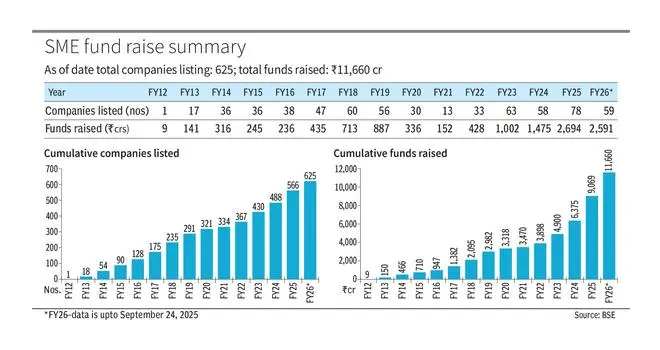
In FY15, there were just 36 issuances on the BSE SME segment. That number hit a high of 78 in FY25. In the first half of this year, 59 MSMEs have already been listed, and expectations are that last year’s figures will be crossed. And, if the first 100 listings on the BSE SME platform took 40 months with a fundraise of around ₹740 crore, the 500th to 600th listing took just 15 months with a fundraise of around ₹4,000 crore. The fact that a third of these companies have migrated to the mainboard shows the positive impact of the capital raising.
Take consumer appliances retailer Aditya Vision that listed on the BSE SME platform in 2016 and later migrated to the mainboard in 2021 and listed on the NSE mainboard last year. Chairman and Managing Director Yashovardhan Sinha says that listing on the exchanges was a big event for the company. While it raised a modest amount of ₹5.8 crore in the IPO, it helped it raise another ₹18 crore in debt.
“So, what actually happened was that our corpus grew by ₹24 crore, and then we started expanding in a very big way. Where we are right now was only because we could raise that initial amount,” says Sinha.
A tighter ship now
Of course, it’s not been smooth sailing for the exchanges. Initially, when the SME platforms were launched, the emphasis was to ensure accessibility to funds rather than imposing stringent financial conditions. At that time, the criteria was fairly relaxed at a minimum net tangible asset of ₹1 crore as per the latest audited financial results, a minimum net worth of ₹1 crore, and demonstration of distributable profits for at least two years.
However, rampant oversubscription, listing at exorbitant premiums, several instances of diversion of funds, inflation of revenues in financial statements, and promoters selling significant chunks in the offer-for-sale portion forced the markets regulator to step in.
The eligibility criteria was tightened, and the net worth condition now stresses ₹1 crore for two preceding full financial years instead of the earlier ₹1 crore; net tangible assets of ₹3 crore in the last preceding financial year instead of at least ₹1 crore. Also, several new criteria have been introduced such as necessity to show an operating profit from operations for two out of three latest financial years preceding the application date, leverage ratio of not more than 3:1, monitoring agency to be appointed for issues above ₹50 crore, repayment of loan to promoters, promoter group and related entities not allowed either directly or indirectly; and working capital above ₹5 crore to be certified by statutory auditor.
Additionally, there are clauses: the offer for sale cannot be more than 20 per cent of the issue size; a minimum promoters’ contribution of 20 per cent equity shareholding is to be locked in for three years, and there have to be a minimum of 200 investors in an IPO.
Quality issuances
The tightening of the regulations has resulted in better quality issuances, says Shripal Shah, MD, Aryaman Financial Services, which has managed around 100 SME issuances.
“These small companies, once they realise that by being transparent, showing everything on their books they can get more money and grow the business, it’s a win-win situation,” he says.
Parth Shah, Director at Smart Horizon Capital Advisors, points out that the filtration system is working well. “Every day, we get 20-30 proposals, and we are taking one or maybe none.”
The onus is now also on the investment bankers to ensure that the documents and the disclosures are in line with the regulations. Shah says his over a decade-long experience in the capital markets helps him assess the quality of the issuer just by looking through the balance sheets or conversing with the promoter.
Notwithstanding the tighter regulations, the fact that SME IPOs still continue to attract good subscription attests to the increased trust in the companies.
Meet Paradeep Parivahan, a 25-year old company that provides logistics services in port cargo handling, which listed on the BSE in March. Bushra Khan, Director of the company, says, “The process was well-structured and streamlined, which reduced friction and built confidence in the system. The BSE team provided step-by-step guidance, with clear documentation requirements and timely clarifications.“
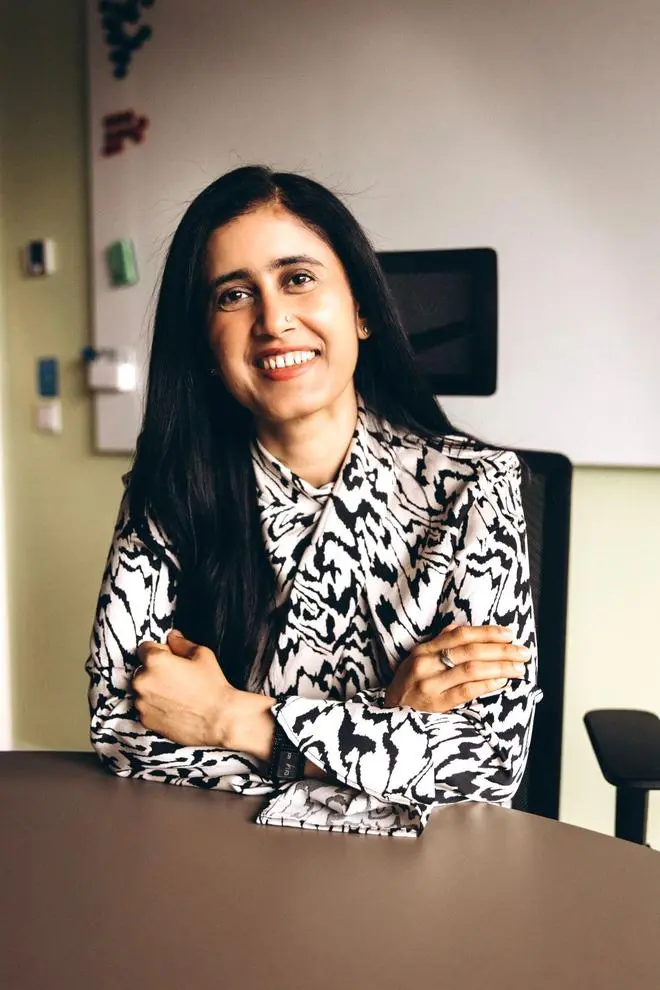
Bushra Khan, Director, Paradeep Parivahan
But processes may be further tightened according to BSE CEO Sundararaman Ramamurthy. “Many changes have been ushered in suo moto by the exchange as well as by the regulator. Now, for further strengthening, certain issues are under active consideration,” he says.
For instance, the exchange has made recommendations related to the role of merchant bankers, disclosure gaps and funds utilisation. “We started with the soft cushion, it was a soft touch regulatory process with which we started, because we wanted to encourage SMEs. Over a period of time, it is maturing and therefore it is tightening,” he says.
“Our strong belief is the more you tighten regulation, the more business you will get.”
AI for scrutiny
Now, BSE is harnessing Artificial Intelligence to help with the scrutiny process. “We have developed an AI tool for evaluating the offer documents that were filed on our SME platform. This AI tool helped us in ensuring that the disclosures are comprehensive and flagged discrepancies across the entire offer document,” says Ramamurthy.
The draft red herring prospectus is a voluminous document and the SMEs often work with small merchant bankers. “Errors and discrepancies are common, so we have to catch them,” he adds, adding that the AI tools can also throw up anomalies such as frequent auditor changes, sudden profit spikes or pending cases against promoters. “If explanations are not satisfactory, we reject applications.”
The tool has been extended to investment bankers as well as a pre-check facility to self-validate the draft offer document, helping in identifying the gaps early-on and prodding them to make necessary amendments before officially filing the offer document with the SME platform.
“The AI tool has helped in reducing the turnaround time and in conducting thorough evaluation in a timely manner, thereby leading to issue timely approvals,” says Ramamurthy.
More than 120 documents have been processed with this tool and the approval time has been cut to 45 days from more than three months earlier.
Small and medium enterprises account for 30 per cent of the GDP and 36 per cent of manufacturing output according to the MSME annual report. As Ramamurthy says, “SMEs are good for the economy as their contribution to exports, GDP, and employment is vital. If even 60,000 out of the 6 crore companies in India get listed, it will create significant wealth and capital for the nation.”
That’s why BSE has gone on an awareness overdrive to drive home the benefits of listing to SMES.
Published on September 29, 2025