




Fans pay homage to Zubeen Garg in Guwahati. Musical icon Zubeen Garg died in Singapore while attending the North East India Festival. | Photo Credit: RITURAJ KONWAR
The true measure of a life’s impact is often reflected in the collective grief that follows its conclusion. The number of individuals who gather, unbidden, to offer a final farewell is a profound metric of connection, respect, and love earned.
On September 21, Guwahati bid adieu to one of its most cherished and celebrated sons, Zubeen Garg. The streets of Guwahati witnessed vast multitudes of mourners, who wanted to honour the legendary singer for the last time. The numbers were so large that it can be equated with other emotional moments frozen in history such as the funeral procession of Annadurai, Ayatollah Khomeini and Princess Diana.
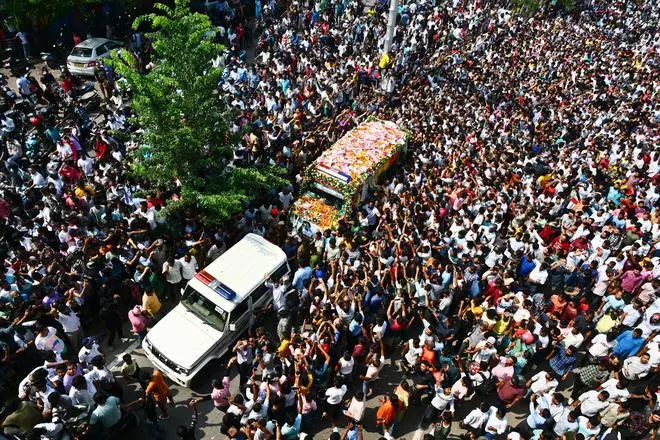
Zubeen Garg’s mortal remains begin their final journey home as thousands pour on to streets for a last glimpse of the singer in Guwahati on Sunday, 21 September 2025. | Photo Credit: RITU RAJ KONWAR
History records several instances of mass gatherings that mark the passing of individuals who shaped nations or cultures. It must be mentioned here that all figures of such gatherings are the best given estimates by official sources. According to the ‘Guinness Book of World Records’ estimates, the funeral of C.N. Annadurai, a former chief minister of Tamil Nadu in 1969, with an attendance of 15 million, holds the record for the largest funeral gathering in the world.
Other significant gatherings include approximately 10 million for the funeral of Ayatollah Khomeini of Iran in 1989, around 4 million for Pope John Paul II in 2005, and about 3 million for Ayrton Senna, the legendary F1 racer from Brazil, in 1994. The funerals of figures like Victor Hugo (author of ‘The Hunchback of Notre-Dame’ and ‘Les Misérables’), Hugo Chávez (former president of Venezuela), and Diana, Princess of Wales, each drew crowds estimated in the millions.

Within this global context, the funeral of Zubeen Garg in 2025 was noted for its scale, with reports indicating a gathering of lakhs, recognised as one of the largest such assemblies.
Incidentally Zubeen Garg, other than Ayrton Senna, is the only strictly non-political or religious leader in this list.
Zubeen Garg was a musical composer and vocalist whose work defined a generation in Assam and beyond. His career spanned decades, producing a vast body of popular work in multiple languages, especially Hindi, Bengali and Assamese. He cultivated an image as an artist who operated outside established systems, often taking public stands on issues of social and political injustice, such as his protest against the CAA in Assam. His advocacy frequently focused on the rights of marginalised communities. His expressions of Axomiya identity transcended political, social, and religious divisions, representing a broader cultural concept that resonated deeply with the public. He was also involved in humanitarian efforts, leveraging his platform for various causes.
The scale of the gathering for Zubeen Garg’s funeral serves as a final testament. It indicates that the real wealth of a person is not counted in possessions, but in the space they occupy in the hearts of people. His legacy is cemented not by awards, but by the silent, powerful testimony of a million voices in mourning, affirming a life lived as a hero of the masses.
Published on September 26, 2025
此内容由惯性聚合(RSS阅读器)自动聚合整理,仅供阅读参考。 原文来自 — 版权归原作者所有。