


Small-cap funds have become the fastest-growing equity segment in India’s mutual fund industry. Over the past five years, investor accounts in this category have surged by nearly 450 per cent, from about 50 lakh to 2.7 crore as of November 2025. This sharp rise in retail participation raises an important question: are investors allocating to small-cap funds based on a clear understanding of risk, or are they merely chasing recent performance?
The small-cap universe largely comprises early-stage businesses with lower market capitalisation, limited liquidity, higher earnings volatility, relatively weaker governance structures, and greater sensitivity to economic cycles. These structural characteristics make small-caps inherently riskier than mid- and large-cap companies.
While small-cap investing can create meaningful wealth over long periods, it comes with pronounced volatility and behavioural challenges. For retail investors, recognising and preparing for these risks is critical before committing capital. Here, we outline two of the most significant risks in small-cap funds and present a disciplined framework to navigate this volatile but potentially rewarding segment.
Large drawdowns
One of the most defining characteristics of small-cap investing is the severity of drawdowns during market downturns. Maximum drawdown, which measures the peak-to-trough decline in portfolio value, is consistently higher for small-cap indices and funds than for their mid-cap and large-cap counterparts.
During the global financial crisis, the Nifty Smallcap 250 Total Return Index (TRI) witnessed a drawdown of about 76 per cent, compared with declines of 73 per cent for the Nifty Midcap 150 and 61 per cent for the Nifty 100. Similarly, during the Covid-19 market crash, the small-cap index fell nearly 59 per cent, while mid-cap and large-cap indices declined by about 43 per cent and 38 per cent, respectively. Large-cap indices typically experienced relatively lower drawdowns, reflecting stronger balance sheets, superior liquidity, and higher institutional ownership.
The implication for investors is clear: small-cap funds demand a much higher emotional and financial tolerance for volatility. Deep drawdowns not only erode portfolio value but also test your discipline. Many investors exit near market bottoms, converting temporary paper losses into permanent capital loss. Only investors who can remain invested through sharp equity drawdowns stand a realistic chance of benefiting from small-cap investing over the long term.
Prolonged periods of underperformance
Another frequently underappreciated risk is the tendency of small-caps to undergo extended phases of underperformance. While small-caps can deliver sharp and outsized returns during favourable cycles, these bursts are often followed by long stretches of muted or even negative performance. Although similar cycles occur in large-cap and mid-cap segments, the magnitude and volatility of underperformance are significantly higher in small caps.
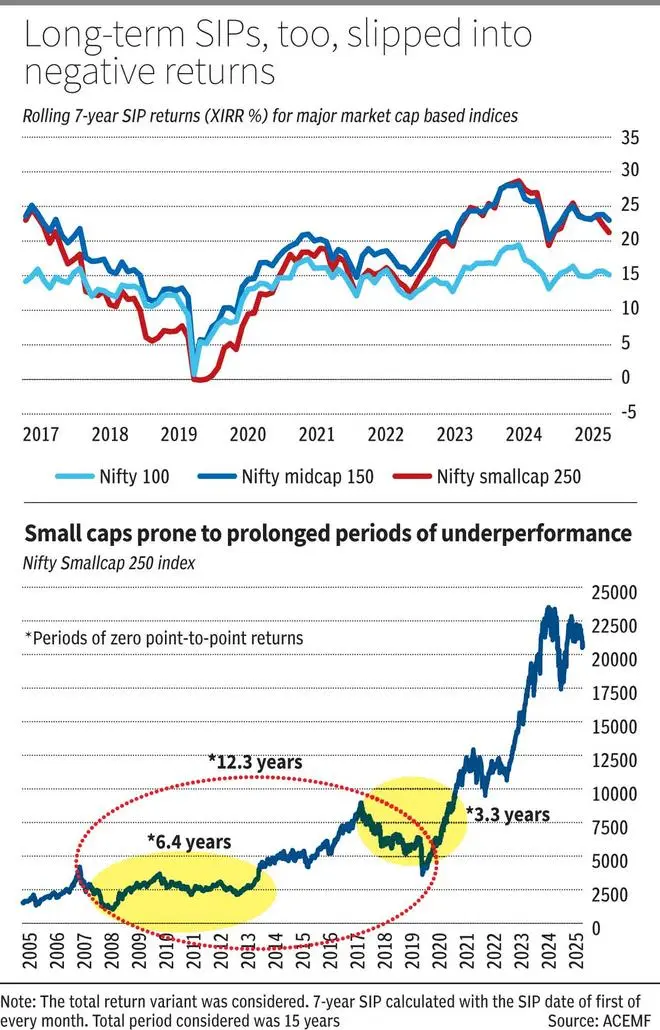
Between January 2008 and June 2014, the Nifty Smallcap 250 index remained largely range-bound, oscillating between 1,000 and 4,000 points, and took nearly 6.4 years to surpass its January 2008 peak. An investor entering via a lump-sum investment at the peak would have earned virtually no returns over this period. While large-cap and mid-cap indices also experienced sluggish performance during the same timeframe, price swings and drawdowns were far more severe in small-caps.
Volatility metrics reinforce this observation. On an annualised basis, the standard deviation of the small-cap index during the period stood at around 37 per cent, compared with 28 per cent for large-cap indices and 34 per cent for mid-cap indices. Higher volatility not only deepens drawdowns but also prolongs recovery periods, increasing both financial stress and behavioural fatigue.
SIPs: helpful, but not a silver bullet
SIP outcomes during such periods offer a more nuanced perspective. Systematic investing tends to work during downturns by accumulating a higher number of units at lower prices. During the 2008–2014 period, while lump-sum delivered zero return, SIPs in the Nifty Smallcap 250 generated an annualised return of about 17 per cent, comparable to the 18 per cent delivered by the Nifty Midcap 150 and higher than the 15 per cent from the Nifty 100. At the fund level, small-cap funds delivered SIP returns of around 18.6 per cent, compared with 14 per cent for large-cap funds and 19.3 per cent for mid-cap funds.
A similar pattern was observed between January 2018 and May 2021, a 3.3-year phase during which the small-cap index delivered virtually zero returns. Despite this, SIP investors in the small-cap index earned an annualised return of about 22 per cent, broadly in line with mid-cap SIP returns of 23 per cent and ahead of large-cap SIP returns of 17 per cent. Funds performed relatively better, with large-cap, mid-cap, and small-cap funds delivering SIP returns of approximately 15 per cent, 21 per cent, and 25 per cent, respectively.
However, SIPs should not be viewed as a guaranteed risk-mitigation tool. Investors often assume that time alone smooths returns, but SIP rolling return data suggests otherwise. During prolonged downturns in small-caps, even disciplined SIP investors can experience extended periods of subdued or below-average outcomes. For example, seven-year SIP rolling returns for the small-cap index briefly turned negative for three to four months during the Covid-19 sell-off, while comparable SIPs in large-cap and mid-cap indices largely avoided negative territory due to more stable earnings and broader diversification. Six out of 10 small-cap funds too delivered negative seven-year SIP returns during April 2020.
Another notable phase spans January 2008 to April 2020, during which the Nifty Smallcap 250 index delivered a near-zero point-to-point return but witnessed sharp swings before staging a powerful rally post-April 2020. A comparison of SIP returns during the period shows that the Smallcap Index delivered 4.5 per cent, lagging the Nifty 100’s 7.8 per cent. Despite the strong post-2020 rally, prolonged volatility caused small-cap SIPs to underperform large-caps over this cycle, highlighting extended phases where patience does not necessarily translate into superior returns.
The message is small-cap investing requires patience, resilience, and a willingness to endure long stretches of disappointment even when investing through SIPs.
A practical framework for retail investors
Assess your risk tolerance: Can you withstand 30–60 per cent drawdowns without selling? Can you stay invested through three to five years of relative underperformance versus large-caps? If the answer is no, your small-cap exposure should be limited or avoided altogether.
Maintain a long investment horizon: Small-caps are long-duration equity assets. A minimum horizon of 7–10 years is essential to absorb cyclicality, allow earnings to compound, and give fund managers time to navigate liquidity and valuation cycles.
Size your allocation prudently: Small-caps should be treated as a satellite allocation rather than a core holding. For most retail investors, 5–15 per cent of the equity portfolio is sufficient. Conservative investors may cap exposure at the lower end, while aggressive investors with long horizons may allocate more. The objective is to capture upside without allowing small-cap cycles to dominate overall portfolio outcomes.
Prefer SIPs over lump-sum investments: SIPs help investors average into volatile assets, reduce timing risk, and enforce behavioural discipline. Lump-sum investments are better suited to periods following sharp market corrections, when valuations have clearly reset, the phases that are difficult for most retail investors to identify consistently. For smaller investors, disciplined SIPs, supplemented by step-ups during salary increases or tactical additions during market dislocations, are more practical.
Rebalance periodically: Rebalancing is critical to risk management. Sharp outperformance in small-caps can inflate portfolio weights and distort asset allocation. Periodic rebalancing — typically annually — helps lock in gains, restore target allocation, and align the portfolio with evolving goals.
Choose wisely between active and index funds: The small-cap space offers active funds, passive index funds, and smart-beta strategies. Active funds charge higher fees relatively but aim to generate alpha through stock selection and risk management. Index funds offer cost efficiency but fully replicate index volatility. Smart-beta funds apply rule-based tilts toward factors such as momentum or quality. Your choice should reflect conviction in manager skill, sensitivity to costs, and preference for simplicity.
Several active small-cap funds have delivered superior results over full market cycles. Investors may also consider consistently rated four- and five-star funds under the bl.portfolio Mutual Fund Star Track Ratings as part of their evaluation framework.
Published on December 20, 2025