


Edelweiss Aggressive Hybrid Fund has established itself as one of the consistent performers in the aggressive hybrid fund category. Since becoming eligible for bl.portfolio’s Star Track ratings, the scheme has maintained either a four-star or five-star rating across the last three editions. Currently, it holds a four-star rating under our framework. Over the past seven years, it has delivered a compounded annual growth rate (CAGR) of 14.4 per cent, comfortably ahead of the category average of 12.5 per cent.
A distinguishing feature of the fund is its factor-driven investment framework. Key portfolio characteristics include maintaining equity exposure largely in the 70-75 per cent range and following a short-duration strategy on the debt side.
Aggressive hybrid funds category is designed to provide a balance between growth and stability. They typically allocate 65-80 per cent of their portfolio to equities and 20-35 per cent to debt instruments. This mix makes them an attractive option for investors seeking reasonable growth while keeping overall risk at a moderate level.
The fund’s equity portfolio is managed through a quantitative, factor-based framework rather than the conventional discretionary stock-picking approach followed by most peers in the category.
Using quantitative models, the strategy combines multiple investment factors such as growth, quality and momentum to identify stocks across market-capitalisation segments. Within the aggressive hybrid fund space, only a limited number of schemes, including Quant Aggressive Hybrid Fund, follow a comparable factor-oriented investment approach.
The investment universe broadly consists of the top 500 companies by market capitalisation. This universe is then divided into four separate buckets: The top 50 large-cap companies, the next 50 companies, mid-cap stocks and small-cap stocks. Within each of these segments, the fund managers identify companies that qualify under growth-at-reasonable-price and quality-at-reasonable-price parameters.
For growth-oriented investing, the fund analyses both growth and valuation metrics to determine whether a company offers sustainable earnings expansion at attractive valuations. For quality investing, the evaluation focuses on parameters such as return ratios, debt-to-equity levels and consistency in earnings performance. The valuation comfort of these businesses is also assessed before inclusion in the portfolio.
Momentum is another important pillar of the strategy. The fund combines growth, quality and momentum factors across all four market-cap buckets to build the final portfolio. Overall, the portfolio is designed to remain broadly equally weighted across the three styles.
The fund also follows a disciplined rebalancing framework. Portfolio reviews and rebalancing exercises are conducted eight times a year. Typically, one review takes place before quarterly results and another after the results season. Before results, the fund managers assess market positioning and expectations regarding future growth trends. After results, the portfolio is reassessed based on actual earnings data, growth delivery and changes in company fundamentals.
The fund follows a flexi-cap approach and as per the latest portfolio as of March 31, 2026, the large-, mid- and small-cap allocation stood at 47 per cent, 15 per cent and 8 per cent respectively.
Currently, the fund is overweight on sectors such as pharma and healthcare, capital goods and, to some extent, chemicals, where it sees better opportunities. On the other hand, the fund remains underweight on oil and gas, IT and financial services. The top three sectors in the latest portfolio were banks (16 per cent), pharma (7 per cent) and telecom (5 per cent). Over the last one year, the fund increased allocation to telecom, petroleum products and capital markets by 2-3 percentage points, while trimming exposure to IT, industrial manufacturing and pharma sectors.
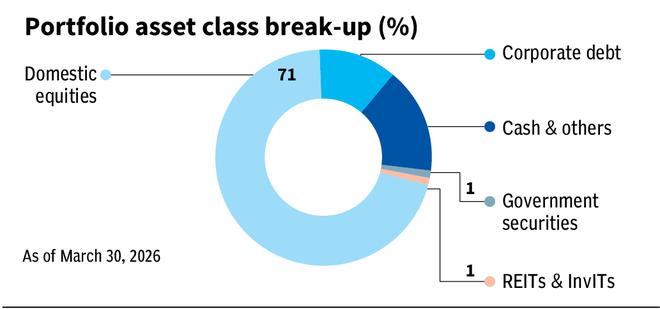
The debt allocation is managed conservatively in line with short-duration fund principles, with the portfolio focusing on high-quality corporate bonds and avoiding aggressive duration calls.
Over the last five years, the fund has maintained a Macaulay duration between 0.7 and 3.5 years, ensuring limited sensitivity to interest rate movements.
The strategy restricts investments largely to AAA-rated securities. This helps to reduce the risk of sharp mark-to-market losses arising from rating downgrades or deteriorating issuer fundamentals.
Prominent names in its debt portfolio include Aditya Birla Finance, HDB Financial Services, NABARD and Bharti Telecom. As of March 2026, the fund’s debt portfolio reported a yield to maturity of 6.7 per cent, lower than the category average of 7.5 per cent due to its short-duration investment mandate.
As per the latest portfolio as of March 2026, it held 12 per cent in corporate debt and less than 1 per cent in government securities.
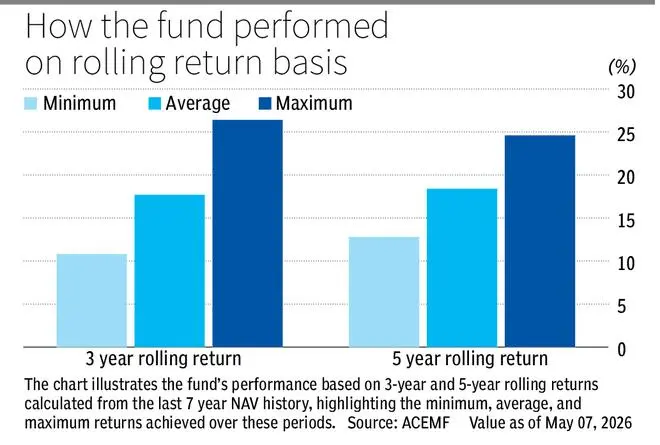
Five-year rolling returns over the past seven years show that the fund delivered an average annual return of 18.4 per cent, outperforming the category average of 16 per cent. The five-year return range has varied between 12.8 per cent and 24.6 per cent. The fund also demonstrated decent performance in three-year rolling returns, delivering a 17.7 per cent CAGR compared with the category average of 15.4 per cent.
From a cost perspective, the regular plan has an expense ratio of 1.86 per cent, lower-than-the-category average of 2 per cent. Interestingly, the direct plan’s expense ratio stands at 0.37 per cent (lowest among peers) vs category average of 0.86 per cent. As of March 2026, the fund managed assets worth ₹3,309 crore.
This provides equity taxation benefits, given its allocation of more than 65 per cent to equities. Investors with a medium-risk profile who are concerned about the current market volatility can consider this fund. An investment horizon of five years or more is ideal. SIPs are also the preferred route, considering the prevailing volatile market conditions.
Published on May 9, 2026
此内容由惯性聚合(RSS阅读器)自动聚合整理,仅供阅读参考。 原文来自 — 版权归原作者所有。