


Edelweiss Balanced Advantage Fund (EBAF) distinguishes itself within the Balanced Advantage Fund (BAF) category through its unique pro-cyclical, trend-based asset allocation strategy. Over the last seven years, it has delivered a compounded annualised return of 13 per cent.
BAFs offer flexibility to swing from high equity to high debt, based on market conditions, valuations, interest rates and proprietary models. This adaptability helps contain downside risk during volatile phases. These funds maintain gross equity above 65 per cent through derivatives, securing the equity taxation benefit.
Unique strategy
EBAF employs a distinctive trend-based strategy that sets it apart from peers. Unlike most balanced advantage funds that follow counter-cyclical or valuation-based approaches, this fund operates on a pro-cyclical model, making it the only purely trend-following BAF in the industry.
A counter-cyclical approach increases equity when markets fall and reduces it when markets rise, betting on valuation mean reversion and market reversal. Examples include ICICI Prudential BAF and SBI BAF. A pro-cyclical approach does the opposite, adding equity as trends strengthen and cutting exposure when trends weaken, assuming momentum persists. EBAF is the only fund that fully adopts the pro-cyclical strategy, though many newer and existing funds now follow a hybrid approach combining both styles.
Tactical positioning using derivatives
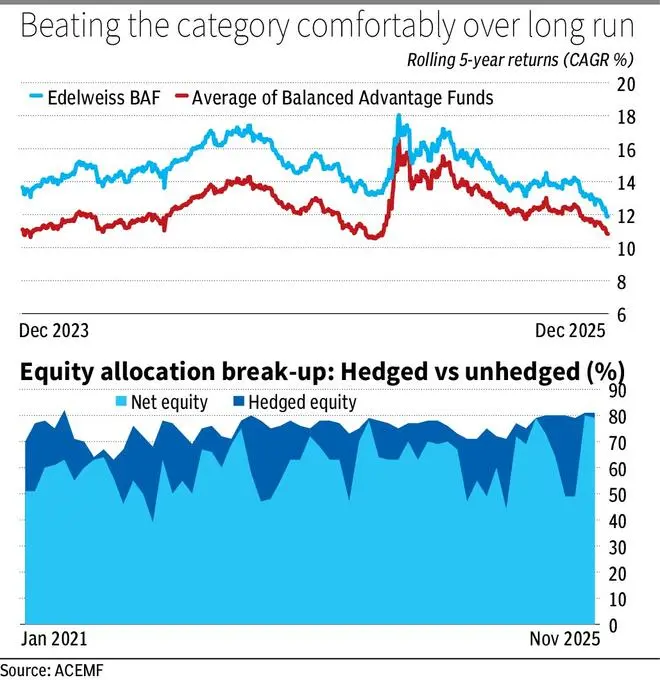
One of the least-understood aspects of BAFs is how they dynamically change equity exposure without selling equity holdings. For every ₹100 invested, about ₹80 is consistently deployed into direct equity, creating a stable core portfolio. While this allocation remains largely constant, derivative exposure is adjusted to manage net equity.
If a BAF were to sell stocks to reduce equity, it would lose favourable equity taxation benefits. This makes derivative-based exposure management not just efficient but essential. Selling equities is also significantly more expensive than adjusting derivative positions. While a round-trip futures transaction costs only three to four basis points, cash equity transactions cost nearly 10 times more at around 36 basis points. Given that BAFs adjust exposures frequently — sometimes daily — using derivatives becomes the only practical approach. Instead of selling stocks, BAFs modify net equity exposure through derivative positions, using index and stock futures.
How does the model work?
EBAF maintains a gross equity allocation up to 80 per cent at most times. While gross equity remains largely constant, net equity exposure fluctuates between 30 and 80 per cent, guided by the proprietary Edelweiss Equity Health Index.
This model employs three distinct signals — short-term, medium-term and long-term — each carrying a weightage of approximately 16.7 per cent. This creates a dynamic range of 50 percentage points (30–80 per cent) for derivatives that the fund can navigate.
The short-term indicator uses 5-day and 12-day moving averages of the Nifty 50. When the Nifty’s closing price exceeds these averages, the signal suggests staying long; when it falls below both, the fund hedges its exposure. This signal responds rapidly to market movements, and a fall or recovery can trigger rebalancing.
The medium-term indicator tracks 50-day and 100-day moving averages, applied in a similar manner. The long-term indicator measures one-year volatility using a proprietary distance-to-displacement ratio which calculates how much the market moves to achieve a given return. For instance, if the Nifty gains 1,000 points but travels 5,000 points to get there (with significant intraday swings), volatility is high. Lower distance relative to displacement indicates healthier market conditions, prompting higher equity exposure. Each signal carries equal weight, and the model rebalances daily, making it far more responsive than valuation-based approaches.
The fund exclusively uses Nifty futures for hedging rather than selling individual stock futures while most of the peers use stock futures extensively. By hedging with Nifty futures while maintaining superior stock selection, the fund aims to generate 1–3 per cent outperformance.
Multi-factor approach
Equity portfolio construction follows a quant-mental approach, combining quantitative factors with fundamental analysis. The fund emphasises quality, growth at reasonable price (GARP) and consistency. For growth identification, the team analyses sales growth, EBITDA growth and PAT growth over the last four quarters. For instance, they rank the top 100 stocks on these metrics, select the top 25 for growth, and then choose 10 stocks offering the best valuations based on price-to-earnings, price-to-book and dividend yield.
The portfolio is largely large-cap oriented. Non-Nifty 50 stocks are capped at 2 per cent each, resulting in a granular portfolio of 60–85 holdings. The fund also participates in special situations, including IPOs, open offers, mergers, demergers and buybacks, allocating 0.5–2 per cent to such opportunities for absolute returns.
The debt portion, around 20 per cent, follows a simple accrual strategy, investing in AAA-rated papers with maturity of up to four years and very short-term debt funds. Liquid and money-market funds are used for margin requirements in derivative trades.
Performance
A pro-cyclical approach performs well in strongly trending markets — during bull and bear phases— because momentum persists. It performs poorly in range-bound or choppy markets, where directions keep changing. A counter-cyclical approach works well when markets return to normal levels but struggles during long, strong rallies or deep falls where prices remain high or low for extended periods.
During the Covid crash, when the Nifty 50 TRI fell 38 per cent, EBAF fell just 15 per cent while the category declined 21 per cent. Through the recovery between March 2020 and October 2021, EBAF delivered 41 per cent versus the category’s 36 per cent. In the recent fall between September 2024 and March 2025, EBAF declined 11 per cent versus the category’s 10 per cent. In the subsequent recovery between March and December, EBAF gained 12 per cent against the category’s 11 per cent.
Based on a five-year rolling return assessment from the last seven years data, the fund posted an average annualised return of 14 per cent, ahead of the category’s 11 per cent. Notably, the fund delivered returns above 12 per cent in nearly 100 per cent of the times and exceeded 15 per cent in almost 41 per cent of them.
From a cost perspective, the regular plan carries an expense ratio of 1.65 per cent, lower than the category average of 1.94 per cent. The direct plan has an expense ratio of 0.51 per cent, below the category average of 0.71 per cent.
This fund is suitable for first-time investors seeking controlled exposure to equity risk, as well as investors with a moderate risk profile who want equity-like growth with limited volatility. A minimum time horizon of three years or more is recommended.
Published on December 13, 2025