









Special-situation funds follow an event-driven investment approach, seeking opportunities created by temporary disruptions rather than long-term market cycles. They invest in companies facing short-term stress due to factors such as corporate restructuring, sector-wide shocks, policy changes, or geopolitical events. These situations often trigger sell-offs, pushing stock prices below conservative estimates of intrinsic value.
Currently, there are seven mutual fund schemes following this theme, each adopting a distinctive investment approach. One of the better-performing funds in this category is ICICI Prudential India Opportunities Fund (IIOF). Completing seven years, IIOF has delivered a compounded annualised return of 21 per cent since its launch in January 2019. It is also the largest fund in the category, managing ₹33,946 crore as of November 2025.
Four-bucket approach
IIOF identifies special-situation opportunities arising from temporary, non-recurring disruptions that create sharp mispricing in fundamentally sound businesses. Once a special situation is identified, the fund estimates intrinsic value using a combination of discounted cash flow (DCF) analysis and qualitative assessment. Intrinsic value is viewed not as a single point estimate, but as a range—bear, base and bull cases—which guides entry, accumulation and exit decisions.
These opportunities are broadly classified into four buckets.
Company-specific
These situations are typically triggered by governance scares, management issues or one-off controversies rather than deterioration in the underlying business. An analysis of the fund’s portfolio shows that it added Infosys in October 2019, when the stock corrected sharply following whistleblower allegations. Investor reaction was emotional, leading to a steep short-term sell-off. However, internal research indicated that governance standards remained strong and the allegations were largely benign. The fund used this panic-driven dislocation to accumulate the stock and exited the position about four months later at levels well above the pre-crisis price.
Sector-specific
These arise when an external shock impacts an entire industry. For instance, during the Covid period, semiconductor supply disruptions led to production cuts, margin pressure and earnings uncertainty for auto manufacturers. Stock prices reflected this pessimism. As supply chains normalised and demand remained resilient, the sector recovered meaningfully. The fund benefited by adding Mahindra & Mahindra in March 2022 and gradually exited the position over the next five months, booking gains of over 50 per cent.
Regulator/govt-driven
These situations occur when policy actions or regulatory interventions temporarily impair profitability or sentiment across a sector. Examples include oil marketing companies facing limited pricing flexibility due to fuel price controls during 2018–22 and 2022–24, telecom companies burdened by regulatory dues and pricing wars during 2022–24, and life insurance companies undergoing heightened scrutiny over mis-selling practices in 2023–24. Such phases often push stocks to irrationally low levels. The fund benefited by tactically positioning in stocks such as Indian Oil Corporation, Bharat Petroleum, Bharti Airtel, HDFC Life and SBI Life.
Global macro/geopolitics
The fund also benefited from global events such as the US–China trade war, Brexit and geopolitical conflicts, which disrupted supply chains, commodity prices and demand patterns. These events led to sharp corrections in sectors such as metals, autos and energy, creating attractive entry opportunities.
Exit strategy
Exit decisions are driven not by the resolution of the special situation, but by the stock approaching its intrinsic value. The fund’s portfolio analysis shows that stocks can remain in the portfolio even after the special situation has played out. According to the fund manager, a special situation serves only as an entry trigger, not a condition for continued ownership. As a result, several stocks in the current portfolio may not display any visible special situation today, but were acquired during periods of valuation dislocation.
Risks
Special-situation funds carry unique risks despite their potential to generate high alpha. The biggest risk is mistaking a structural problem for a temporary one, which can lead to permanent capital loss if a turnaround fails. Event risk is another concern, where regulatory, legal or governance issues worsen instead of improving. Timing risk is also significant, as markets may take longer than expected to normalise. Finally, behavioural risks such as overconfidence in research or anchoring to intrinsic value estimates can impair judgment.
These funds tend to underperform when expected events are delayed or fail to materialise, market volatility stays high, liquidity tightens, or valuations normalise faster than fundamentals, reducing the scope for mispricing-led gains.
Portfolio construction
IIOF is sector and market-cap-agnostic, with allocations driven by stock-level opportunities. Banks, IT and insurance are the top sector exposures. As of November 2025, large-, mid- and small-cap allocations stood at 68 per cent, 19 per cent and 13 per cent, respectively.
Although the portfolio holds around 70 stocks, it is meaningfully concentrated at the top. The fund follows a long-tail structure, with the top 15 holdings accounting for roughly 58–65 per cent of the portfolio (58 per cent as of November 2025), reflecting high conviction in select ideas.
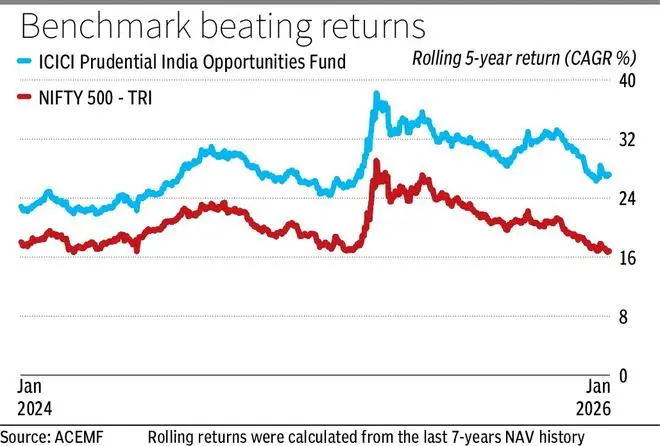
Performance
IIOF topped the performance table with an average five-year rolling CAGR return of 28 per cent, calculated using the last seven years of data, compared with 20 per cent for its benchmark, the Nifty 500 Total Return Index. On costs, the regular-plan expense ratio stood at 1.56 per cent, below the peer average of 2.1 per cent, while the direct-plan expense ratio was 0.65 per cent, lower than the category average of 1 per cent.
Investing in this fund requires patience, as opportunity-driven ideas take time to play out. Given its thematic nature, it is best suited as a satellite allocation with a recommended holding period of five years or more. A systematic investment route is the preferred mode.
Published on January 3, 2026