


The latest liquidity stress-test disclosures for small-cap mutual funds reveal a notable rise in the time required to unwind portfolios. AMFI data show that the time needed to liquidate 50 per cent of small-cap portfolios has climbed to 20 days in October 2025, up from 15 days a year earlier. Likewise, the period required to sell 25 per cent of holdings has increased to 10 days, compared with 8 days in October 2024. This underscores weakening liquidity and diminishing market depth in the small-cap universe. The analysis is based on category averages for 31 small-cap schemes.
These disclosures have been published monthly ever since February 28, 2024, when SEBI raised a red flag over signs of froth in the mid- and small-cap segments and directed fund houses to run and report liquidity stress tests regularly.
Here are four major shifts visible in the stress-test metrics over the past year, and what they mean for small-cap investors:
Liquidity stress has deepened
Returns in the small-cap segment have been largely flat. The Nifty Smallcap 250 Total Return Index (TRI) inched up only 1 per cent over the past year, compared to the 11 per cent gains posted by the Nifty 100 TRI and Nifty Midcap 150 TRI.
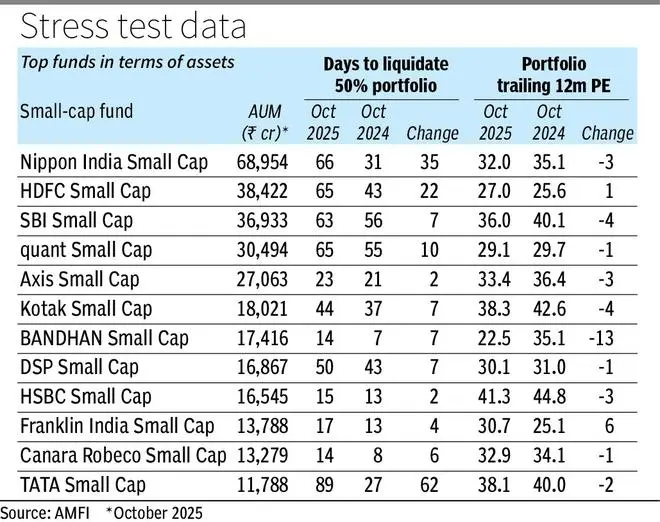
As noted, the liquidity profile of small-cap funds has weakened considerably over the past year. The strain is far more pronounced in the largest schemes. For instance, liquidation days for 50 per cent of the portfolio surged in Tata Small Cap (27 to 89), Nippon (31 to 66), HDFC (43 to 65), Quant (55 to 65), SBI (56 to 63) and Axis (21 to 23). These schemes manage ₹18,000 crore to ₹69,000 crore in assets.
A key driver behind this pressure is the rapid expansion in assets. The category’s assets under management (AUM) grew by ₹50,382 crore (+16 per cent) over the year to ₹3.72 lakh crore. As flows poured in, funds were forced to add heavily to existing positions. Of the 818 stocks held across small-cap portfolios, 84 saw their share quantities more than double over the past year. These include names such as Navin Fluorine International, Ujjivan Small Finance Bank, PG Electroplast, The Ramco Cements and Home First Finance.
Even though the overall traded volumes in these 84 stocks remained steady (₹10.7 lakh crore in the first half between November 2024 and April 2025 vs ₹11.2 lakh crore in the second half between May 2025 and October 2025 on the NSE), fund positions expanded much faster. This means in many stocks funds are now carrying positions more than twice as large as a year ago. This naturally lengthens the time required to unwind portfolios, even though trading volumes have not changed materially. The category drew net inflows of ₹56,600 crore over the past year, intensifying the liquidity pressure.
Portfolios shift away from small-caps
The category has seen a clear reallocation over the past year. Small-cap exposure declined by around 2.5 percentage points, even as mid-cap weights rose by 2.3 percentage points and large-cap allocations increased by 1 percentage point. Nearly 20 schemes trimmed their small-cap holdings, with meaningful reductions in PGIM India (down 14 percentage points to 70 per cent), BOI (down 13 points to 68 per cent) and Union (down 12 points to 73 per cent).
Managers appear to have reduced exposure to the most illiquid small-cap names in favour of more liquid mid- and large-cap stocks. This is a defensive shift aimed at improving liquidity and lowering volatility. With inflows still strong, many managers also find better deployment opportunities in mid- and large-cap counters.
Cash buffers edge lower
Cash levels in the category dipped by around 0.8 per cent points over the past year. Among the larger schemes, Nippon India, Kotak and SBI reduced cash by about 1 percentage point, while Quant cut its buffer by 3 percentage points and Axis by 5 percentage points. In contrast, Bandhan, HDFC and DSP increased their cash positions by 2–4 percentage points. A thinner cash cushion, coupled with longer liquidation timelines, raise the risk of funds being forced to sell holdings at unfavourable prices during periods of stress.
Valuation compression
The average trailing Price to Earnings (P/E) multiple of small-cap funds eased slightly from 35.2 to 34.7 over the past year, after dropping to a low of 29 in February 2025. The correction has been sharper in certain schemes — Bandhan’s P/E fell from 35.1 to 22.5, while Aditya Birla’s declined from 38.8 to 29.9. However, a few funds, such as HSBC, continue to trade at relatively elevated multiples (44.8 to 41.3). For context, benchmark trailing P/E ratios as of October 2025 stood at 36.4 for the BSE 250 SmallCap and 30.8 for the Nifty Smallcap 250.
The softening in P/E levels in many funds likely reflect a combination of earnings catch-up, valuation multiple compression amid a cautious market. Active trimming of high-P/E stocks could also be a driver as managers rotate towards mid- and large-caps.
What should you do
Stress-test disclosures aim to highlight how liquidity can behave during market volatility and how it may affect equity portfolios. This helps investors realign their savings based on risk appetite and financial goals.
The data underlines the risks that small-cap investors could face during a market shock, with elevated valuations lowering the margin of safety. Long-term SIP investors (5+ years) need not worry too much about short-term liquidity stress; market falls can help them accumulate units cheaper. But those looking to exit within the next 1–2 years should watch these liquidity and valuation cues closely, because they can influence when and at what price they can get out.
Published on November 22, 2025