


Following a series of aggressive economic actions by the Trump administration, uncertainty hangs heavy over India’s external sector. The actions started with the imposition of an unexpectedly high reciprocal tariff of 25 per cent on merchandise imports from India, ostensibly aimed at correcting the Indo-US bilateral current account deficit. This was soon followed by a further 25 per cent punitive tariff because of India’s continued engagement in trade involving cheap Russian oil after the outbreak of the Ukraine war. That surprised an Indian government which had assumed that it would be favoured with sanctions of waivers by a friendly US state.
Both these actions were accompanied by commodity-specific duties on items such as aluminium products, furniture and branded pharmaceuticals that may affect Indian firms. And finally, the US announced that the fees for H-1B visa petitions, would be raised from $2000-5000 to $100,000, making it extremely expensive to hire foreign professionals. India would be significantly affected by this, since professionals from India accounted for as much as 71 per cent of such visas issued in financial year 2024.
The significance of these actions for India’s balance of payments varies, and their effects would be transmitted through very different channels. The 50 per cent tariff would have an overall adverse effect on India’s merchandise exports to the US, with the impact being particularly damaging for sectors such as textiles, gems and jewellery, electronics, and pharmaceuticals.
Export pattern
In financial year 2024-25, of India’s merchandise good exports of $87 billion, electronic goods accounted for 17.6 per cent in value followed by 11.8 per cent in the case of pharmaceutical products and 11.5 per cent for gems and jewellery. Output and employment in those sectors are bound to be affected.
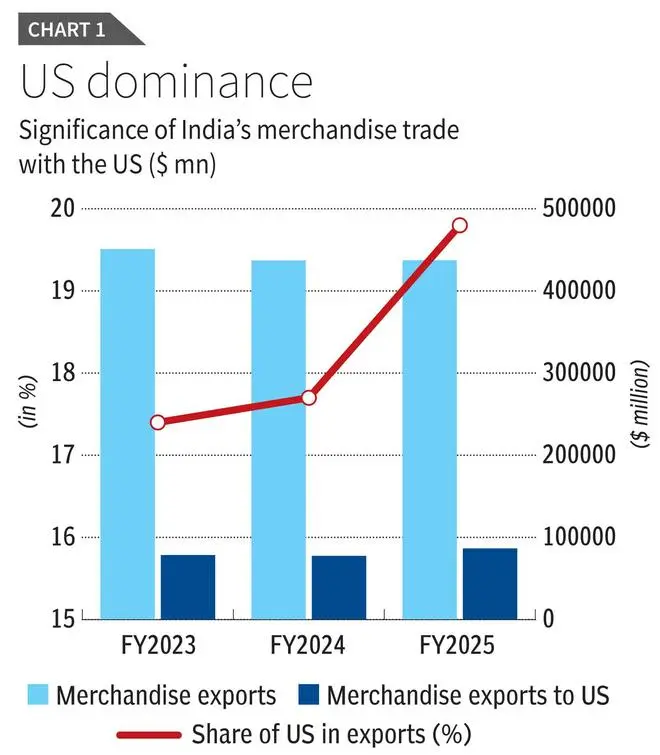
There are two issues here. The first is the importance of overall merchandise exports relative to India’s GDP, which stood at around 11 per cent in 2024-25, and of merchandise exports to the US, in particular, to GDP which was a low 2.2 per cent. Based on this significance of merchandise trade with the US relative to GDP, it could be argued that the impact on India growth is likely to be minimal. That, however, is the direct effect. There could be an indirect effect that operates through the balance of payments. That effect can be significant, since merchandise exports to the US accounted for between 17 and 20 per cent of India’s total merchandise exports (Chart 1). And merchandise exports accounted for between 60 and 65 per cent of India’s imports. This implies that a likely sharp fall in India’s exports to the US can widen the trade deficit.
That in itself may not have been a matter for much concern because there were two other important sources of foreign exchange inflows on the current account of India’s balance of payments. One was exports of “Telecom, Computer and Information Services”, which largely consisted of exports of software and IT-enabled services (hereafter IT services). Gross export revenues from ‘IT services’ rose from 32 per cent of the value of merchandise imports in 2023 to 39 per cent in 2025 (Chart 2).
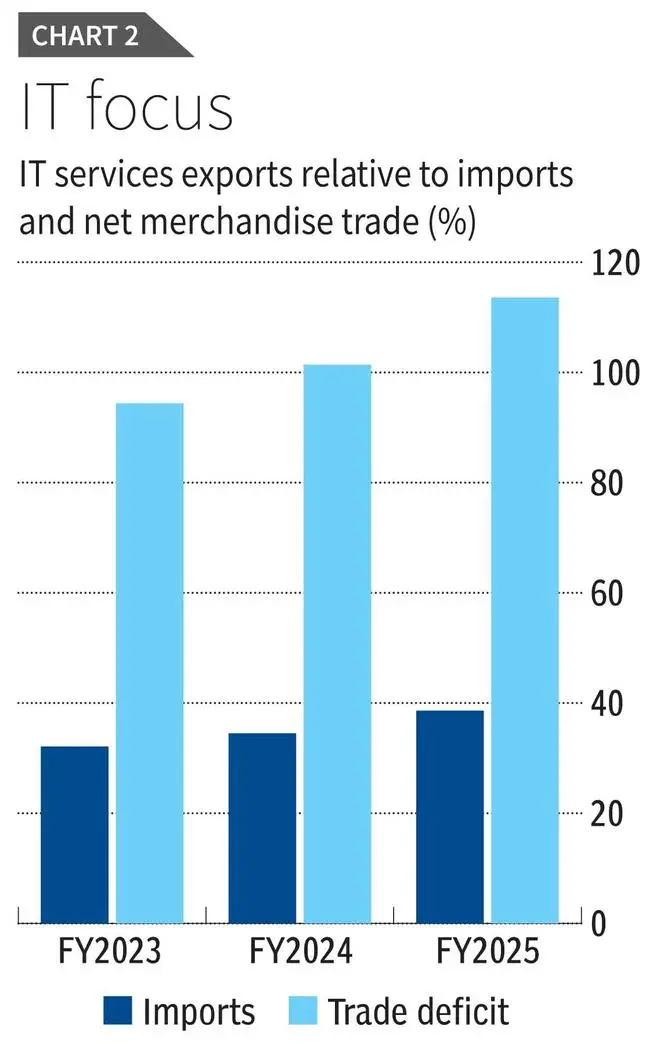
More importantly, inflows on account of the exports of ‘IT services’ helped cover between 94 and 114 per cent of the merchandise trade deficit between FY2023 and FY2025. That is, these inflows were important from the point of view of covering the merchandise trade deficit and can be a source of resilience if the merchandise trade deficit widens.
Worker remittances
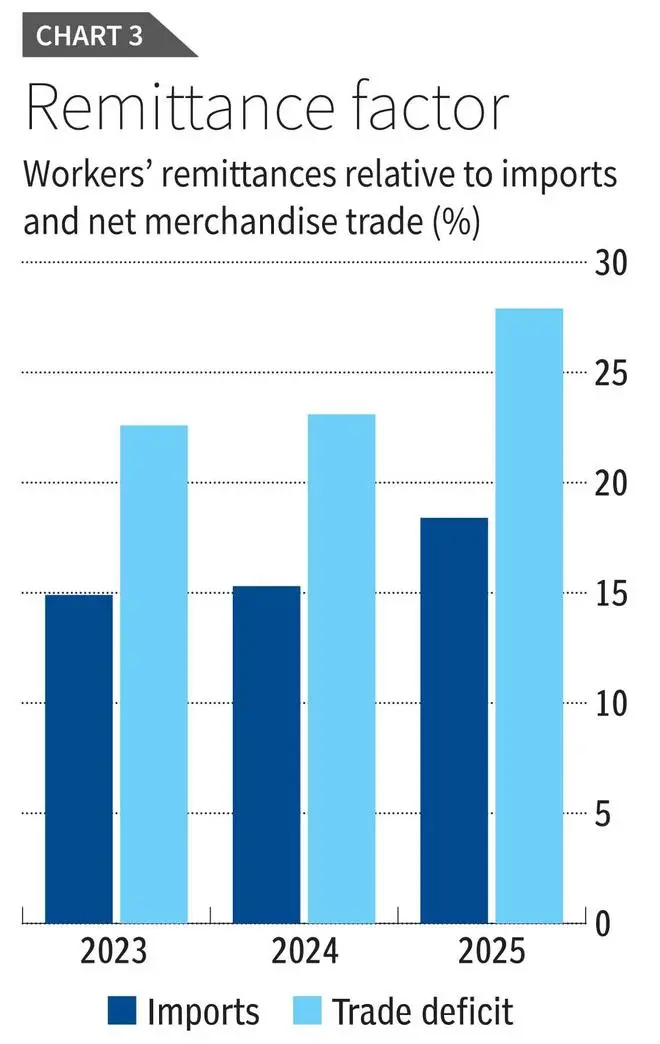
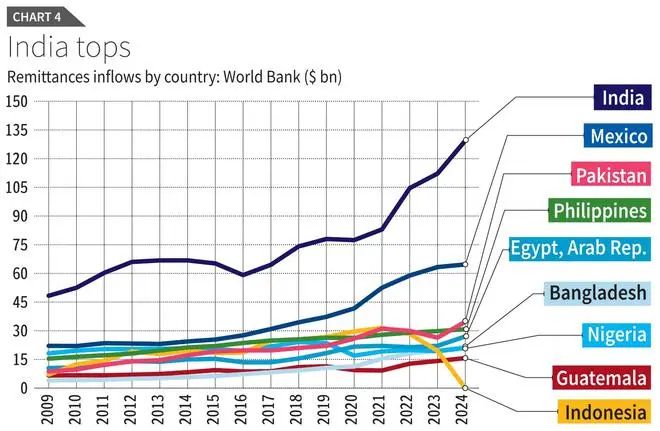
The other similar, source of strength was the inflows on account of worker remittances (with outflows under this head being minimal). These inflows amounted to between 15 and 18 per cent of the value of merchandise imports and 23-28 per cent of the value of the trade deficit (Chart 3). India ‘s experience in terms of the volume of flows over time has indeed been unique, as World Bank data suggest (Chart 4). This too was an important source of resilience, that help finance trade deficits with little difficulty.
Between them inflows on account of gross revenues from ‘IT services’ and workers’ remittances added up to between 47 and 57 per cent of merchandise imports. So even if merchandise exports took a hit from Trump aggression, the overall adverse impact on the balance of payments would have been mitigated by inflows through these two channels.
That room for manoeuvre that these two sources of inflows provided India is also now under threat. The Trump administration’s decision to charge a massively hiked fee of $100,000 for issuing H-1B visas has been justified on the grounds that these visas were being misused to hire cheap foreign substitutes for qualified American workers, depriving Americans much needed jobs. Whether conscious or not, this decision targets India, since Indian workers account for an overwhelming share of these visas that are limited in number.
This too can have two consequences. First, the current cohort of workers on H-1B visas providing on-site services will have to be replaced with more expensive substitutes. Most Indian H-1B visa holders earn less than $100,000 in a year, but are crucial components of India’s IT services export strategy. The substitution is likely to affect the competitiveness of Indian IT service providers, and imports earnings from exports of software and IT-enabled services.
Software exports
Of the software and IT-enabled services exports, software services and business process outsourcing services account for as much as 92 per cent. On-site support services are part of the chain used to deliver such services, so even though on-site services account only for 10 per of the value of exports, disruption in the provision of such services can potentially affect overall exports.
Moreover, the H-1B decision may just be a first intervention in the area. If getting US citizens more of the jobs in software services is the intention, the next step in the never-ending protectionist push on the part of the Trump administration is likely to be restrictions on imports of offshored software and IT-enabled services to the US. The United States accounted for 54 per cent of software and IT-enabled services exports from India in 2023-24. That long-term bonanza could well be under threat.
A second impact of the H-1B decision is likely to be on remittances. For quite some time now, the source regions for remittance inflows has been shifting away from the Gulf Cooperation Council countries to North America, especially the US, which accounted for 28 per cent of inflows in 2023-24. Even over the short period between 2016-17 and 2023-24 the share of remittance inflows from the US rose from 23 per cent to 28 per cent, whereas that from the UAE and Saudi Arabia together fell from 39 per cent to 26 per cent. Remittances tend to be predominantly from shorter-term H-1B visa holders who have families and non-resident accounts in India. The coming squeeze in H-1B visa use can, therefore, adversely affect remittance flows as well.
The loss of foreign exchange earnings from these sources can therefore impact India’s hitherto comfortable current account balance on the external account. That could also increase uncertainty for foreign portfolio investors who have favoured India disproportionately in their choice of investment locations. And together that could spell balance of payments difficulties, currency instability and lead to slower growth
Published on September 30, 2025