


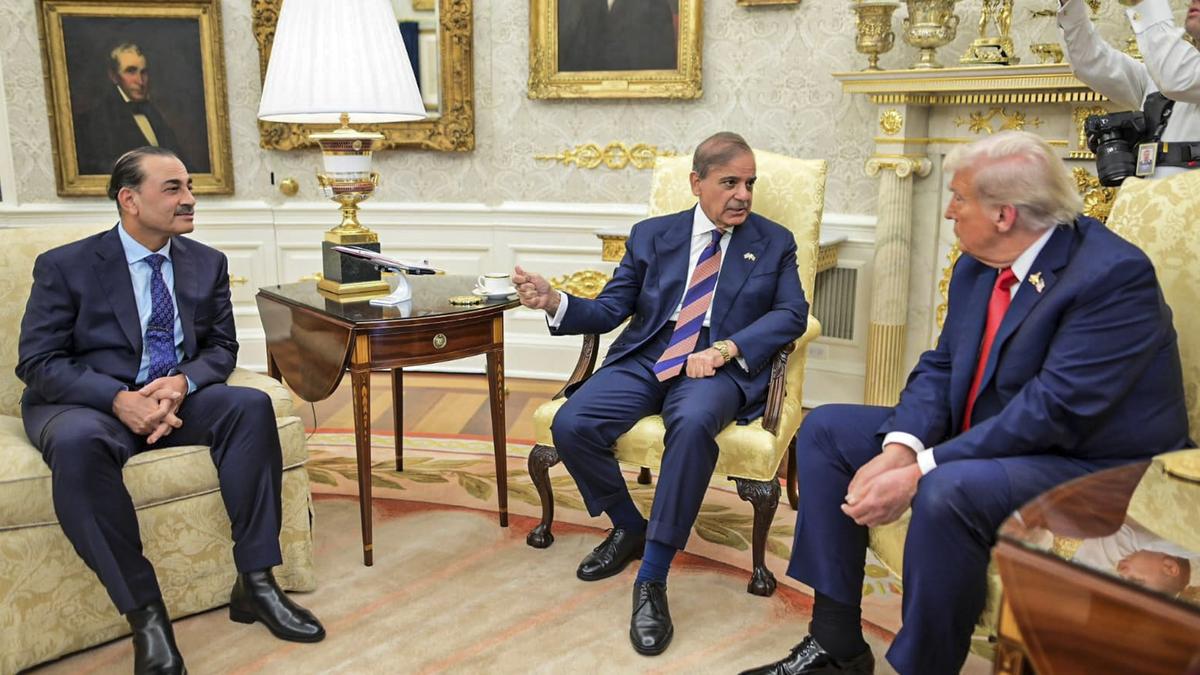
Pakistan has turned from being an insignificant pawn on the global chessboard into something more dynamic | Photo Credit: -
It’s a geopolitical mystery involving our next-door neighbour with whom we just fought a mini-war. Why is the US courting Pakistan so assiduously? Washington is bending over backwards. Field Marshal Asim Munir must be one of the few foreign guests ever invited to the White House twice in barely four months.
Even the Pakistanis are baffled. Some seasoned analysts speculate Washington’s renewed interest has less to do with Pakistan’s intrinsic value and more with pressuring India to align with US strategic priorities. Pakistani academic Junaid S Ahmad put it sharply: “The United States, red-faced with frustration, dangles an unusual set of privileges before Pakistan’s military junta, as if polishing a rusted sword could somehow intimidate New Delhi into line.”
Pakistani analyst and opinion writer Cyril Almeida is blunter: “The big uncertainty is that no one actually knows why Trump is being nice to Pakistan.” About the Washington meeting, Almeida commented acerbically: “Asim to get big boy meeting at White House… Shehbaz to tag along…”
Pakistan has turned from being an insignificant pawn on the global chessboard into something more dynamic, a knight capable of leaping in unexpected directions. Munir and Prime Minister Shehbaz Sharif caught the world’s attention in Washington and then in Riyadh when they signed a military cooperation agreement with Saudi Arabia.
Will Pakistan now defend the Saudis against the Houthis or even Iran? Will it lend troops to protect the Gulf region? Or will it, as seems most likely, train the Saudi military and stay away from Yemen’s frontlines? Pakistan has always treated its other neighbour, Iran, with extreme caution.
It seems unlikely Islamabad would risk Tehran’s wrath, even for a generous infusion of Saudi riyals.
The American agenda was further muddied when President Donald Trump abruptly declared that the US wants the sprawling Bagram Airbase outside Kabul back and that the Taliban government should hand it over immediately.
Trump, in his trademark candour, admitted Bagram’s location was ideal for spying on China’s remote Xinjiang region. Could Pakistan help the US shoehorn its way back into Bagram? That seems doubtful, especially since Pakistan and the Taliban government are not on backslapping terms right now, and such a move would invite Beijing’s ire.
Adding to the intrigue is Pakistan’s newfound importance as a home of crude oil and rare earth minerals vital for the electric vehicle sector. Yet Pakistan has never lived up to its mineral-rich promise. The most famous example, the Reko Diq project in militancy-plagued Balochistan, is said to hold vast gold and copper deposits, yet progress has been painfully slow and commercially disappointing.
These geopolitical shifts have forced Pakistan into a delicate balancing act. On one side lies China, with which it maintains an “all-weather strategic cooperative partnership,” and on the other, a capricious US, which had effectively dumped Pakistan after the chaotic Afghan withdrawal. Islamabad is now attempting to keep both powers engaged, a tricky dance on an increasingly slippery stage.
Meanwhile, Beijing has been pursuing a vigorous diplomatic offensive across South Asia. Determined to block India’s rise as a regional rival, China has deepened ties not only with Pakistan but also with Bangladesh, Nepal, Sri Lanka, and the Maldives. Reports suggest China and Pakistan have held as many as 22 meetings this year, while Beijing and Dhaka have met seven times in 14 months. Most tellingly, China was the driving force behind a trilateral meeting with Pakistan and Bangladesh in Kunming in June, a move underscoring its regional ambitions.
India views any resumption of ties between Pakistan and Bangladesh warily. But tripwires remain. Bangladesh still demands an apology and money owed to it from the time of the 1971 war that split East and West Pakistan.
Amid all this, Pakistan’s economic situation remains precarious. Inflation has eased somewhat, and its balance of payments position is marginally better. Hopes are pinned on Saudi investments following the new defence accord, though even China, once Pakistan’s most enthusiastic investor through the China-Pakistan Economic Corridor (CPEC), has scaled back several grand projects. Global corporations are retreating too. Procter & Gamble recently became the latest multinational to shut down its Pakistan office, a symbolic blow to investor confidence.
While Pakistan seeks to reinvent itself as indispensable — militarily to the Saudis, strategically to the Americans, and economically to the Chinese — India will need to play an extremely cautious game.
We face a geopolitical chessboard dominated by an unpredictable Trump-led US, a calculating China, and a Pakistan suddenly back in play. We must make the right moves and stay agile or risk finding ourselves cornered on the world stage.
Published on October 8, 2025
此内容由惯性聚合(RSS阅读器)自动聚合整理,仅供阅读参考。 原文来自 — 版权归原作者所有。