


Behind the blue-coloured shed that could be mistaken for a storage unit of the two-wheeler showroom next door, stands the manufacturing unit of the shuttered Sresan Pharmaceuticals — whose cough syrup has been linked to the deaths of over 20 children in Madhya Pradesh.
Located along the Bengaluru Highway in Sunguvarchatram, 60 km from Chennai, the nondescript ‘pharmaceutical manufacturing unit’ has show-cause notices plastered on its walls. A visit to the facility reveals several blue chemical barrels on its porch, some labelled ‘sorbitol’ and ‘liquid glucose’. No signs though, of the tragedy Sresan’s cough syrups (Coldrif) have caused families hundreds of kilometres away.
Regulatory representatives, speaking on condition of anonymity, say this facility was a fit case for risk-based inspections.
Following the deaths, and on the request of MP’s health authorities, TN drug regulators inspected the site and found 39 critical observations and 325 major observations. They ranged from unhygienic storage and rusted, leaking equipment to use of raw materials of non-pharmaceutical grade. The stocks of Coldrif syrup (batch SR-13) were found containing 48.6 per cent diethylene glycol (DEG), way over the permissible 0.1 per cent. (DEG is a toxic industrial solvent and consumption can cause kidney failure and even death.)
Sresan’s manufacturing licence (originally issued in 2011) was subsequently cancelled, and a couple of senior drug inspectors were suspended, as “they did not inspect the manufacturing unit and initiate steps to stop production,” Ma Subramanian, TN Health Minister, told mediapersons. Sresan Pharma’s proprietor, G Ranganathan, was arrested by the MP Police, with assistance from TN counterparts.
Second foray
This was not Ranganathan’s first foray into the pharmaceutical business — a review of company records from the Ministry of Corporate Affairs (MCA) point to two launches — in 1990 and 2017, respectively.
Sresan Pharmaceuticals Ltd, incorporated in 1990, was designated as “strike off” by the MCA in 2009, effectively rendering it defunct. In July 2017, Ranganathan registered a sole proprietorship firm under the name ‘Sresan Pharmaceutical Manufacturer’, the company’s GST filings show. And in 2020, the firm is named in an unstarred question in Lok Sabha — in a list of essential drug manufacturers from Tamil Nadu — indicating continued operations.
Recent GST filings define Sresan’s business as manufacture of “haematinics and erythropoietin preparations” (used in formulations to treat anaemia and cancer) and “promethazine, chlorpheniramine, astemizole, and cetirizine” (ingredients in cough and cold syrups).
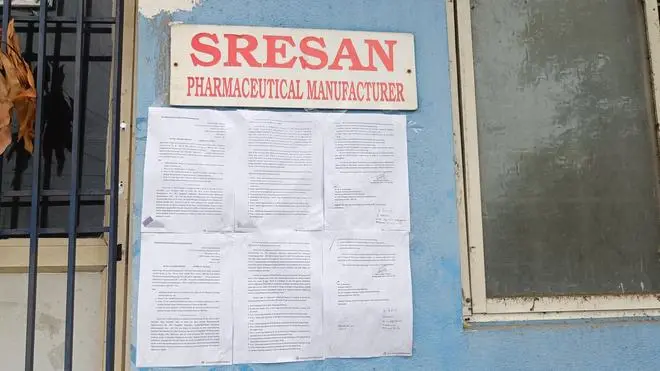
Show-cause notices pasted on the manufacturing unit’s wall | Photo Credit: Mangaiyarkarasi J
Blind spots
“In the manufacturing process of propylene glycol, there is no possibility of diethylene glycol formation. This is not a contamination. This is clearly adulteration,” alleges Ganadhish Kamat, former global quality head at Dr Reddy’s Laboratories.
Experts say the manufacturer is responsible for checking the quality of raw materials and maintaining these records for inspection. Prashant Reddy, a lawyer, and the author of The Truth Pill: The myth of drug regulation in India, says, “The law mandates annual inspection. That never happens in India. The State government issues and cancels licences... so, they are responsible for inspecting the facilities. The central government may conduct joint inspections, but the primary responsibility lies with the State.”
Kamat adds that there is no uniformity in the applications for permission across states. “Unlike USFDA, where inspection reports are available to the public... Indian regulators do not share inspection reports,” he says, making it difficult to assess the risks posed to public health.
“Our drug laws are completely outdated,” says Kamat of the Drugs and Cosmetics Act, 1940, calling for global standards.
GMP
Even the revised Schedule M rules (which define good manufacturing practices) came into effect in June last year, but only for large manufacturers (turnover above ₹250 crore). Micro, small and medium-sized enterprises (MSMEs) got an extension up to December 31, 2025.
Pointing to the repeat delays and alleged dilutions, Kamat says, “Some requirements (under Schedule M) call for vendor qualification. Had this been implemented , this (Sresan cough syrup) crisis could’ve been avoided.”
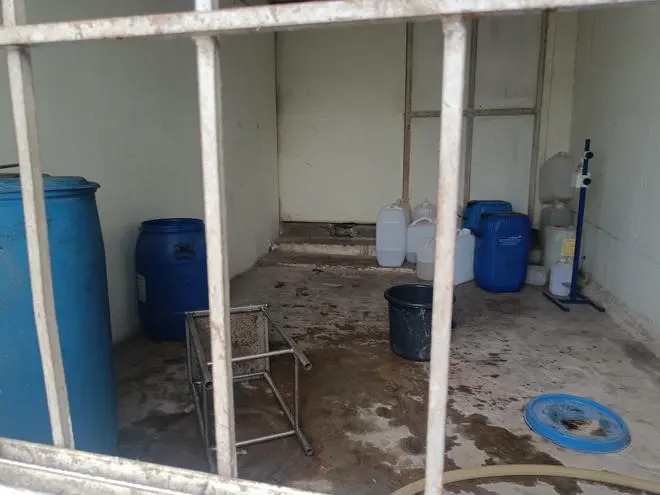
A look inside the Sresan Pharmaceutical Manufacturer’s unit that made the deadly cough syrup which killed more than 20 children in Madhya Pradesh | Photo Credit: Mangaiyarkarasi J
Gaps in enforcement
Health is a State subject, so State FDAs sometimes operate independent of the Central authority, say representatives.
Sumant KR Tiwari, Joint Director (Drugs), FDA Jharkhand, calls for “... one law, one regulator, one enforcement agency across the country”. He also proposes an all-India drugs control services cadre (similar to IAS/IPS) to shore up the abysmally low staff strength.
In fact, the Centre is reported to be mulling a new drugs law to replace the D&C Act (1940).
Adverse event
Kamat further points to India’s “poor” pharmacovigilance (PV), stressing that a medicine-related adverse reaction should be reported to the doctors, besides the company and the PV cell.
“If somebody in a remote place develops kidney failure and dies, nobody will even come to know. This issue came to light because all these deaths happened in one place, and back to back,” he says.
“So, when a cough syrup batch of 10,000 bottles is contaminated with DEG, it is not possible that only 22 children were affected,” he observes.
“I don’t know how many more innocent children have to die before drug regulatory agencies wake up and take appropriate action,” he says, calling for rigorous implementation on the ground.
More Like This



Published on October 20, 2025