
惯性聚合 高效追踪和阅读你感兴趣的博客、新闻、科技资讯
阅读原文 在惯性聚合中打开

推荐订阅源

H
Heimdal Security Blog
A
Arctic Wolf
K
Kaspersky official blog
V
Vulnerabilities – Threatpost
Threat Intelligence Blog | Flashpoint
Simon Willison's Weblog
L
LINUX DO - 热门话题
MongoDB | Blog
MongoDB | Blog
T
Threat Research - Cisco Blogs
D
Docker
爱范儿
爱范儿
T
Tenable Blog
C
Check Point Blog
B
Blog
C
Cisco Blogs
Vercel News
Vercel News
The Cloudflare Blog
T
Threatpost
NISL@THU
NISL@THU
T
Tor Project blog
V2EX - 技术
V2EX - 技术
P
Palo Alto Networks Blog
Application and Cybersecurity Blog
T
Tailwind CSS Blog
G
GRAHAM CLULEY
P
Privacy & Cybersecurity Law Blog
SecWiki News
SecWiki News
博客园 - 司徒正美
S
Security @ Cisco Blogs
GbyAI
GbyAI
S
Secure Thoughts
Microsoft Security Blog
The Register - Security
Recorded Future
Recorded Future
Cloudbric
Cloudbric
Webroot Blog
Webroot Blog
N
News and Events Feed by Topic
Y
Y Combinator Blog
博客园_首页
T
Troy Hunt's Blog
The Hacker News
The Hacker News
雷峰网
雷峰网
Google DeepMind News
U
Unit 42
AWS News Blog
AWS News Blog
PCI Perspectives
PCI Perspectives
V
Visual Studio Blog
博客园 - 聂微东
有赞技术团队
有赞技术团队
酷 壳 – CoolShell
酷 壳 – CoolShell

Latest Agricultural News, Crop Prices, Farming, Agri Business News | The HinduBusinessLine

Basmati exporters urge govt to suspend ₹83/tonne levy amid delayed payment, shrinking margin Pulses import value down 35% in FY26 at $3.57 billion on lower volumes, prices India could limit sulphur exports as supplies tighten, sources say China resumes buying broken rice from India Hot, dry conditions may prevail over most of North-West, Central India for another week IMD issues intense heatwave warning for several parts of Maharashtra Kerala fisheries sector hit by fuel shortage & rising kerosene prices ITC makes history with India’s first FSA 3.0 certification for wheat, paddy NSRCEL, Pernod Ricard India Foundation conclude 3rd cohort of Circular Economy Incubation Programme India’s sugar output up 8% at 27.39 mt as of April 15 NAAS suggests govt to consider one-time licensing for imported horticulture hybrids Polavaram project: Construction of ECRF dam to be be completed by March 2028 Climate-hit Kashmir saffron farmers battle rising porcupine menace India targets cocoa self-sufficiency by 2040 with national mission and reforms Avi Polymers launches KrishiBuddy AI platform to transform smart farming in India India gets imported Urea offer at $935, $959 per tonne Indian agriculture sector under threat by below-Normal Monsoon, El Nino, and West Asia war: ICRA Hindustan Zinc’s DAICHI launches products on retail and quick commerce platforms Oppressive heat conditions to spread out over Central and East India from today Global fertilizer supply crunch tightens farm economics India's green fuel plans collide with farmers' water fears Madhya Pradesh CM says basmati rice from the State is exported to 47 nations NAAS calls for developing smart alternate fertilisers to achieve self sufficiency TRI launches agri-voltaic project to help farmers earn double income Temperatures may trend up over North-West, Central India until weekend Global coffee prices rise as fertiliser costs and West Asia tensions threaten supply India’s soyabean imports surge to 3.09 lakh tonnes during Oct-Mar 2025-26 oil year Unnat Krishi Mahotsav concludes, farmers to emerge as energy, fuel & hydrogen providers, says Gadkari ‘UP banned only forced sale of non-subsidised fertilizers to farmers’ How kashmir’s breakthrough is making Gucchi mushroom farming possible Govt imposes import curbs on Glufosinate for 6 months Nirmala Sitharaman hits back at MK Stalin over farm bonus advisory row HyFarm, Sri BioAesthetics in pact to boost potato ecosystem health India’s edible oil imports fall 9.2% in March over Feb due to demand correction SC notice to Centre, others on plea concerning MSP Govt extends validity of $1400 per tonne MEP on honey exports till Dec 31 Centre not taking away State’s power on bonus for agri produces, says FM Sitharaman From diesel to daylight: How government solar schemes are powering India’s farmers The next energy leap: Replicating ethanol’s success in diesel Cotton Association revises output estimates for 2025-26 up at 324 lakh bales of 170 kg each Agtech marketing in the age of regional content and creator communities Rajnath Singh, Nitin Gadkari to join 3-day agri event at Shivraj’s home turf, inaugurated today How agripreneurship will drive improved rural livelihoods in India World’s largest tur producer, yet an importer: A self-sufficiency puzzle unfolding on ground Ethanol in diesel generators: India’s next practical step towards energy security How sustainable sourcing can unlock value in India’s agri-value chains Tractor sales cross 10 lakh mark in FY26 on strong rural demand, GST cut Cotton prices firm up tracking global prices Corn prices poised to fall on Iran-US ceasefire pact ASMS launches agri-commerce network AYOU in Hyderabad Ladakh turns to apricot blossoms to stretch short tourism season Structural gaps affect growth of India’s high-value horticulture sector: Report March 2026 was the fourth-warmest month on record, says European weather agency India relaxes rice exports norms to some European countries Unseasonal rains damage rabi crops on 2.49 lakh ha, wheat most affected: Agri Minister Maharashtra government expands agricultural oversight structure Unseasonal rain, hailstorms, may drag Indian wheat output by over 5% Milky Mist beats FY26 targets, IPO on track, says CEO Only 10% of Indian key reservoirs are filled over 80% Yara India to ramp up digital strategy to strengthen retailer connectivity Israel allows import of Indian okra seeds, wants virus-free declaration CropLife asks farmers to tap zaid season window after rabi loss and below normal monsoon ahead El Niño threat puts brakes on FY27 auto growth as rural demand risks rise StarAgri plans North East expansion with focus on agri infrastructure and jobs Soybean poised to turn bearish as US farmers shift from corn West Asia Conflict: Natural gas allocation to fertiliser sector upped to 95% Indian govt hikes NBS fertilizer rates for kharif season by up to 21% to ₹41,533.81 crore Farmers in Kashmir voice concerns over inadequate safety nets as hailstorms devastate apple orchards Fertiliser sector eyes supply normalisation, easing global prices Lower crop may weigh on Indian coffee exports in current fiscal Agri-input industry flags ‘Inspector Raj’ return Indian Ocean Dipole may hold key to El Nino’s impact on this year’s monsoon India’s South-West Monsoon will be below-normal this year, says Skymet Telangana Govt tied up with ICRISAT, PJTAU to promote soil health Shivraj urges farmers to make India self-sufficient in oilseeds and pulses Freight surge, logjam hurts egg exports despite strong demand Sugar consumption in April may fall by 2 lakh tonnes on cool weather and LPG scarcity Industry body urges Maharashtra to retain inspector-free fertilizer policy Chittoor farmers install solar panels over agri fields India likely to see weaker monsoon in 2026, Skymet forecasts Indore's Solarsure brings solar power plants to benefit 50,000 farmers India’s coffee exports hit a record high of $2.13 billion in 2025-26 fiscal Prices of essential food items are not unusually volatile, says Govt Oil palm price breaches ₹23,000-mark in Telangana Rabi season fertiliser procurement faces ‘too many ifs’, says FM Sitharaman GITAM develops IoT-based system to help sericulture farmers Nova dairy’s bulk sales halt; Sterling Agro sees zero dispatches in 20 days India may restrict sugar export, likely to allow higher ethanol blending with petrol India has food grain stock three times the existing buffer norms: Centre With 6.44% growth, Milma posts ₹4,624 cr turnover in FY26 Edible oils, industry essentials drive growth outlook; FMCG recovery gradual, says Report Bursts of rain spells douse summer heat in Chennai Kharif 2026: Crystal Crop Protection launches fodder seed products India seeks 2.5 million tonnes of urea amid West Asia supply disruptions BiofuelCircle sets up over 70 biomass banks Why pepping up cereals with proteins is vital for Global South Natural farming gains focus as India prepares for Kharif 2026 amid fertiliser concerns The rise of natural honey in India: A shift from mass production to purity From ethanol to bio-isobutanol: India’s next leap India’s 2026-27 peanut output may rise 3% on higher area
IMD forecast of below-normal Indian monsoon poses risk to agriculture, economy
2026-04-14 · via Latest Agricultural News, Crop Prices, Farming, Agri Business News | The HinduBusinessLine

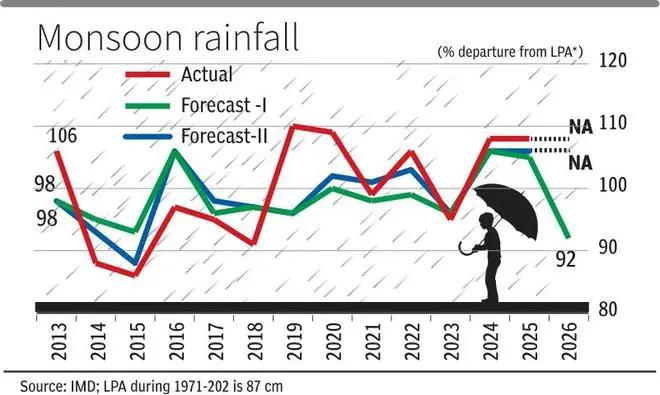
India’s South-West monsoon, which makes up 75 per cent of the country’s annual rainfall of 116 cm, is likely to be “below normal” this year. It will quantitatively be 92 per cent of the Long Period Average (LPA) of 87 cm, said M Ravichandran, Secretary, Ministry of Earth Sciences.

The dominance of impact from a possible emergence of El Niño scales higher as the other two influencers -- Indian Ocean Dipole (IOD) and Eurasia snow cover -- are either neutral of positive for the Indian monsoon. The below-normal monsoon forecast, which could impact the country’s agriculture sector, comes at a time when input costs for the growers are on the rise due to the Iran war.

The India Meteorological Department’s projection is for a rainfall lower than the forecast of 94 per cent rainfall made by private forecast agency Skymet last week. If IMD’s forecast turns out to be correct, this year’s monsoon rainfall will be the lowest since 2018, when India received 91 per cent of normal rainfall.
Increased resilience

However, as India’s irrigated area has been rising continuously (55 per cent of net cultivable area has assured water sources), mainly driven by groundwater resources, the resilience to a lower rainfall has increased after the 2009 drought. In 2018-19, the kharif foodgrains output increased to 141.52 million tonnes (mt) from 140.47 mt in the year-ago period, despite a 9 per cent deficit monsoon. But, it marginally brought down the rabi season (winter-sown) foodgrains production 143.69 mt from 144.55 mt.

Due to the robust foodgrain production, the lower rainfall did not affect the retail food inflation, which declined to 0.1 per cent in FY2018-19. In 2023, too, the country experienced El Niño. However, it had a different impact as the 94 per cent rainfall of LPA affected the production of key crops such as pulses and oilseeds. It also led to drought in about a third of the country. It also resulted in food inflation and forced the Centre to ban the export of rice and permit the duty-free import of pulses.

According to MK Dhanuka, Chairman, Dhanuka Agritech Limited, IMD’s forecast of a below-normal monsoon makes planning more critical. “For key crops like paddy, cotton, pulses, and oilseeds, the distribution and timing of rainfall will be critical. Rainfall variability could influence sowing decisions and regional demand for crop protection products,” he said.

The IMD projection was a highly anticipated announcement following predictions of below-normal precipitation from various experts and agencies. While this initial outlook is confined to the cumulative rainfall for the June–September season, omitting specific geographic or monthly breakdowns, it remains a critical driver for policy decisions and fluctuations in the stock and commodities markets.

Super El Nino

Briefing media, IMD’s director-general M Mohapatra said that most of the climate models indicate that El Niño conditions are likely to emerge after June, and it may negatively impact the monsoon in the second half (August-September) of the season. Currently, weak La Niña conditions are transitioning to ENSO-neutral conditions over the equatorial Pacific and that may remain till June.

A Super El Niño has been predicted for this year by some global weather agencies. Earlier instances of Super El Niño were: 1532, 1578, 1789-93 (termed Mega El Niño), 1876-78 (Greatest El Niño), 1982-83, 1997-98 and 2014-16 (it tied with 1997-98 for the strongest El Niño on record).

Mohapatra said that out of 16 El Niño years since 1951, Indiathe n monsoon was either below normal or deficient 9 times, whereas in 7 such years, there was normal or higher rainfall. The lowest monsoon rainfall was 78 per cent in 1972 in an El Nino year.

Monsoon’s significance

The South-West monsoon is key to the country’s economic growth as a good kharif harvest leads to a thriving rural economy. Higher purchases by rural India lead to demand for FMCGs, tractors, automobiles, jewellery, electronics and other white goods. Any failure in the monsoon could undermine economic growth.

This year, the below-normal forecast comes at a time when the agriculture sector is facing rising costs of fertilizers, crop inputs and fuel due to the Iran war.

Mohapatra said the IOD conditions (sea surface temperature in the Indian Ocean) are neutral and may turn positive towards the end of the monsoon season. While a positive IOD helps monsoon, its negative conditions lowers the rainfall. Mohapatra also said that the northern hemisphere and Eurasia snow cover area during the last three months (January to March) was slightly below normal and such conditions help monsoon rains in India.

Rainfall between 96-104 per cent of LPA is considered ‘normal’ and between 90-95 is ‘below normal’. Similarly, IMD has categorised rainfall between 105-110 per cent of LPA as ‘above normal’ and more than 110 per cent as ‘excess’. Below 90 per cent rainfall is considered ‘deficient’ or meteorological drought.

Skymet has said as El Niño is expected to strengthen, the second half of the monsoon season may be negatively impacted with lower rainfall. According to Skymet, rainfall in June may be 101 per cent of normal, in July 95 per cent, August 92 per cent, and in September 89 per cent. Prediction of geographical distribution in the entire season shows that it may be normal in the southern states, above normal in east and north-east India. But the key foodgrain producing Central and North-West regions may have below normal rainfall, it said last week.

In 2025, the monsoon rainfall was above normal, or quantitatively 108 per cent of the LPA (during 1971-2020). The IMD had predicted 105 per cent above normal rainfall in the first forecast and 106 per cent in its second stage forecast.

Dhanuka said while the current supply situation is manageable, continued pressure on raw material costs and logistics requires careful inventory planning to ensure timely availability during peak demand months”

Published on April 13, 2026