


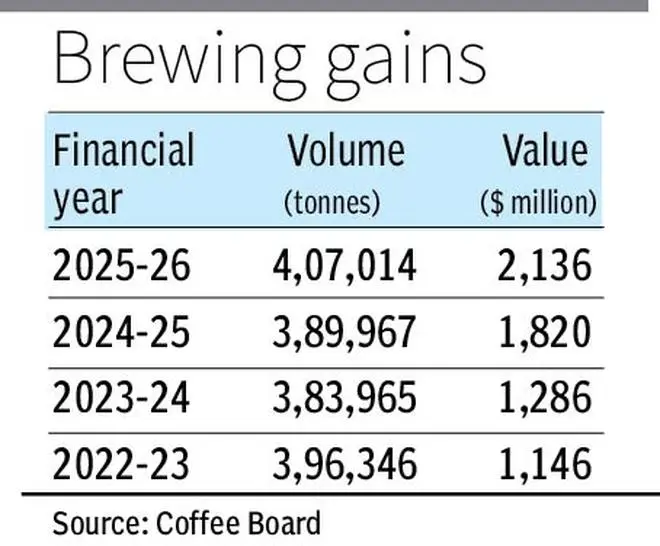
India’s coffee exports registered a 17 per cent growth to a record $2.136 billion for the financial year ending March 2026 on higher prices and a modest increase in volume. In the previous year, shipments were to the tune of $1.82 billion.
As per the latest data released by the Coffee Board, export volumes increased by 4.65 per cent rise to cross 4.07 lakh tonnes during FY26 over 3.88 lakh tonnes in 2024-25. In rupee terms, the exports grew 22.47 per cent to ₹18,887 crore over ₹15,421 crore. The per unit value realised by exporters was up 17 per cent at ₹4,64,041 per tonne against ₹3,96,525.
Ramesh Rajah, President, Coffee Exporters Association, said shipments were a record high in value and volume during 2025-26, breaking earlier records. “A five per cent growth in volumes is a commendable performance on a higher base,” Rajah said, adding that the growth in shipments was possible due to a higher crop.
India’s coffee output during 2024-25 (October-September crop year) was 3.63 lakh tonnes, comprising 1.05 lakh tonnes of arabicas and 2.57 lakh tonnes of robustas.
War Impact:
Shipments to West Asia have slowed down and stranded at various ‘safe’ ports due to disruption in logistics on account of the war in the region. “Its too early to quantify or predict the impact on exports to West Asia in the current financial year,” he said.
However, shipments to Europe, the main market for Indian coffees, are going on through the Cape of Good Hope. “We expect the shipments to Europe to pick up,” Rajah said.
Kurma Rao M, CEO and Secretary, Coffee Board, said the initiatives taken by the Government towards ease of doing business helped boost the shipments. Besides the demand for value-added coffees also contributed to the growth, he said.
Shipments double in 4 years:
Italy, Germany, Russian Federation, Belgium and Turkey continue to be among the top five buyers of Indian coffees.
India the seventh largest producer of coffees is the fifth largest exporter of the commodity. In fact, the Indian coffee shipments have almost nearly doubled over the past four years although the volumes have remained steady. The surge in shipments was largely on account of strong uptrend in global prices and improved realisations. Firm demand from key markets, supply constraints in major producing countries, and a shift toward higher-value varieties have driven the gains.
Published on April 6, 2026