


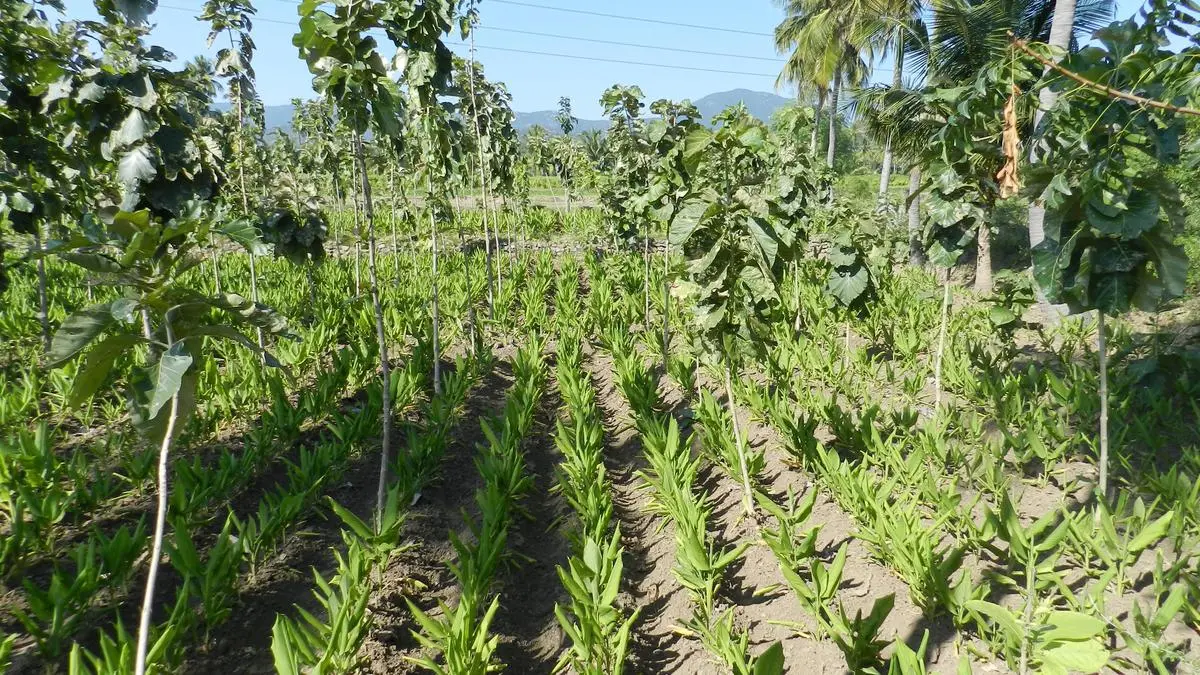
Agroforestry offers a practical way to balance ecological resilience with economic stability. | Photo Credit: IFGTB
Climate change is already reshaping India’s agricultural landscape. Rising temperatures, erratic monsoons and declining soil health are directly affecting millions of farmers. In rural India, where agriculture underpins livelihoods and food security, unpredictable weather increasingly drives income volatility and crop failure. As India pursues its Viksit Bharat 2047 vision, scaling inclusive and economically viable climate action will be critical.
Agroforestry offers a practical way to balance ecological resilience with economic stability. By integrating trees with crops and livestock, it improves land productivity while creating additional income streams through timber, fruit, fodder and other tree-based produce.
With approximately 54.8 per cent of India’s geographical area being used as agricultural land and 54.6 per cent of the workforce engaged in agriculture and allied sector activities, even modest agroforestry adoption can deliver significant carbon reduction. Unlike large-scale afforestation projects that require dedicated land and long gestation periods, agroforestry builds on existing farming systems. This makes it easier and less disruptive to scale across diverse agro-climatic zones.
This approach is closely aligned with India’s climate commitments. The country has already created an estimated 2.29 billion tonnes of CO₂ equivalent carbon sink by 2021 and is targeting 3.5 to 4.0 billion tonnes by 2031 to 2035 under its updated Nationally Determined Contributions. Meeting these goals will require scalable solutions for small and marginal farms, an area where agroforestry has a clear advantage over many other interventions. However, adoption remains limited due to several structural barriers.
A large number of our farmers are small landholders who lack the financial means to invest in tree and fruit plantations, including essential agricultural inputs such as saplings, fertilizers and drip irrigation systems. Other key challenges include limited market linkages, high wastage and fluctuations in demand.
Strengthening Farmer Producer Organisations (FPOs) can improve market access and bargaining power. At the same time, better-designed financial products and targeted extension support can build farmer confidence and bridge the gap between upfront effort and long-term returns, making agroforestry a more practical choice.
The push towards net zero and the growth of voluntary carbon markets open up another important pathway. As companies commit to climate targets, demand for credible, nature-based carbon credits is rising. Linking smallholder farmers to these value chains can unlock upfront investment, improve cash flow visibility and reduce the risks of long-gestation crops, making agroforestry more financially viable and accelerating adoption at scale. This is where the private sector can play a significant role in building scalable and replicable models.
Some of the Iņitiatives undertaken currently show how climate action can be structured to benefit smallholders. The initiatives have ensured the distribution of nearly 1 million saplings, of which over 600,000 have been planted across 5,000 acres of land, at no cost to farmers. They also provide agricultural inputs, technical support and market linkages. Such models show that farmer participation increases when climate-friendly interventions are practical and economically viable.
As corporates increasingly partner with farmers, agroforestry is emerging as a scalable pathway for climate-resilient agriculture. Its potential to strengthen rural livelihoods, support carbon markets and restore ecosystems is already evident. With sustained policy support and private investment, agroforestry could become central to building a more resilient and future-ready agricultural system in India.
The author is Head, Greening India
Published on May 10, 2026
此内容由惯性聚合(RSS阅读器)自动聚合整理,仅供阅读参考。 原文来自 — 版权归原作者所有。