




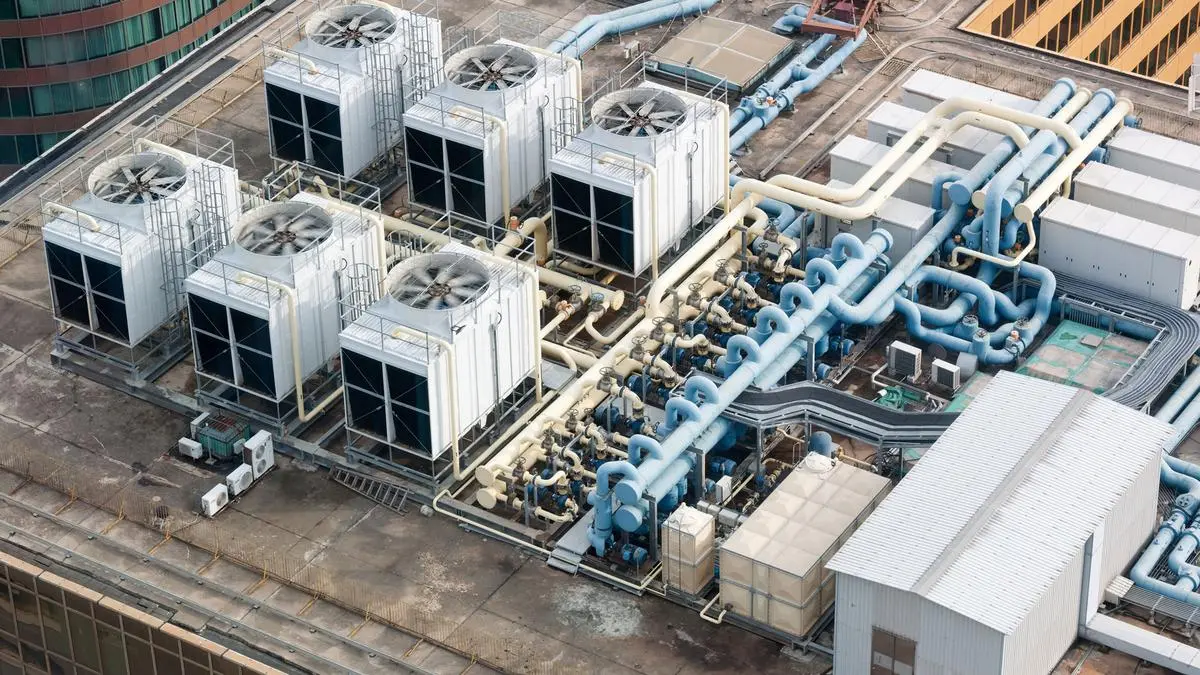
District cooling is more efficient than individual air conditioning units or centralised systems for single buildings | Photo Credit: 4FR
As heat stress grows, demand for cooling systems such as air-conditioners is expected to hit the roof in the coming years. What does that mean for power demand?
Estimates show that ACs alone will push peak power demand in India to 120 GW by 2030. This is almost half the current overall peak demand of 235 GW.
The study by the India Energy & Climate Center (IECC) at University of California, Berkeley, about a year ago shows that between 2025 and 2035, Indians will buy 130-150 million more room ACs. It warns that without “targeted interventions, room ACs alone could contribute over 180 GW to India’s peak load by 2035, straining the power system and necessitating costly investments in new capacity”.
One way to temper this surge in power demand is to accelerate room AC efficiency improvements. The study says this could help reduce peak demand by more than 60 GW by 2035, avoid ₹7.5 lakh crore in generation and grid investments, and deliver up to ₹2.2 lakh crore in net consumer savings.
‘District cooling’ is the alternative suggested by industry insiders. But what is district cooling? According to the International District Energy Association, it is an “efficient way to air condition a network of buildings in cities or campuses. Central cooling plants house large, highly efficient, industrial-grade equipment that produce chilled water for supply to customer buildings through an insulated underground piping network. Cold supply water enters the building and flows through a heat exchanger, absorbing heat from the building space before recirculating back to the central plant through a closed loop return line”. In short, district cooling works by aggregating demand across multiple users.
District cooling is fundamentally more efficient than individual air conditioning units or centralised systems for single buildings, says Sudheer Perla, former Managing Director of Tabreed Asia.
The need for maximum power varies from customer to customer at different points in a day. A central plant servicing customers across residences, commercial buildings and industrial complexes can meet the demand with 10-25 per cent less installed capacity, compared with dedicated chillers for individual buildings.
Scale allows a district cooling plant to adopt technology innovations and superior operational processes, which may not be possible for standalone units. Such plants use large centrifugal chillers, making them more efficient than the standalone units found commonly in homes and offices. Standalone AC units use air to reject heat and retain cooling. This uses up more energy. District cooling plants use water, which, Perla points out, “allows for 50-60 per cent improvement in energy efficiency compared to traditional cooling systems”. Further, they store cold water in large, insulated tanks at night — when demand is low and power is cheaper in industrial clusters — to be able to discharge at peak hours during the day. This itself can shave off 20 per cent of peak electricity demand for cooling.
The efficiency gap is staggering, says Abhas Jha, who works with the World Bank’s Department of Urban Development, Resilience and Land, in a LinkedIn post. “Conventional split ACs consume 1.1-1.5 kW per tonne of refrigeration. District cooling systems run at 0.75-0.8 kW.”
A major challenge, however, is the need for a large quantum of water, says Perla. “In a water-stressed country like India, utilising potable water for cooling is non-viable. He suggests integrating sewage treatment plants (STPs) with district cooling.
Treated sewage effluent can serve as the medium for heat rejection, without endangering water security in this circular economy approach.
The capital expenditure for a district cooling system is nearly double than that of a five-star window AC and 20 per cent higher compared with a standard building-level chiller. On the other hand, the lifecycle cost is significantly lower with district cooling.
For this to work at scale, Perla calls for policy favouring a utility business model, where private players invest, own and operate the infrastructure through long-term contracts, much like power or water utilities.
In India, no State government has yet mandated district cooling for building clusters. But that is the way to go, says Perla, recommending mandates in greenfield zones and ‘public utility’ status to facilitate land allocation and ‘right of way’ for chilled water pipes.
He cites GIFT City in Gandhinagar (Gujarat) and Amaravati in Andhra Pradesh as examples where district cooling was incorporated at the planning stage.
In brownfield environments, namely district cooling efforts in existing buildings such as Chennai’s IT corridor, developers can come together to replace end-of-life systems with a centralised district cooling plant, potentially reducing power demand by up to 50 per cent in a single cluster, Perla says.
Increasing urban heat and data centres are the two biggest drivers of energy demand, says Perla, pointing out that half of a data centre’s energy is currently consumed by cooling. So, if India continues to augment power supply without demand-side interventions such as district cooling, it will end up “creating more climate harm than climate good”.
Further, moving large heating, ventilation, and air conditioning (HVAC) systems from rooftops to central plants can free up space for rooftop solar units. When combined with waste-to-energy plants (using excess heat to run chillers), Perla suggests that district cooling could help reduce dependence on the grid by 70-80 per cent.
Published on March 16, 2026
此内容由惯性聚合(RSS阅读器)自动聚合整理,仅供阅读参考。 原文来自 — 版权归原作者所有。