


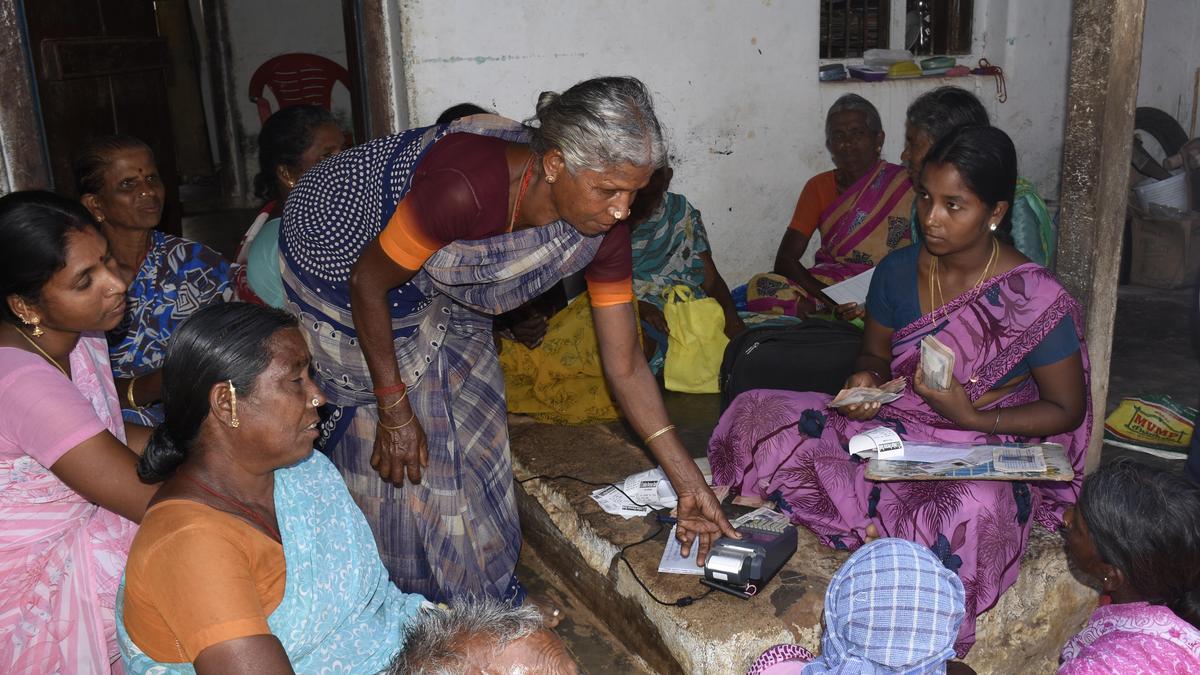
DELIVERING MONETARY SECURITY. Women banking agents help bridge the gap between formal finance and rural households | Photo Credit: SRINATH M
India’s growth story will be defined by not only its digital infrastructure and capital markets, but also how effectively it converts financial access into economic agency, especially for rural women. Over the past decade, an extraordinary foundation has been laid. Under the Pradhan Mantri Jan Dhan Yojana, more than 57 crore bank accounts have been opened, of which over 32 crore belong to women. This represents one of the biggest financial inclusion shifts in history, delivered through a last-mile network of more than 13.5 lakh ‘bank mitras’ — customer service points that act as local bank representative or agent — serving rural and semi-urban India.
Yet, access alone does not equal empowerment. A significant number of women still rely on male relatives to operate their bank accounts.
Social norms, mobility constraints and the gender gap in digital confidence continue to limit direct engagement.
The implication is clear: The next phase of inclusion must move beyond account ownership to usage and income generation.
The government’s ‘One Gram Panchayat, One Business Correspondent Sakhi’ initiative recognises that women are more likely to transact, save and borrow when served by women agents. There are over 10 crore women already organised into self-help groups (SHGs), of whom 4 crore have the potential to become ‘lakhpati didis’ — earning sustainable monthly incomes of ₹10,000 or more through activities, such as agriculture value-addition, micro-enterprises, and allied livelihoods.
The Union Budget’s proposal to establish self-help entrepreneur (SHE) marts is significant. These community-owned retail platforms are not merely market access points but also economic accelerators.
By combining market linkage with innovative financing, they can convert decentralised production into organised rural commerce. The multiplier effect is substantial: When women’s incomes rise, rural consumption improves, nutrition outcomes strengthen, and household investments in education and healthcare increase.
However, this calls for strengthening the ecosystem around women banking agents — the operational bridge between formal finance and rural households. Evidence shows what is possible. In Uttar Pradesh alone, nearly 40,000 women bank mitras serving SHG members have facilitated transactions exceeding ₹31,000 crore. To scale up this impact nationally, coordinated action is needed across financial institutions and government stakeholders.
First, reduce entry friction — recruitment processes for women agents must be simplified, with faster onboarding.
Second, lower start-up costs — a traditional banking correspondent setup can cost nearly ₹1 lakh, putting it beyond the reach of many rural women. Lightweight handheld devices capable of basic transactions can dramatically expand participation while maintaining compliance and security standards.
Third, solve mobility constraints — many women agents depend on spouses for the commute to bank branches for cash management or reconciliation. Access to flexible two-wheeler financing can significantly improve productivity.
Fourth, institutionalise continuous capacity building — video modules delivered on mobile platforms in local languages can provide ongoing training, product knowledge and peer learning.
Fifth, expand earning pathways: When women agents move beyond cash-in/cash-out services to higher-value offerings, such as loan sourcing, insurance distribution and SHG digitisation, the role becomes a primary livelihood rather than a supplementary income. This transition is critical for retention and scale.
The government can reinforce these efforts through targeted facilitation. Joint recruitment drives by corporate business correspondents and rural livelihood missions can identify motivated candidates in SHGs. Structured handholding during the first year — when dropout risk is highest — can stabilise new entrants.
India has already built the rails of financial inclusion: Digital identity, interoperable payments, direct benefit transfers and an extensive agent network. The next leap is to ensure these rails carry entrepreneurial activity, not just transactions. Rural women represent the single largest untapped economic multiplier in this system.
When women transform from welfare recipients to wealth creators, the impact is systemic. Financial institutions gain deeper market penetration and higher product adoption. Local economies benefit from increased liquidity and enterprise formation. Households gain resilience. And the nation moves closer to an inclusive growth that is both scalable and sustainable.
(The writer is Co-founder and CEO, FIA Global)
Published on March 16, 2026
此内容由惯性聚合(RSS阅读器)自动聚合整理,仅供阅读参考。 原文来自 — 版权归原作者所有。