









In India, the next wave of AI may largely be a chatty affair. As businesses race to replace call centres with intelligent voice agents, startups are building for a uniquely complex market, where scale, language, and latency (delay between input and output) collide.
According to Tracxn data, Indian voice AI startups raised $160.58 million across 37 funding rounds between 2019 and 2026. Funding peaked in 2023 at $41.6 million across five rounds, while this year it has so far reached $30.2 million across three rounds.
Bengaluru-based Gnani.ai, a voice-first agentic AI company, was co-founded in 2016 by Ganesh Gopalan and Ananth Nagaraj. The startup’s voice AI platform processes over 30 million spoken interactions daily in over 12 languages, for more than 200 enterprises across sectors including banking, financial services and insurance (BFSI), telecom and automotive, as also government entities. It is also one of the four ventures selected under a government mission for sovereign foundational AI development.

Sneha Roy, co-founder and COO of Murf.AI
“Our agentic AI platform is designed to handle India-specific nuances like multilingual conversations and turn-taking. We also operate at one of the highest scales worldwide. While it’s easy today to deploy a basic voice AI agent, the challenge lies in delivering that at scale — with low latency, high accuracy, and a price point viable for the Indian market. That’s where we excel,” says Gopalan, who is also the firm’s CEO.
The company recently launched Inya VoiceOS, a voice-to-voice model that eliminates the need for intermediate speech-to-text (STT) and text-to-speech (TTS) layers. Currently in a 5B-parameter (a measure of the model’s learnability) version, a 14B-parameter upgrade is expected soon. The Vachana STT and Vachana TTS models offer human-like speech and zero-shot (minimal training) voice cloning capabilities in 12 Indic languages.
Gnani.ai ensures data sovereignty by running all inferences on local data centres. It also has a large proprietary voice dataset .
“We operate across three layers —AI agents tuned to solve specific problems like banking collections, loan disbursal, onboarding, and KYC; an intermediate agent AI layer for partners to build their own agents; and our foundational AI layer, where we provide models such as STT, TTS, and SLMs (small language models) via APIs (application programming interfaces).”

Raoul Nanavati, co-founder and CEO of Navana.ai
Gnani.ai says its recurring revenue is growing 2–3x annually. It added around 120 customers in the past year and expects to double or triple the count this year. It is also expanding to Japan, the US, and West Asia, while targeting 6–7 verticals by the year-end. Recently, it secured $10 million Series B investment and plans Series C soon.
Down to dialects
India has over 700 dialects, and most global AI models work well only for English and Hindi. Navana.ai, a voicing AI infrastructure and agent company, addresses this gap by building models from scratch and collecting proprietary data nationwide to enable voice agents at scale.
“We don’t just deliver voice agents but also build the underlying models that power them,” says Raoul Nanavati, co-founder and CEO of Navana.ai.
The company recently collaborated with IISc, Bangalore, on RESPIN, one of India’s largest open source speech datasets, capturing how the country sounds across domains like finance and agriculture. This effort produced over 10,000 hours of audio across nine languages, including 38 dialects.
Navana.ai deploys voice agents for customers who handle inbound and outbound calls, across 22 languages and use cases, with pricing based on per-minute usage.
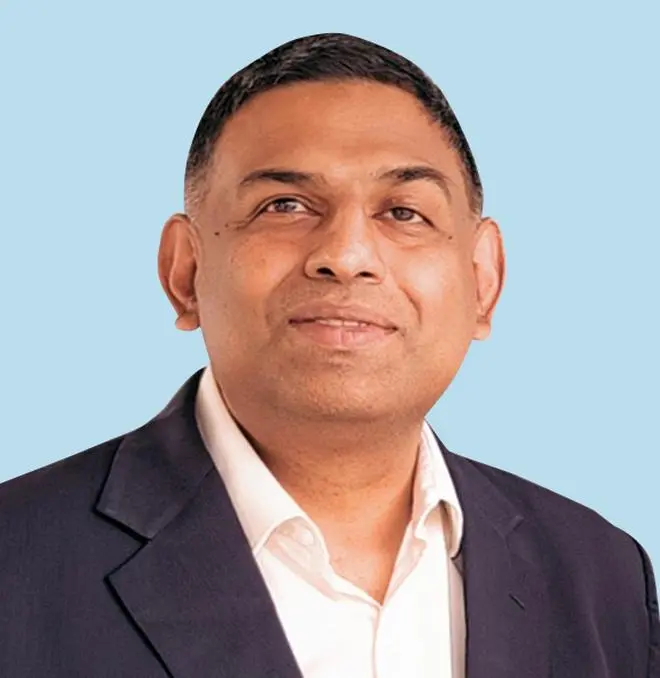
Ganesh Gopalan, co-founder and CEO of Gnani.ai
“We are also looking at sovereign markets outside India with a similar makeup — non-English countries with multiple languages in Southeast Asia, the Middle East, Africa, and parts of Europe,” Nanavati says.
To date, Navana.ai has raised $1.5 million and is currently concluding a Series A round.
“India is voice-first culturally. But for the last decade, digital India has been forced to click, type, and tap. The gap is in capacity and reliability. Businesses cannot put enough humans on the other end of every conversation, across languages, and during peak-hour spikes. Voice AI closes that gap,” explains Sneha Roy, co-founder and COO at Murf.AI, a voice AI company founded by IIT-Kharagpur alumni.
India’s linguistic diversity is the core engineering problem the company is solving for, since many global voice models are not built to handle code-switching efficiently, she says.
Murf.AI offers two core models. Falcon, a real-time TTS engine for voice agents, which supports 35-plus languages and is priced under ₹1 per minute. Falcon encodes phonemes separately from voice, preventing accent carry-over during language switches and preserving native fluency.
The second model, Speech Gen 2, is customised for content creation, with granular control over tone, pacing, and pronunciation for enterprise use.
“Our models are built on ethically sourced speech: consented voice recordings, with voice actors earning royalties every time their voice is chosen,” Roy says. The company builds its own proprietary voice models, giving it full control over the architecture.
Murf.AI serves two customer segments: enterprise content teams through Murf Studio, a SaaS platform for voiceovers, e-learning, marketing, and training content; and developers and businesses via the Murf Voice API, built on its Falcon model. It has scaled up to over 195 countries and 10 million users.
Murf.AI has raised $11.5 million across two funding rounds. It has grown 13x in four years, with ARR now at ₹85–90 crore. The number of paying customers has increased 500 per cent and it is on track to double its revenue, the company says.
Himani Agrawal, COO, Microsoft India and South Asia, observes that since voice systems often operate in regulated environments, handle sensitive data, and interact directly with customers or frontline employees, organisations are increasingly choosing to build in-house AI systems, rather than using standalone tools. “This is a natural progression in AI adoption. As AI moves into mission-critical use, it must be governed, observable, and tightly integrated with existing identity, security, and data frameworks,” she says.
“India is a voice-first country. Talking is just more natural here than typing or texting... In B2B, the quantum of business that happens over the phone is staggering — whether it’s selling insurance, loans, real estate, or even an FMCG distributor calling retailers to find out the week’s needs. All of this is still unscaled and manual, which is where the opportunity lies,” says Vardhan Dharnidharka, Principal, Stellaris Venture Partners.
More Like This



Published on April 13, 2026