







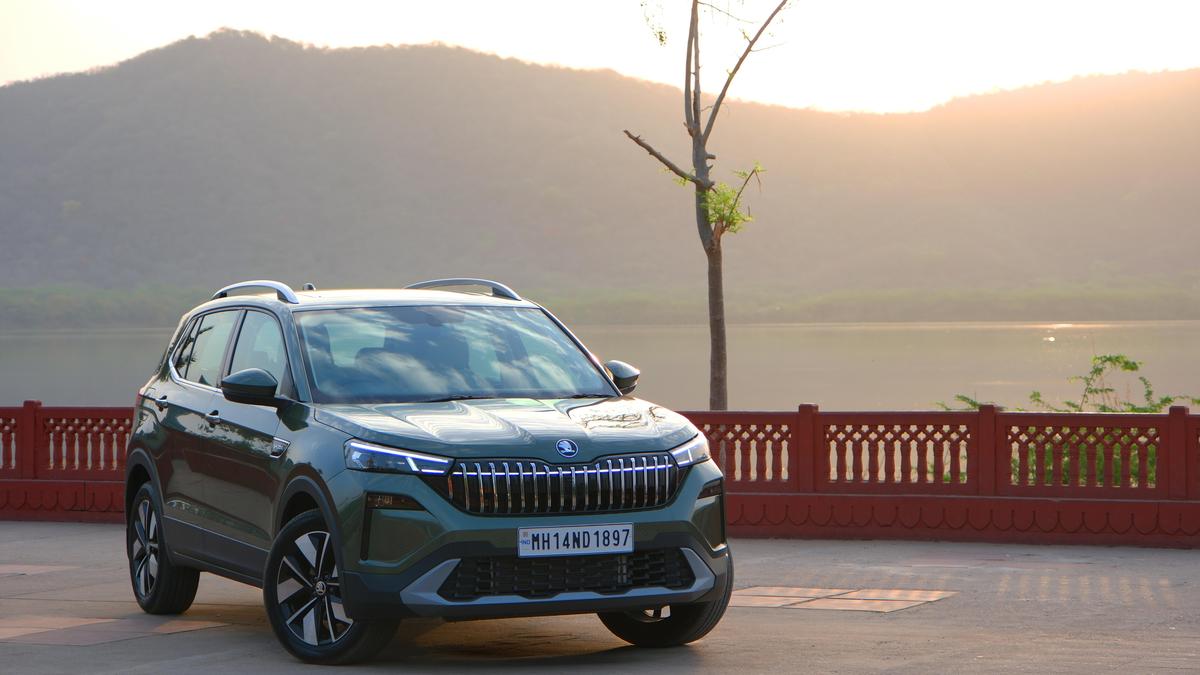
Skoda Kushaq | Photo Credit: Skoda Auto India
Competition is meant to be a good thing, however it often tramlines the breed. Now, the class of SUVs that the Kushaq calls its playing field is among the toughest to crack, but it’s also one that rewards handsomely. Like in every cut-throat class, there’s an incumbent here, too and it often overwhelms its peers with its success. Incumbents are also infamous for setting expectations — often in a debatable direction — and the rest are left with no choice but to simply follow. This mid-life update to the Kushaq is therefore, a lot about it keeping with the times while still trying to maintain its distinct and rather likeable identity.
The Kushaq arrived on a refreshing note about a few years ago, introducing a heightened degree of finesse to the class. Its blend of driving pleasure and a plush, upmarket cabin experience (which it shared with its sibling, the VW Taigun), in addition to top-notch safety and build quality standards, single-handedly steered Skoda as a well-embedded player in this segment and, as a consequence, in India. Largely unchanged since its inception and with its rivals (Creta, Seltos, Grand Vitara, Duster, among others) doing their bit to turn up the heat, the Kushaq was in need of an insightful reassessment, something Skoda has duly performed.
First up are a bunch of segment-firsts. A new 8-speed torque converter automatic gearbox has been introduced to the 1.0 TSI variant (it’s either that or a 6-speed manual) and the rear seats now sport a massage function. There’s also a Google Cloud-powered AI assistant which, on this test, I steered away from trying out. Next are a bunch of new features, namely a sunroof (standard across the range; Prestige and Monte Carlo variants get a dual-pane panoramic unit), an illuminated light band that runs across the breadth of the grille, illuminated ‘Skoda’ lettering incorporated into the connected tail-lamps, Park Pilot and a 26.03-cm virtual cockpit. The infotainment screen continues to offer a great user experience through great touch sensitivity and an intuitive layout.
The headline act here is, of course, the new Aisin 8-speed automatic gearbox. While it leaves elbow room for the 7-speed DSG (offered in the 1.5 TSI) to shine brighter, on its own it’s a likeable gearbox offering smooth shifts and great driveability. At 80 kph, for instance, the revs drop to approximately 1600 rpm in 8th, as opposed to around 2200 rpm in 6th. This translates to improved highway efficiency from the 1.0-litre engine which misses the cylinder deactivation tech seen in the 1.5. With a greater cruising ability, better efficiency and a stronger feature suite, the 1.0 clearly has evolved into an even more compelling buy.
It does struggle with low-speed ride quality, however. Around the unruly bylanes of Jaipur, the 1.0-litre Kushaq felt pronouncedly lacking in suspension comfort, with thuds and mild rattles marring the experience. Over smooth roads, it’s quick to transform into a stable and finessed car, but frankly you’d expect better from an SUV with a Skoda badge.
It’s the 1.5 TSI variant that feels like the more ‘Skoda’ of the Kushaqs. Right from idle, it feels like the engine the Kushaq was built around and that’s not just down to its higher power output (147.5 bhp as compared to the 1.0’s 114 bhp). The larger engine’s added weight, Skoda’s product development team confirmed, seems to get the suspension to work better and the difference in low-speed ride quality is quite substantial. This variant (I drove the top Prestige trim) also feels calmer and airier courtesy its new dual tone cabin which sees the seats, door panels, lower half of the dashboard and the roof lining wearing beige. The typically nice materials — not overzealously opulent but certainly robust — lend the cabin a more elegantly understated feel in this trim.
One thing that’s common between the two spec levels is the ease of driving. The Kushaq is very impressive in its steering manners, and navigating through the labyrinth of Jaipur felt entirely relaxing and, in fact, fun. Another consistency, although on a different note, is rear-seat comfort. It’s a no-nonsense affair, with pleasantly firm seats that offer ample room, and you certainly won’t feel claustrophobic in there — that’s with the sunroof shades closed, mind you! There’s a segment-first massage function, too, but it’s more a talking point than an actual revelation to use. Let’s say you won’t necessarily bother with it beyond when the novelty of your new Kushaq wears off.
Among other noteworthy aspects are the ample boot under which you will find a space-saver (variants with 17-inch wheels get a 16-inch spare of the same tread width; alloy wheels are now standard across the range), electrically-adjustable front seats and also clever cabin space utilisation, with roomy door pockets and stowage under the front armrest.
So, how do you choose between the two engine variants? If you see yourself driving a lot and in a mixed cycle, the 1.5 TSI is an easy pick, not just within the range but across the segment. What you expect from a Skoda, the Kushaq 1.5 TSI delivers almost effortlessly and while it is more of a driver’s car, it also benefits from a nicer cabin experience. It also happens to be the calmer car to drive, with a more linear torque spread, larger power reserves and, of course, that unbeatable 7-speed DSG.
While the 1.0-litre is a noticeable step down, some of it is also contingent to your driving environment. If, for instance, your primary driving cycle involves first-world road infrastructure, the value of the 1.0-litre may be hard to resist. In fact, with Skoda standardising a lot of features across the range, even the base Classic+ variant makes a lot of sense as your stepping stone into this class.
Has all of this work set Skoda in a space where it can breathe easy? Yes, and the Kushaq sure is an even easier car to consider as a result. The clock, however is ticking. Never mind what the competition lays down as the norm, Skoda has enough expertise to rewrite the rules of the class. All it needs, in fact, is to look inward. What remains to be seen is whether it chooses to, and when.
@TheMotorGram
Published on March 20, 2026
此内容由惯性聚合(RSS阅读器)自动聚合整理,仅供阅读参考。 原文来自 — 版权归原作者所有。