





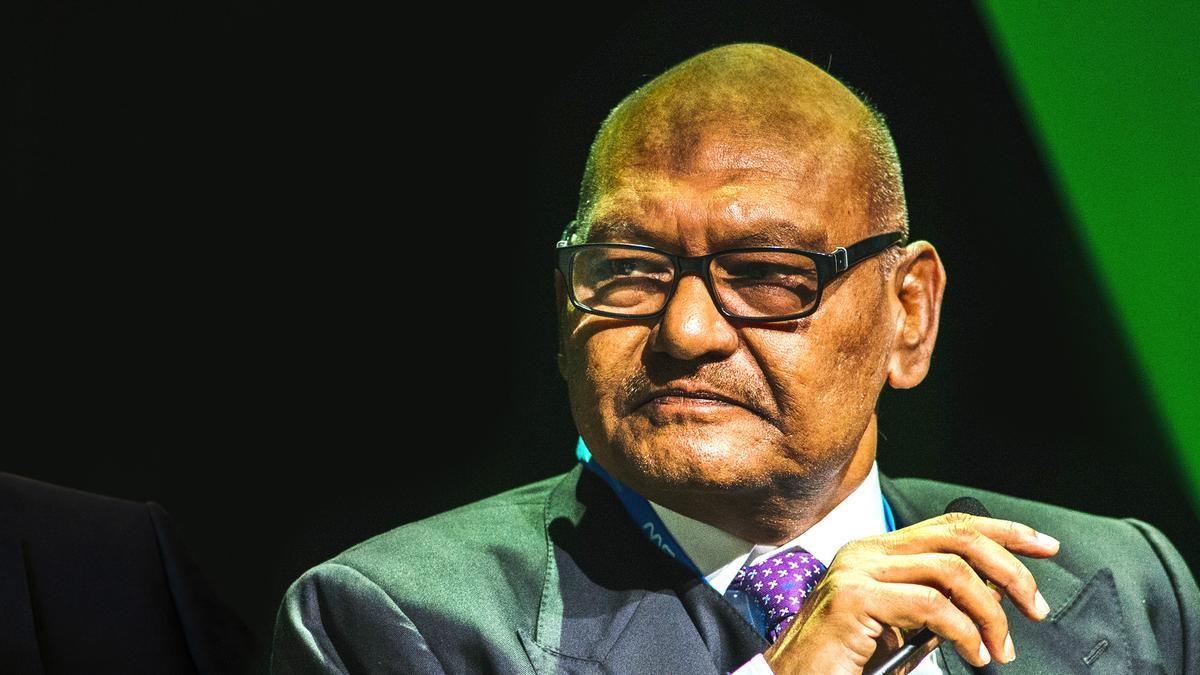
UNRESOLVED ACRIMONY. Goutam Adani, Chairman of Adani Group; and Anil Agarwal, Chairman of Vedanta Resources
The stressed assets of Jaiprakash Associates Ltd (JAL) have become a bone of contention for India Inc, with corporate titans Anil Agarwal and Gautam Adani crossing swords as they lay claim to the insolvent holdings across sectors such as cement, hospitality, power and real estate.
After the many twists and turns in the nine-year-old JAL insolvency case, the National Company Law Appellate Tribunal (NCLAT) reserved its judgement on April 22. The Anil Agarwal-led Vedanta had challenged the committee of creditors’ (CoC) wisdom in approving the lower bid of Adani Enterprises for JAL.
“The IBC system declared us the highest bidder for Jaiprakash Associates. It was publicised widely that Vedanta is the highest bidder. But after that the system gave it to someone else. All this has hit the image of the Indian system across the globe,” mining magnate Agarwal recently told a leading magazine.
“India’s transparent system has taken a hit. In the public auction, we increased our bid and then we were given in writing that we are the highest bidder,” Agarwal said, adding that what had happened was not right from an investor’s viewpoint.
Last month, the Allahabad bench of the National Company Law Tribunal (NCLT) had approved Adani Enterprises’ ₹14,535 crore resolution plan for JAL after it secured about 89 per cent approval from the CoC.
Vedanta moved NCLAT to stay the execution of the NCLT approval of Adani’s bid for JAL. NCLAT declined an interim stay but said the plan would be subject to the outcome of Vedanta’s appeals. Aggrieved by the outcome, Vedanta challenged the NCLAT decision in the Supreme Court. While declining to halt the implementation of the resolution, the apex court ruled that the implementation would be subject to the NCLAT order.
Sonam Chandwani, Managing Partner, KS Legal & Associates, said the acceptance of a bid from the Adani Group that is lower than that of Vedanta and even below the liquidation value raises serious concerns.
While a resolution plan below liquidation value is not expressly barred, preferring it over a higher compliant bid would require a reasoned justification based on feasibility and certainty of implementation, she said.
The NCLT and NCLAT have recognised the permissibility of the Swiss challenge (a unique bidding process) or similar competitive bidding mechanisms for transparent price discovery and enhanced value, she added.
In its petition challenging the lenders’ decision to accept Adani’s offer, Vedanta contended that its addendum bid is about ₹3,400 crore higher in gross value terms and roughly ₹500 crore more in net present value.
Last October, Vedanta offered ₹17,926 crore with upfront payment of ₹3,770 crore. The following month, through an addendum, it raised the upfront cash payout to ₹6,563 crore while keeping the overall bid value unchanged, which included ₹1,200 crore towards settlement of dues related to the Sports City residential and commercial real estate project in Noida.
And yet the CoC accepted Adani’s bid of ₹14,535 crore, including upfront payment of ₹6,000 crore, on the grounds that not only is the upfront component higher but the balance payment will also be quicker — within two years against Vedanta’s five-year timeline.
The trouble for JAL, once an infrastructure giant, started around the 2008 global financial crisis, which triggered a severe downturn in the Indian real estate and construction sector.
After rapid expansion until 2013, the company saw its fortunes declining and debt ballooning. The attempts by the promoters to sell assets could not salvage the debt-laden group.
In 2014, JSW Energy acquired two of Jaiprakash Power Ventures’ hydropower plants (1,391 MW) for ₹9,700 crore. The group then struck a ₹16,100-crore deal with UltraTech Cement in 2016 to sell six integrated cement plants and five grinding units of 21.2 million tonnes capacity. In 2017, the Supreme Court barred the directors from selling personal assets after the company failed to repay deposit holders on time.
In 2018, ICICI Bank filed the first insolvency petition against JAL, followed by SBI in 2022. JAL had an outstanding debt of ₹29,361 crore across 22 lenders. Clearly a downward spiral that JAP could not come out of.
Vedanta’s petition before the Supreme Court alleged that the lenders had acted “arbitrarily” while rejecting its JAL bid and questioned the role of the resolution professional in the insolvency process.
Vedanta also mentioned that the NCLT had erred in appreciating the commercial wisdom of lenders, as that is not “absolute” and, therefore, it can be set aside in cases of “arbitrariness, perverseness or capricious exercise” of power.
Vidya K, Partner, King Stubb & Kasiva, Advocates and Attorneys, said the reported rejection of Vedanta’s higher bid once again brought to focus the primacy of the CoC’s “commercial wisdom”.
“While the CoC’s discretion is wide, it is not unbounded. It must still operate within the framework of transparency, fairness and value maximisation that underpins the corporate insolvency resolution process,” she said.
Mechanisms such as a Swiss challenge or structured bidding rounds are not mandated, but are available to enhance price discovery and process credibility, she added.
The NCLT judgement rejecting Vedanta’s bid stated that the company had submitted a revised addendum to its resolution plan on November 8, 2025, a day after the 23rd CoC meeting at which final plans had been submitted for voting. The CoC refused to consider the addendum, deeming it unsolicited and in violation of the process framework. The CoC noted that accepting Vedanta’s late-stage revision would have required reopening the bidding process and allowing all other bidders to revise offers, which was not feasible within the insolvency timeline.
The tribunal noted that independent evaluator BDO had assigned Adani an aggregate score of 89.26 out of 100, compared with 75.6 for Vedanta. While Vedanta’s offer was higher in net present value, Adani scored better on overall parameters, including upfront cash and qualitative factors.
For lenders seeking closure in a long-drawn resolution process, Adani’s upfront cash component and tighter payment timeline offered greater comfort. Moreover, it offers a big relief to 5,000 homebuyers with approved claims of ₹2,074 crore across JAL’s projects.
Aaron Jonathan Solomon, Managing Partner at Solomon & Co, said that though Adani’s bid is lower than the liquidation value, there are other factors that the CoC took into consideration.
Liquidation value operates as a floor for protected creditor entitlements and as a decision-support benchmark, while the ultimate business choice remains with the CoC, he said.
Which way will NCLAT decide? Will the highest value argument or the commercial and feasibility factors carry the day?
Published on April 27, 2026
此内容由惯性聚合(RSS阅读器)自动聚合整理,仅供阅读参考。 原文来自 — 版权归原作者所有。