







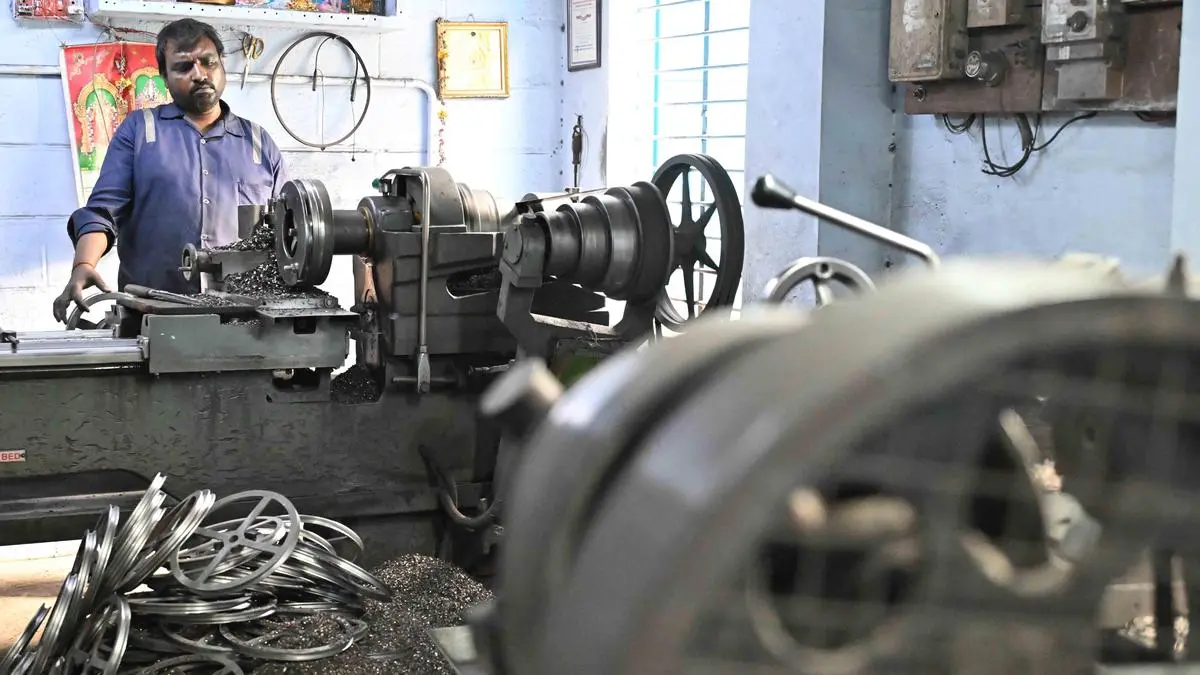
STARTING SMALL. MSMEs can benefit from a green energy marketplace suited to their needs | Photo Credit: Siva SaravananS
An inconvenient truth could slow Tamil Nadu’s industrial momentum. Its next phase of growth may be constrained not by finance, logistics or labour, but by restricted access to risk-adjusted clean power. As global supply chains increasingly demand low-carbon manufacturing, access to reliable and verifiable renewable electricity is becoming a key determinant of competitiveness, particularly for export-oriented units and micro, small and medium industries (MSMEs).
Tamil Nadu is among India’s leading manufacturing and export-oriented states and has emerged as a major renewable energy manufacturing hub. The State’s Circular Economy Investment Policy 2026 reflects a growing recognition of global sustainability and carbon disclosure requirements, including emerging frameworks such as the EU’s Carbon Border Adjustment Mechanism.
However, MSMEs, which form the backbone of Tamil Nadu’s industrial ecosystem, face a persistent challenge. They often lack the scale and institutional capacity to procure clean power through complex, long-term renewable energy contracts. The challenge goes beyond electricity tariffs. The need is for power that combines price certainty, reliability of supply, contractual stability and verifiable low-carbon/ carbon-free energy consumption in the production process.
Additionally, MSMEs often lack internal capacities to meet environmental, social and governance framework requirements. Therefore, the risks are manifold. Tamil Nadu already hosts one of India’s largest concentrations of renewable-powered industries, particularly with captive installations and 0.5 MW or more power demand. Existing instruments such as the Green Day-Ahead Market and Green Term-Ahead Market, available through power exchanges, improve renewable energy access but remain largely transactional platforms that do not fully address the needs of MSMEs and/or export-oriented industries.
To further its goal of becoming a global manufacturing hub, Tamil Nadu must move beyond renewable capacity addition to focus on institutional mechanisms that improve access to risk-adjusted green power.
First, the State could consider a green energy marketplace that aggregates MSME demand and enables cheaper access to risk-adjusted, standardised renewable power contracts linked to open-access and power exchange mechanisms. Aggregating demand can aid negotiating power, reduce counterparty risk and improve access to verifiable clean energy.
Second, Tamil Nadu could integrate net-zero considerations into new investment projects at the detailed project report stage. Embedding clean energy procurement and emission baselines in project planning can improve bankability and access to climate-aligned finance.
Third, the State could develop a green investment tracker to consolidate industrial data on energy use, renewable adoption and emissions intensity. Such a mechanism can reduce information asymmetry, support green investment readiness and function as a pre-due diligence layer for investors evaluating climate-aligned manufacturing ecosystems.
Industrial competitiveness will be determined not by cost alone, but also the ability of firms to demonstrate how their production is powered. Through institutional and market innovations, Tamil Nadu can evolve into a globally competitive, low-carbon manufacturing hub.
(The writer is a former policy director (India) at GWEC and a former fellow at TERI. Views are personal)
Published on May 11, 2026
此内容由惯性聚合(RSS阅读器)自动聚合整理,仅供阅读参考。 原文来自 — 版权归原作者所有。