


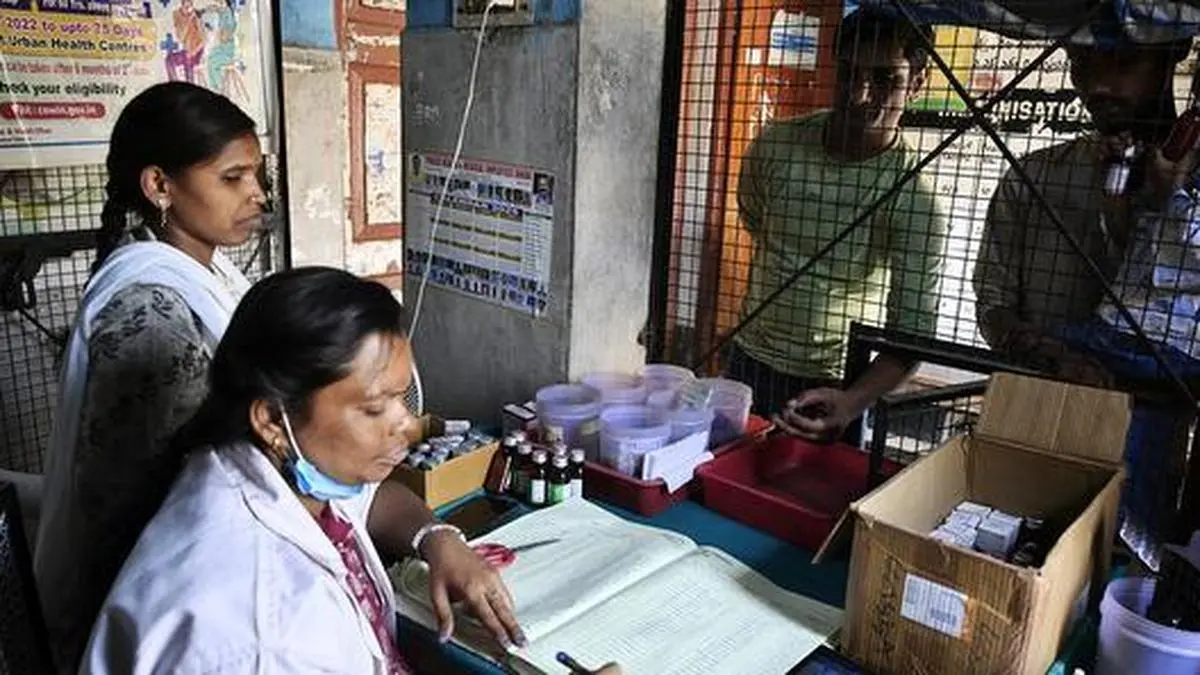
RIGHT TO HEALTH. The primary health centres serving rural populations are mandated to stock listed essential medicines | Photo Credit: NAGARA GOPAL
India’s national list of essential medicines (NLEM) plays a major role in ensuring access and affordability in India. It serves as a guide for the procurement of medicines that are available free of cost in public health facilities . However, the potential of the NLEM is often not realised due to the stockouts reported in public health facilities and loopholes in the Drugs Prices Control Order (DPCO). Moreover, many new and efficacious medicines are missing in the list.
A regularly updated NLEM will directly benefit patients across India. First, and most important, as the medicines on the NLEM are subject to price control through the National Pharmaceuticals Pricing Authority, they are accessible to households that cannot afford the market rates. Second, when doctors prescribe from an evidence-based essential medicines list, patients receive treatments that are proven to work, reducing needless drug use. Third, as a guiding document for the procurement and supply of medicines in the public sector, the NLEM is a lifeline for rural communities and the urban poor who are dependent on public health facilities.
The NLEM mandates that listed medicines must be stocked at all levels of the public health system, including the basic primary health centres that serve rural populations.
The Supreme Court of India has consistently held, through a series of landmark judgements, that the Right to Life enshrined under Article 21 of the Constitution includes the right to health and the right to access medical treatment; the non-revision of the NLEM is, therefore, a potential violation of the fundamental right to life. India is a party to the International Covenant on Economic, Social and Cultural Rights (ICESCR), under which a core obligation is the provisioning of essential medicines “as from time to time defined under the WHO Action Programme on Essential Drugs”.
The World Health Organization’s (WHO model list of essential medicines serves as the basis for India’s NLEM. The WHO has revised its model list on two occasions since 2022 — in 2023 and 2025 — incorporating significant additions and updates. In stark contrast, India’s NLEM has not been revised since 2022. While the NLEM contains 384 medicines, the WHO model list of 2025 contains 523 medicines. Around 17 active cancer treating agents, four supportive agents for cancer treatment, and nine monoclonal antibodies (mAbs) from the WHO model list are missing in the NLEM. This means, the list that determines which medicines citizens can access affordably is falling behind global standards.
Every medicine absent from the NLEM is one that escapes price control, remaining beyond the reach of millions of ordinary Indians, particularly the rural poor. The case for updating the NLEM is overwhelming and urgent. India cannot continue to be the pharmacy of the world while leaving its own people with a medicine list that lags years behind global standards.

Srishti Bhatt is an independent legal researcher
(The writer is an independent legal researcher. Views are personal)
Published on June 1, 2026
此内容由惯性聚合(RSS阅读器)自动聚合整理,仅供阅读参考。 原文来自 — 版权归原作者所有。