








For Ramesh Kumar, founder of Grahaa Space, the idea of building a space-tech startup was sparked not by rockets but a video.
Formerly employed at IBM and Dell, where he worked extensively on livestreaming technologies, Kumar traces his inspiration to NASA’s HDEV experiment, which continuously streamed high-definition videos from International Space Station via IBM’s UStream platform. “That was the first time I saw what was possible,” he says.
While satellites today capture vast amounts of earth observation data, most of it is static, delayed, or expensive to access. “Outside major cities, a large part of global imagery is outdated,” Kumar notes. To remedy that, Grahaa Space is building a constellation of nano satellites equipped to deliver near real-time video data of the earth.
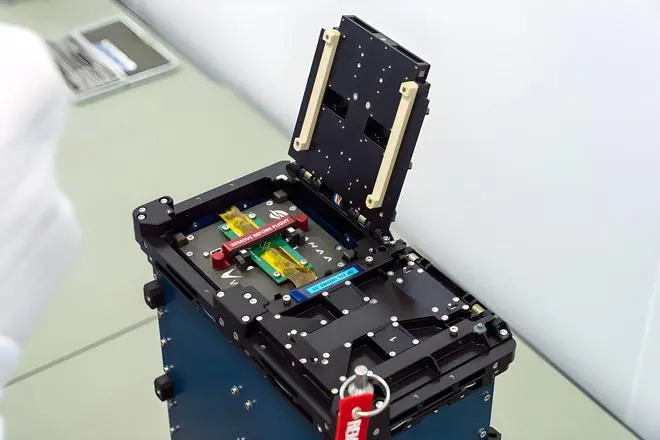
The Solaras S2 nano satellite developed by Grahaa Space
Founded in 2018 and incorporated in 2021 after pandemic-related delays, Grahaa Space is attempting to solve a long-standing gap in earth observation — namely latency.
“More than 90 per cent of the global imagery is not in real-time,” Kumar points out.
For its constellation of nano satellites, Grahaa has developed a compact, stackable satellite platform, together with proprietary optical payload and onboard data compression technologies — innovations it has patented. The broader ambition is to become a data layer for applications spanning defence, agriculture, smart cities, and environmental monitoring.
Revenue stream
Like most deep-tech ventures, Grahaa’s journey has been iterative, moving from lab-scale development to test missions and now towards commercial launches. The startup is currently preparing for orbital missions with private launch players such as Skyroot Aerospace.
Revenues are modest at present, largely driven by secondary offerings and from providing plug-and-play satellite platforms to research institutions. The core business — real-time earth observation — is still in the works, with plans for proof-of-concept missions and a phased rollout of the satellite constellation.
Bootstrapped and backed by grants such as Nidhi Prayas and Startup India Seed Fund, Grahaa is in talks with investors to scale up operations. It has also signed over 15 memorandums of understanding for upcoming missions. Having witnessed the rise of the e-commerce and edtech sectors, Kumar believes space-tech is the next wave. “We want to be ready when that wave peaks,” he says.
More Like This



Published on April 27, 2026