
惯性聚合 高效追踪和阅读你感兴趣的博客、新闻、科技资讯
阅读原文 在惯性聚合中打开

推荐订阅源

量子位
cs.AI updates on arXiv.org
F
Fortinet All Blogs
博客园 - 聂微东
奇客Solidot–传递最新科技情报
奇客Solidot–传递最新科技情报
Hugging Face - Blog
Hugging Face - Blog
V
Visual Studio Blog
小众软件
小众软件
有赞技术团队
有赞技术团队
雷峰网
雷峰网
钛媒体:引领未来商业与生活新知
钛媒体:引领未来商业与生活新知
AWS News Blog
AWS News Blog
C
Cisco Blogs
美团技术团队
T
Threat Research - Cisco Blogs
C
CERT Recently Published Vulnerability Notes
人人都是产品经理
人人都是产品经理
宝玉的分享
宝玉的分享
Threat Intelligence Blog | Flashpoint
酷 壳 – CoolShell
酷 壳 – CoolShell
Stack Overflow Blog
Stack Overflow Blog
W
WeLiveSecurity
D
DataBreaches.Net
博客园 - 司徒正美
Blog — PlanetScale
Blog — PlanetScale
IT之家
IT之家
云风的 BLOG
云风的 BLOG
Cyber Security Advisories - MS-ISAC
Simon Willison's Weblog
Google DeepMind News
T
The Blog of Author Tim Ferriss
Know Your Adversary
Know Your Adversary
NISL@THU
NISL@THU
OSCHINA 社区最新新闻
OSCHINA 社区最新新闻
The Cloudflare Blog
Vercel News
Vercel News
月光博客
月光博客
T
Tailwind CSS Blog
H
Help Net Security
aimingoo的专栏
aimingoo的专栏
P
Proofpoint News Feed
Application and Cybersecurity Blog
Spread Privacy
Spread Privacy
cs.CL updates on arXiv.org
Cisco Talos Blog
Cisco Talos Blog
Microsoft Security Blog
V
V2EX
WordPress大学
WordPress大学
Cyberwarzone
Cyberwarzone
Recent Announcements

Business Tech News: Latest Updates on Innovations, Startups, and Market Trends | The HinduBusinessLine

Geo-engineering against climate change ZincGel vs Li-ion battery Why the energy sector isn’t AI-ready yet IT services giant TCS takes an AI-led avatar IIT-M revives forgotten route to industrial wastewater treatment IIT-Kanpur-incubated start-up develops unique battery technology Two faces of water Why the made-in-India ePlane is unique Moving satellite data at laser speed Longer-lasting zinc battery How simulation tech can ready robots for the real world DAE commissions world’s first nuclear heat-based copper-chlorine hydrogen plant DAE commissions world’s first nuclear heat-based copper-chlorine hydrogen plant Subterranean forest of fungi Using sound waves to bypass charge-based circuits AI aides to decode Indian law How the US funding cut impacts cancer research The time to deploy thorium is now The protein-peptide bonds that heal IIT-Kanpur hosts India’s first DORIS beacon How plants summon help Fishing out fake news using a deep-learning neural network IIT-Madras sets up testing tank for ships, submarines Dentistry’s prehistoric drill With AI, science is borderless Coal gas can yield clean hydrogen at $1.25 a kg Light, compact antennas IMD launches pilot weather forecast within 1 km radius in UP, national roll out in 2-3 years Nationwide ban soon on Paraquat herbicide over toxicity concerns, health risks ParvAI: ‘Windows to the soul’ and workplace safety Why agreeable AI is a liability in competitive markets Indian material for magnet making Using lasers to punch holes in cell walls When the grid becomes an all-knowing data system Micro-mining for critical rare earth minerals Half the capex, less carbon: The molten magic inside Tata Steel’s HIsarna bet Cosmic aid for miners Efficient brakes and EV range India contributes ₹745 crore to multi-country ITER Big budgets, slow science: BARC under-spends on R&D Artemis-2: Hurtling moon-ward on an epochal mission Power supply lessons for AI Why nuclear fusion is gaining funding Defence research stays underfunded Micro attacks on sewer lines Turning the ubiquitous optical fibre into a sensor The PRAGYA tokamak Mind-reading tech No exam is too hard for AI? Carnot battery: Carbon dioxide as ideal ‘working fluid’ On a leash of light On a wing and an AI-powered tool How do ‘natural polypills’ work? AI tool for capturing and managing hospital records How sea microbes can protect agri fields Why India should choose to build not just powerful, but also governable AI Flaring and quaking Qualcomm has an Edge in India Soil testing of rhizosphere CMFRI achieves captive breeding of threatened mangrove clam No erasures RDI scheme could be operationalised this year IIT-M’s ramjet shell is an engineering marvel Sun-powered supercapacitor 10 years on, NALCO yet to start gallium extraction project Budget doubles allocation for nuclear research to ₹2,410 cr Underwater water Recent successes in science-led atmanirbharta Electric mobility may take wing in the not-too-distant future Eco-friendly semiconductors Twinning prayers and AI at mega temple festival Solar cells of efficiencies above 30% A lesson from Germany on infrastructure maintenance Fabled city in the high mountains Optimising bioreactor design Sensing UV-C in femtoseconds ISRO to kick off 2026 with launch of Earth Observation Satellite Thriving in extremes Indo-Lankan leg-up for S&T Using AI to better assess cyclone damage War on drug resistance goes undersea Big, bad business of junk food Rosatom’s mini variant of small modular reactor Clear thinking on pranayama Can GenAI be a responsible teaching assistant? Pharma PLI fetches ₹26,832 cr sales ‘Scripting’ ideal AI output Honeywell’s technology may bring biomass to the centre stage India-made human-like robot Scorched by 163-year drought NTT’s quantum leap into near sci-fi realm A reality check on AI’s negotiation skills Salinity-proof epoxy coating for marine installations Heat from small-scale solar units could accelerate India’s net-zero transition Cross-species transplantation is at a regulatory crossroads Nature, the ultimate climate warrior Breakthrough in desalination technology, using carbon ‘flowers’ Epidemiology-ML collab decodes India’s struggles with air quality
How ‘spent’ graphite breathes new life into fuel cell
By K Bharat Kumar · 2026-05-18 · via Business Tech News: Latest Updates on Innovations, Startups, and Market Trends | The HinduBusinessLine
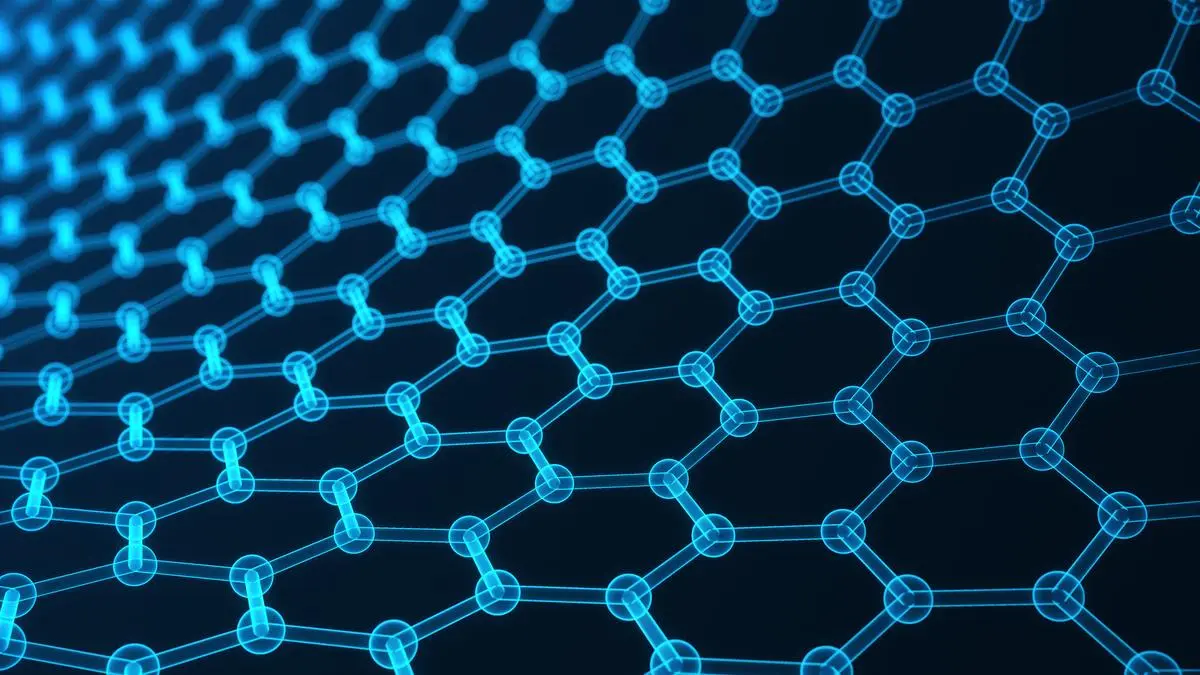
Graphene atomic structure

Graphene atomic structure | Photo Credit: Rost-9D

It is commonly known that lithium-ion (Li-i) batteries can be recycled. But the focus is mostly on salvaging nickel, cobalt and manganese. Their poor cousin graphite is generally ignored; it cannot be reused in new Li-i batteries as it loses the structure needed to function effectively.

However, this ‘spent’ graphite finds use in a different application. It can help extend the life of a methanol fuel cell.

Ordinarily, graphite needs to be ‘exfoliated’ before it can be used in a fuel cell. Exfoliation in this context means the breaking down of bulk graphite into several layers so as to increase the available surface area. Greater the surface area, the better the conductive support in a cell.

The exfoliation of fresh graphite consumes significant amounts of energy. A spent Li-i battery, on the other hand, gives you ready-made exfoliated graphite after the mechanical stress it has undergone in the battery through repeated use. In other words, the very reason graphite is discarded from batteries makes it useful in fuel cells.

Methanol fuel cells typically suffer from a ‘leakage’ of methanol, leading to its interaction with the platinum used in the cell, making the precious metal less effective. Leaking past the membrane separating the anode and the cathode, methanol oxidises to form carbon monoxide, which ‘poisons’ the expensive platinum. This affects the cell’s efficiency and longevity.

Prof Raman Vedarajan leads a team working on this issue at the Advanced Research Centre for Powder Metallurgy and New Materials (ARCI), under the government’s Department of Science and Technology. Says Prof Vedarajan, “In collaboration with the Institute of Minerals and Materials Technology, we cleaned the spent graphite of metallic contaminants and applied it as a ‘scavenger’ in the DMFC (direct methanol fuel cell).”

He explains that the “exfoliated graphite helps capture the permeating methanol before it reaches the platinum catalyst”.

Asked how the new piece of research helped save on cost and/or effort, he replies, “DMFCs typically run for about 15,000 cycles. Using exfoliated graphite can help extend the life of these cells to 20,000 or even 25,000 cycles.”

The research has been validated in a lab. According to Prof Vedarajan, “There is sufficient proof that it can work, so a prototype is being built.” This could help manufacturers not only reduce battery waste but also address another environmental headache — fuel cell inefficiency.

Published on May 18, 2026