








A newly discovered semiconductor property of a known self-assembling bacterial shell protein could pave the way for safe, environmentally friendly electronics — from mobile phones and smart watches to medical instruments and environmental sensors.
Traditional semiconductor materials, such as silicon, are rigid, require high-energy processing and contribute to the growing problem of electronic waste. Thus, there is increasing demand for sustainable, soft and biocompatible electronics (wearables, implantables and green sensors).
A team of scientists from the Institute of Nano Science and Technology (INST), Mohali, explored whether self-assembling bacterial shell proteins — which naturally form stable, large, flat, 2D sheets with built-in electron density patterns and aromatic residues — could be intrinsically photoactive.
Led by Dr Sharmistha Sinha, the researchers Silky Bedi and SM Rose found that when the proteins form flat, sheet-like films they absorb ultraviolet light and generate an electrical current without any added dyes, metals or external power, and act as light-driven, scaffold-free semiconductors, much like the materials used in electronic circuits and sensors.
The team discovered that the proteins naturally arrange themselves into thin, sheet-like structures. When UV light shines on them, tiny electrical charges begin to move across the protein surface. This happens because the proteins contain tyrosine, a natural amino acid that can release electrons when excited by light. “As these electrons and protons move, the protein sheet produces an electrical signal — similar to how a miniature solar cell would operate. This light-driven effect relies on the protein’s internal order and does not require any synthetic additives or high-temperature manufacturing,” says a press release.
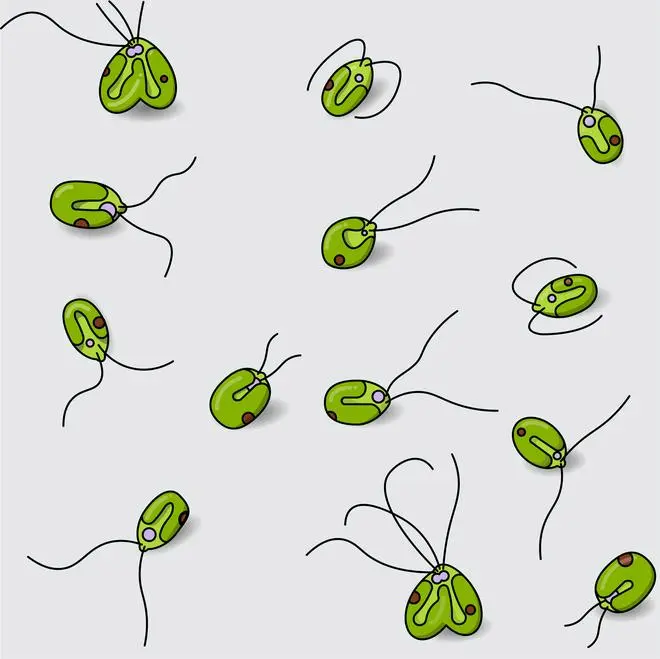
Researchers from IIT-Bombay and IIT-Mandi have demonstrated, using a minimalist robotic model, that the complex swimming behaviour of single-celled organisms can emerge from simple physical interactions. Their study, published in Physical Review Letters, shows that the characteristic “run-and-tumble” motion seen in microorganisms such as the alga Chlamydomonas reinhardtii can be replicated at a macroscopic scale without invoking biological or hydrodynamic complexity.
In nature, Chlamydomonas swims through the synchronised beating of two flagella, producing straight “runs”, punctuated by sudden “tumbles” when the flagella fall out of phase and reorient the cell. The team used two self-propelled robots, mechanically coupled by a rigid rod, to mimic the distal fibre that connects the bases of the flagella. By varying the attachment angle and offset of the connecting rod, the researchers captured the essential mechanical ingredients behind run-and-tumble dynamics.
To emulate the physical world of microorganisms, where friction dominates and inertia is negligible, the robots were made to move on a high-friction surface, reproducing over-damped active Brownian motion. The coupled robots spontaneously exhibited long, straight runs interrupted by sharp, often 180-degree tumbles.
Theoretical analysis showed that the run state corresponds to stable configurations of the coupled system, while tumbles arise from spontaneous misalignment of the robots’ self-propulsion forces, generating torque through the connecting rod. Importantly, it shows hydrodynamic interactions are not essential for run-and-tumble motion; mechanical coupling alone is sufficient. The study has implications in designing simple, autonomous micro-scale machines.
Published on January 26, 2026
此内容由惯性聚合(RSS阅读器)自动聚合整理,仅供阅读参考。 原文来自 — 版权归原作者所有。